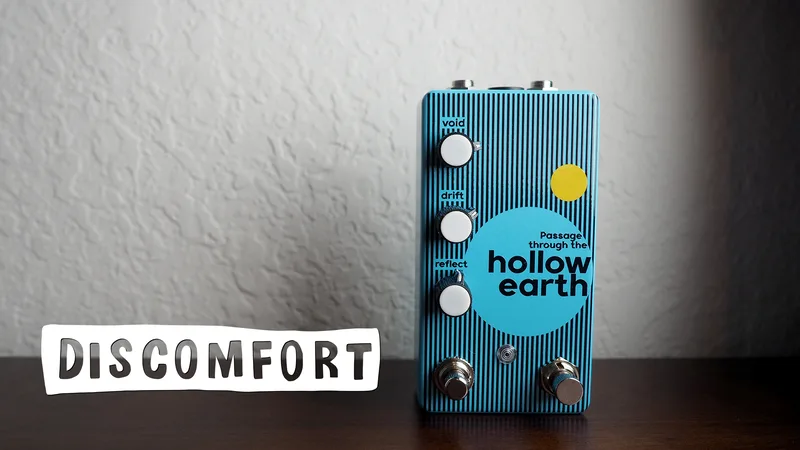

The Passage Through the Hollow Earth Reverb is a reverb pedal from Discomfort Designs, a builder whose releases Pedal of the Day has covered repeatedly. It is a tandem circuit using the Belton brick and the PT2399 chip, and it is built for reverb that goes well beyond room and hall sounds: Pedal of the Day describes it as creating "twisted springs, washy plates, and at extreme settings, ambient voids and planet-shaking feedback"1. For players looking at other reverb approaches, the pedal sits within the wider field of Reverb Pedals.
The controls and the Etherblast footswitch
The pedal features a simple control section, and its defining control is the momentary Etherblast footswitch. While it is held, Etherblast swells the Mix (Intensity) and Decay (Time) controls to their maximum, which Pedal of the Day describes as delivering "controlled bursts of havoc"1. In practice, that means a player can set a usable reverb on the knobs and then, by holding the footswitch, push the pedal into a full, extreme wash for as long as the switch is down.
The Reflect knob sets the pre-delay time, the short gap between the dry note and the reverb that shapes how distinct the dry guitar stays from the wash1.
| Control | What it does |
|---|---|
| Mix (Intensity) | Reverb level; swelled to maximum by the Etherblast footswitch1 |
| Decay (Time) | Reverb length; swelled to maximum by the Etherblast footswitch1 |
| Reflect | Sets the pre-delay time1 |
| Etherblast footswitch | Momentary switch that swells Mix and Decay to maximum1 |
Circuit and sound
The tandem Belton brick and PT2399 arrangement is the heart of the pedal. The Belton brick is a reverb module common in pedal design, and the PT2399 is a chip widely used in delay and reverb circuits; running the two together in tandem is what gives the Passage Through the Hollow Earth its range from spring-like and plate-like tones to the ambient voids and feedback Pedal of the Day describes at extreme settings1.
What reviewers said
Pedal of the Day's review addressed how the circuit behaves at its extremes, finding that it "remains clean, pushing them to max reverb time without glitches"1. In other words, the reviewer found the pedal held together even at maximum reverb time, a setting where some reverb circuits break up or misbehave.
The Passage Through the Hollow Earth has drawn attention from published reviewers for how the circuit behaves at its limits, with Pedal of the Day noting that it "remains clean, pushing them to max reverb time without glitches"1.
Videos
Pedal of the Day
Questions
What does the Etherblast footswitch do?
The Etherblast is a momentary footswitch. While it is held down, it swells the Mix (Intensity) and Decay (Time) controls to their maximum, producing controlled bursts of extreme reverb. When released, the pedal returns to the settings on its knobs, so a player can keep a normal reverb sound underfoot and push it into full washes on demand.
What chip does the Passage Through the Hollow Earth use?
It is a tandem circuit using the Belton brick and the PT2399 chip. The Belton brick is a common reverb module in pedal design, and the PT2399 is a chip widely used in delay and reverb circuits. Pairing the two in tandem is what shapes the pedal's character.
What does the Reflect knob control?
The Reflect knob sets the pedal's pre-delay time, the short gap between the dry signal and the reverb. Pre-delay affects how separated the dry guitar sounds from the wash, and the knob also feeds into the pedal's overall reverb character.
Who makes the Passage Through the Hollow Earth Reverb?
It is made by Discomfort Designs, a pedal builder whose releases have been covered regularly on Pedal of the Day. The Passage Through the Hollow Earth is one of the company's reverb pedals.
Sources (1)
- Discomfort Designs Passage Through The Hollow Earth Reverb, Pedal of the Day, 2021-11-19