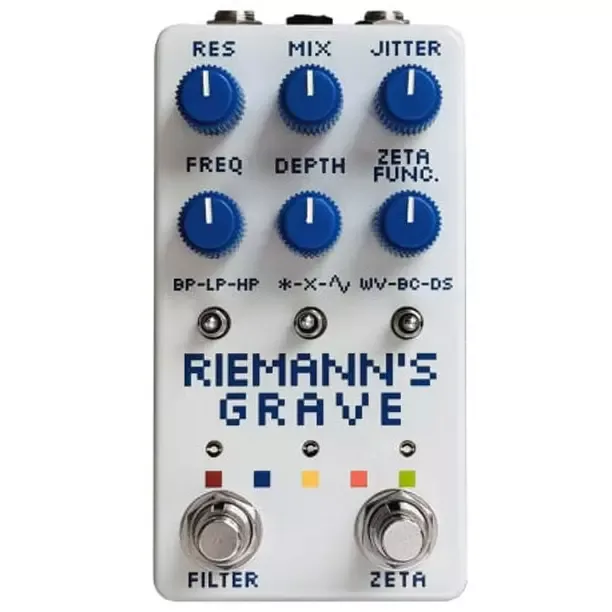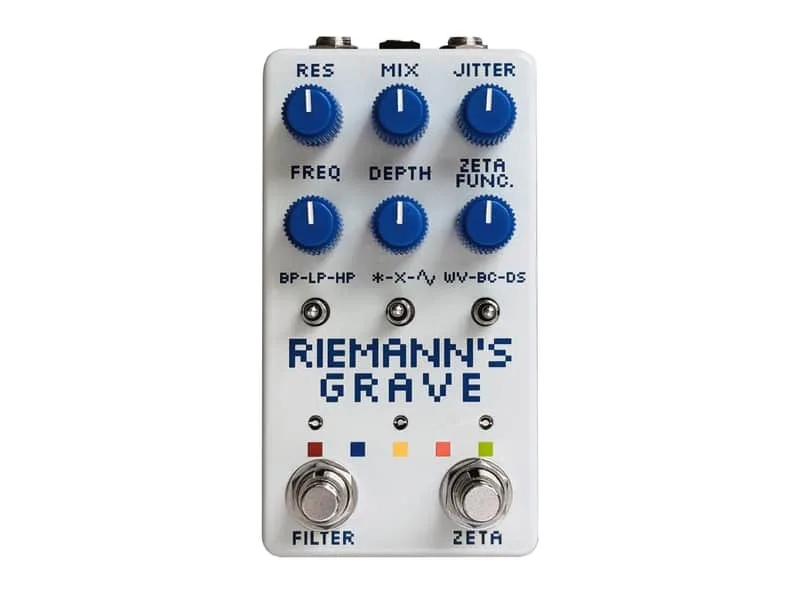


The Riemann's Grave is a distortion pedal and a modulated filter in one enclosure, made by Discomfort Designs. Delicious Audio describes it as "not a simple distortion pedal; it's a powerful, self-contained workstation for timbral sculpting," built as a dual-engine system with the distortion engine on the right and the filter engine on the left1. Guitar Pedal X calls it a Multi-Mode Stereo Modulated Filter and 3-way Distortion Pedal, and reports that it produces "robot-talk, fluttery, zithery and swooshy textures with lo-fi distortion"2.
The pedal started life in a larger 1590BB enclosure, reviewed by Pedal of the Day in 2022 as the Riemann's Grave Modulated Allfilter, built around "a curated trio of biquad filters paired with a sample rate reducer"321. In October 2025 Discomfort Designs shrank it into a compact stereo enclosure, sold in two editions2.
A distortion and a modulated filter in one pedal
The filter side is a multi-mode filter whose frequency can be modulated by a random sample and hold wave or a Wandering Sine, a slowly drifting sine wave4. A central modulation switch routes one of three sources to the filter's frequency: static (no modulation), random sample and hold, or the Wandering SineWave12. A Depth knob sets how far the modulation pushes the filter around, and a clean Mix control blends the processed signal back with your dry sound1.
The distortion side is what Discomfort Designs calls the Zeta Function section, which Delicious Audio describes as "a harmonic mulcher"1. Its three-way switch selects between waveshaping, bitcrushing, and octave distortion, with a knob to dial in the intensity of the sonic degradation1. Pedal of the Day frames the same three modes as wave folding, bit crushing, or octave up distortion, ranging from mild saturation to full mangling4.
The two engines are independent. With separate footswitches for the distortion and filter sections, you can run the filter alone for sweeping, modulated tone shaping, the distortion alone, or both stacked1.
"At its core, it's a stereo filter pedal."
The original 1590BB version worked differently under the hood: two low pass filters with modulation applied randomly or with precision, plus a sample rate reducer for bit crushing2. That version also took inputs beyond guitar. Pedal of the Day noted it "works on drums, synths and any other input signal you can think of," transforming them into "a fury of bits, bleeps, pops and more"3.
The controls
The compact Riemann's Grave carries six knobs and three three-way switches, plus the two engage footswitches2.
| Control | What it does |
|---|---|
| Frequency | Sets the cutoff of the X-Pass filters2 |
| Resonance | Adds emphasis at the filter's cutoff frequency12 |
| Mix | Blends clean signal with the effected signal12 |
| Depth | Sets the amount of modulation applied to the filter12 |
| Zeta Function Param | Sets the intensity of the selected distortion type12 |
| Jitter | Applies random variation, see below12 |
The three switches divide the work:
| Switch | Positions |
|---|---|
| Modulation | Random Sample & Hold / Static / Wandering SineWave2 |
| Frequency Range | Band Pass / Low Pass / High Pass2 |
| Distortion / Zeta Type | Wavefolder / Bitcrusher / Octave Distortion2 |
Delicious Audio describes the filter as a state-variable filter you sculpt with Frequency and Resonance controls, with the Frequency Range switch toggling between Band Pass, Low Pass, and High Pass modes1.
The Jitter knob
Jitter is the control that sets the Riemann's Grave apart from a conventional filter-plus-distortion setup. Delicious Audio explains that "a dedicated 'Jitter' knob applies chaotic, random modulation to all other parameters simultaneously"1. In other words, turning Jitter up does not add one more effect; it makes every other setting on the pedal, the filter cutoff, the resonance, the modulation depth, wander randomly at once. Guitar Pedal X labels it simply "Jitter (Random Variation)"2.
What reviewers said
Pedal of the Day reviewed the compact version in October 2025 and found it keeps up the maker's track record: "Whenever a new pedal from Discomfort Designs shows up, there's a rarified excitement that builds"4. The reviewer called it "a fun little thing that has a mind of its own, flipping the script on what normal effects should be," and said the baby blue enclosure "will expand your mind and hone your skills as an experimental musician"4.
Guitar Pedal X's coverage was similarly positive about its range: "there are so many cool tones onboard, it's quite an unusual combination but really potent at the same time, absolutely fantastic for distressed and lo-fi tones overall"2.
The earlier 2022 Pedal of the Day review of the original Modulated Allfilter version called it "an effects unit that defies all logic and convention," with "each twist and turn of a knob or flick of a switch resulting in an abstract display of auditory prowess"3.
Where the name comes from
The pedal is named for Bernhard Riemann, the German mathematician who made contributions to analysis, number theory, and differential geometry3. The Zeta Function section takes its name from the Riemann zeta function, one of his best known works, and the pedal's filter and modulation concepts lean on the same mathematical territory13.
Videos
Discomfort Designs
Discomfort Designs
The Pedal Zone
Questions
Is the Discomfort Designs Riemann's Grave stereo?
Yes. Guitar Pedal X describes the compact edition as a stereo device. The original 1590BB edition was shrunk into this compact stereo enclosure, so the filter engines can process a stereo signal rather than a single mono guitar feed.
Can the distortion and filter be switched on separately?
Yes. The pedal has two independent footswitches: Filter Engage on the left and Zeta Engage, the distortion section, on the right. You can run the modulated filter alone, the distortion alone, or both together, which makes it behave like two pedals sharing one enclosure.
What does the Jitter knob do on Riemann's Grave?
Jitter is a random variation control. According to Delicious Audio, a dedicated Jitter knob applies chaotic, random modulation to all of the pedal's other parameters simultaneously. Turning it up makes the filter, distortion and modulation settings wander on their own instead of staying where you set them.
What are the three distortion types on Riemann's Grave?
The Zeta Function section offers three modes selected by a three-way switch: Wavefolder, Bitcrusher, and Octave Distortion. Pedal of the Day describes these as wave folding, bit crushing, or octave up distortion, with the Zeta Function Param knob setting how much of each effect you get.
How much does the Riemann's Grave cost?
Guitar Pedal X reported in October 2025 that both editions of the compact Riemann's Grave sell for £295 on the Discomfort Designs webstore. That is the maker's direct price in British pounds as stated; no US dollar price has been published.
Who was Riemann's Grave named after?
The pedal is named for Bernhard Riemann, the German mathematician who made contributions to analysis, number theory, and differential geometry. Pedal of the Day notes the name is apt for a pedal built around mathematical filter and modulation concepts.
Sources (4)
- Discomfort Designs Riemann's Grave V2, Delicious Audio, 2025-10-14
- Guitar Pedal X, Guitar Pedal X, 2025-10-17
- Discomfort Designs Riemann’s Grave Modulated Allfilter, Pedal of the Day, 2022-10-31
- Discomfort Designs Riemann's Grave Octave Bit Crusher Distortion Filter, Pedal of the Day, 2025-10-16