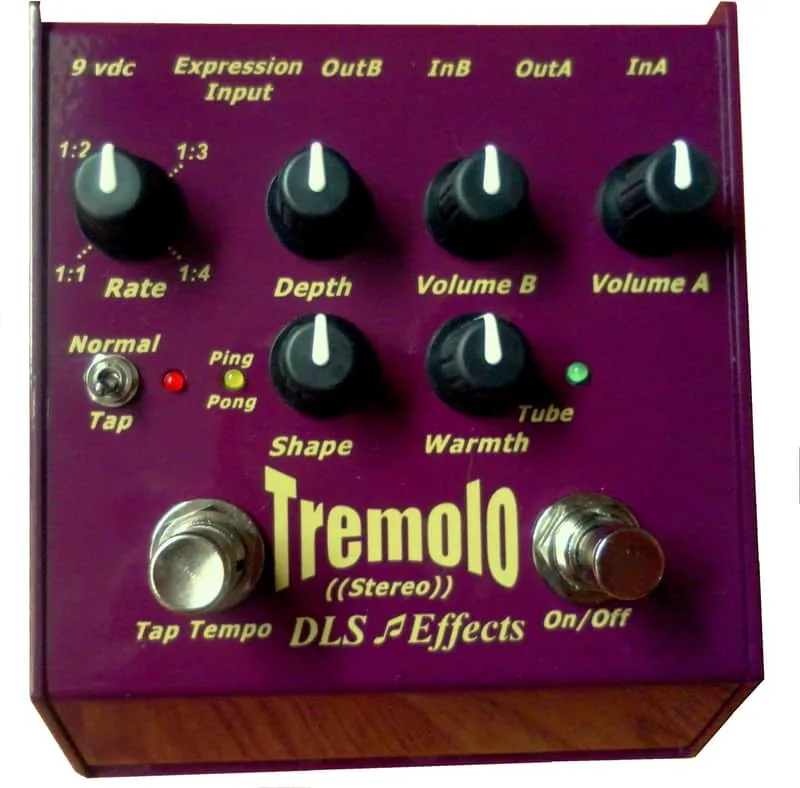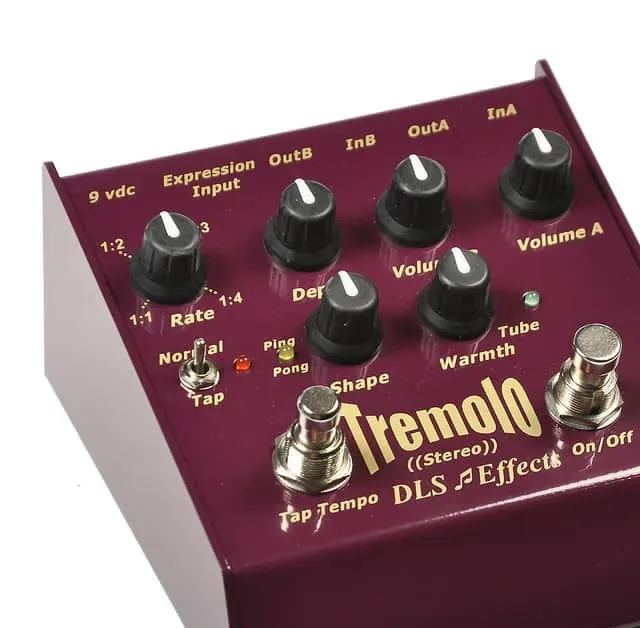

The DLS Effects TR1 Tremolo is a stereo tremolo pedal built around two different sounding analog optical circuits, announced in August 2012. DLS Effects described it as a "pure Analog, Stereo Tap Tremolo," and gave it a Shape control that reshapes the tremolo wave, tap tempo with beat multiplication, and a Ping Pong mode that pans the effect from amp to amp1. Vintage Guitar's January 2013 review found it "can create an intense tremolo effect and syncopation to the beat"2.
Two optical tremolos in stereo
The TR1 carries two independent in and out channels that can be used in mono or stereo. DLS Effects says the two analog optical devices sound different from each other, and a Warmth pot blends between vintage tube sounding tremolo and a more aggressive tremolo by adjusting the bias of those circuits1. Vintage Guitar described the same arrangement as "the pedal's two analog optical circuits"2.
For stereo setups, the pedal includes a Ping Pong mode that pans from amp to amp1. Vintage Guitar also noted a second way into that territory: double tapping the Tap Tempo engages a "pan" mode, creating a spacious pulse effect in stereo2. If you are weighing the TR1 against other options in the effect family, the Tremolo Pedals page covers the wider field, and DLS's plainer single-channel offering is on the DLS Effects Tremolo page.
Controls, tap tempo and expression
Vintage Guitar's review summed up the control set as extensive: a Multiply/Ratio control, Depth, individual Volume controls for the A and B outputs, Shape, and Warmth2.
| Control | What it does |
|---|---|
| Shape | Transforms the tremolo wave shape and duty cycle, for flavors like vintage rhythmic tremolo, slicing tremolo, and a playing backwards sound1 |
| Warmth | Blends vintage tube sounding tremolo to more aggressive tremolo by adjusting the bias of the two optical circuits1 |
| Multiply/Ratio | Sets tap tempo multiplication and ratio2 |
| Depth | Sets tremolo depth2 |
| Volume A / Volume B | Individual output levels for the two channels2 |
Speed can be set three ways, according to DLS Effects: with the Rate pot, with Tap Tempo, or with an external expression pedal1. The Tap Tempo can be multiplied by 1, 2, 3 or 4 beats per tap, and the setting is stored in non volatile memory1. Vintage Guitar confirmed the expression input takes a standard TRS expression pedal for speed control2. If you need a pedal for that jack, the Expression Pedals page lists the type.
Power, bypass and size
The TR1 runs from 9V DC, and DLS Effects says any polarity works, with the internal supply charge pumped to near 15V DC for headroom1. Vintage Guitar noted the pedal will also run off most pedalboard power supplies2.
Bypass is split across the two channels: Channel-A in and out uses true bypass switching, while Channel-B in and out has a buffered output1. Vintage Guitar's review referred to the pedal's true-bypass footswitches2. If your board depends on full true bypass in every routing, the B channel's buffer is the part to plan around.
The pedal measures 4.3 inches wide by 4.7 inches deep1.
What reviewers said
Vintage Guitar's January 2013 review, which tested the TR1 alongside DLS's RotoSim, put the price at $249 and highlighted the pedal's compact footprint, "only measuring 4.3" wide by 4.7" deep!"21.
On the sound, the review's verdict was that the TR1 "can create an intense tremolo effect and syncopation to the beat"2.
"can create an intense tremolo effect and syncopation to the beat"
The review's account of the control set, the TRS expression input, and the double tap pan mode is the main published record of how the pedal behaves in use2.
Videos
Prymaxe
PJ and the Beard
Questions
Is the DLS TR1 Tremolo true bypass?
Partly. Channel-A in and out uses true bypass switching, while Channel-B in and out has a buffered output, according to DLS Effects. Vintage Guitar's review also noted the pedal's true-bypass footswitches. So if you run the TR1 in mono through Channel-A, your signal passes with true bypass; the second channel's output is buffered instead.
What power supply does the DLS TR1 need?
The TR1 runs from 9V DC, and DLS Effects says any polarity is fine, which is unusual. Internally the voltage is charge pumped to near 15V DC for headroom. Vintage Guitar noted it will also run off most pedalboard power supplies.
Does the DLS TR1 have a ping pong stereo mode?
Yes. DLS Effects says the TR1's two independent in and out channels can be used in mono or stereo, including a Ping Pong mode that pans the tremolo from amp to amp. Vintage Guitar also noted that double tapping the Tap Tempo engages a pan mode, creating a spacious pulse effect in stereo.
How much did the DLS TR1 Tremolo cost?
At its 2012 introduction, DLS Effects listed a manufacturer's price of $299 with a street price of $249. Vintage Guitar's January 2013 review also listed the TR1 at $249.
Is the DLS TR1 analog or digital?
The TR1 is analog. DLS Effects described it as a pure analog stereo tap tremolo, and Vintage Guitar's review pointed to the pedal's two analog optical circuits as the core of its sound.
Sources (2)
- DLS Effects Announces the TR1 Tremolo Pedal, Premier Guitar, 2012-08-17
- DLS TR1 Tremolo and RotoSim, Vintage Guitar magazine, 2014-04-21