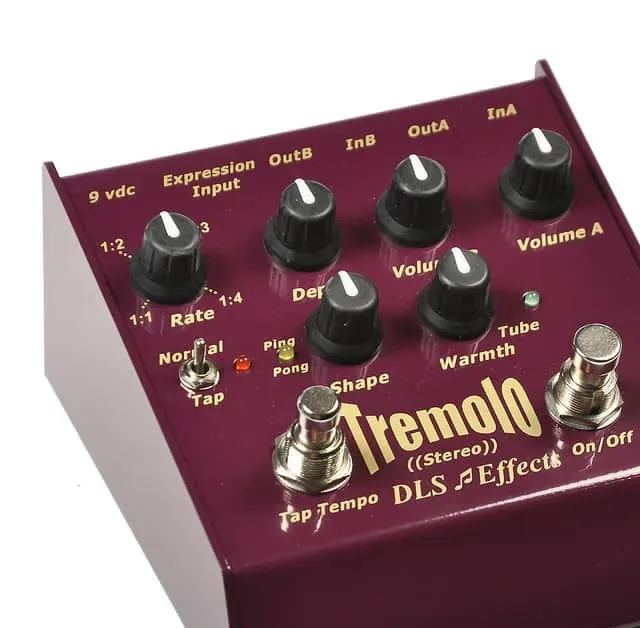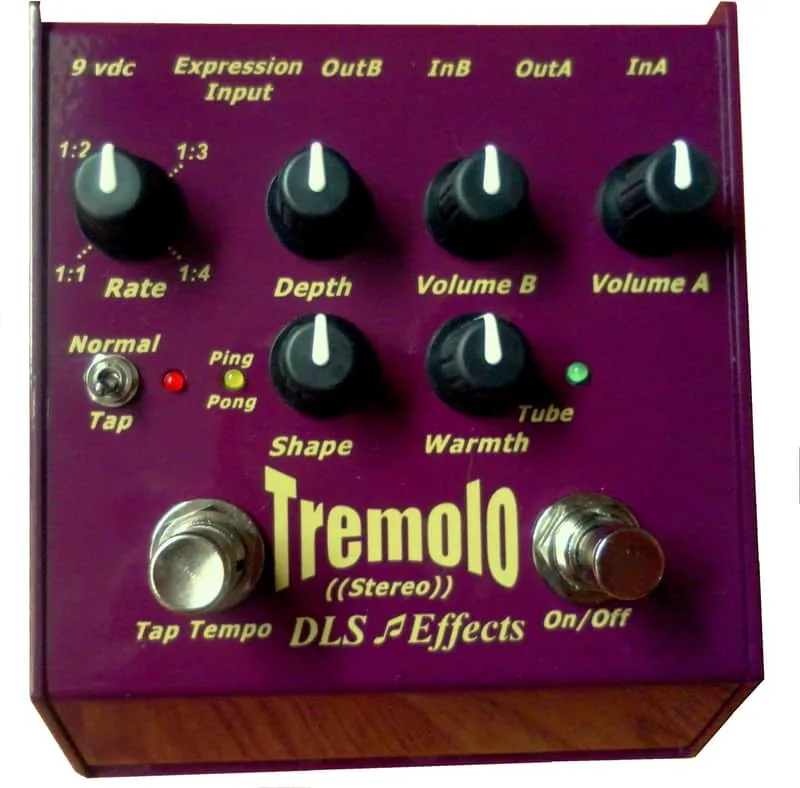
The DLS Effects Tremolo is an analog optical tremolo pedal: it uses light-dependent components to raise and lower your volume in a repeating cycle, the same approach classic amp tremolos used. Where it stands out from most tremolo boxes is that it is true stereo, with two independent channels that can run in sync or ping-pong between two amplifiers, and that its optical circuit is tunable, with a Warmth control that biases two different sounding optical devices from vintage tube tremolo to more cutting chop1.
RockBoard's PedalPedia describes it as a "Pure Analog, stereo Tap Tremolo with tons of tremolo styles," aimed at everything from "classic amp tremolos from the past to more cutting Tremolo to taste"1. The pedal descends from the company's TR1 Tremolo, announced in August 2012, and keeps that pedal's core ideas: analog optical circuitry, stereo operation, tap tempo and a Warmth control2.
What it does: analog optical tremolo in true stereo
Optical tremolo works by using a light source and a light-dependent resistor to attenuate the signal, which gives the smooth, rounded character players associate with vintage amplifier tremolo. The DLS Tremolo puts two of these optical circuits inside one box, and the Warmth pot biases them against each other, so you can sit anywhere between a thick, vintage tube-style pulse and a more aggressive, cutting chop, or blend the two1.
The stereo side is the other half of the story. The pedal has two channels with stereo input and output jacks, and three ways to use them123:
- Both outputs in sync, pulsing together
- Ping Pong mode, which pans the tremolo from amp to amp2
- Mono operation, using a single channel2
Vintage Guitar's reviewer, testing the TR1 with a Fender Strat and a Blues Deluxe amp, noted that the Ping Pong mode "creating a spacious pulse effect, in stereo" came from doubling the Tap Tempo switch, and that the pedal's stereo in and out jacks made the effect practical on a two-amp rig3.
The controls: Rate, Shape and Warmth
Three knobs define the pedal's sound, and the current version adds a Shape control that the original TR1 approached differently13.
| Control | What it does |
|---|---|
| Rate | The traditional speed knob, sets the tremolo rate directly1 |
| Shape | Transforms the tremolo wave shape and duty cycle, for flavors from vintage rhythmic tremolo to slicing tremolo and a "playing backwards" sound1 |
| Warmth | Biases two different sounding optical components, from vintage tube sounding tremolo to more cutting tremolo, or any blend in between1 |
On the original TR1, the control set was larger: a Multiply/Ratio control, Depth, individual Volume controls for the A and B outputs, Shape (which selected wave shape and cycle), and Warmth. Vintage Guitar explained that Warmth "adjusts the bias of the pedal's two analog optical circuits (in conjunction with Shape), allowing the player to dial in specific tremolo sounds from thick and warm to choppy and aggressive"3. The current pedal's Warmth pot carries that same idea forward1.
Tap tempo and expression control
Speed can be set three ways, which matters if you play to a click or want to change speed on the fly12:
- Rate knob: set the speed by ear1
- Tap tempo: tap the speed in, then multiply it by 1, 2, 3 or 4 for faster subdivisions1
- Expression pedal: connect an external expression pedal and control speed continuously1
On the TR1, the tapped tempo was stored in non-volatile memory, so the pedal remembered your last setting between power cycles, and the expression input took a standard TRS expression pedal23. Vintage Guitar also found the tap and ratio functions could "create an intense tremolo effect and syncopation to the beat"3.
History: the TR1 Tremolo
DLS Effects announced the TR1 Tremolo on August 17, 2012, as a "pure Analog, Stereo Tap Tremolo"2. Vintage Guitar reported the introduction later that month, noting that the Channel-B input and output had a buffered output4. The January 2013 issue of Vintage Guitar carried a full review of the TR1 alongside DLS's RotoSim rotary speaker pedal, tested with a Strat and a Blues Deluxe amp3.
The TR1's power arrangement was unusual for its day: it ran from 9V DC of any polarity, with an internal charge pump raising that to near 15V for headroom, and it also ran off most pedalboard power supplies23. The current DLS Effects Tremolo simplifies this to a standard 9V DC center negative supply at 40mA1.
Power details differ between versions. The current DLS Effects Tremolo needs 9V DC, center negative, drawing 40mA1. The original TR1 accepted 9V DC of any polarity and charge pumped it internally2. If you are buying used, check which version you are looking at.
How it compares
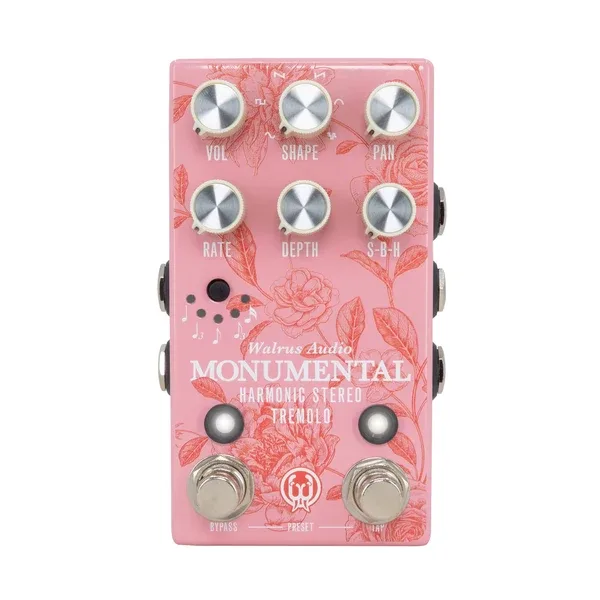
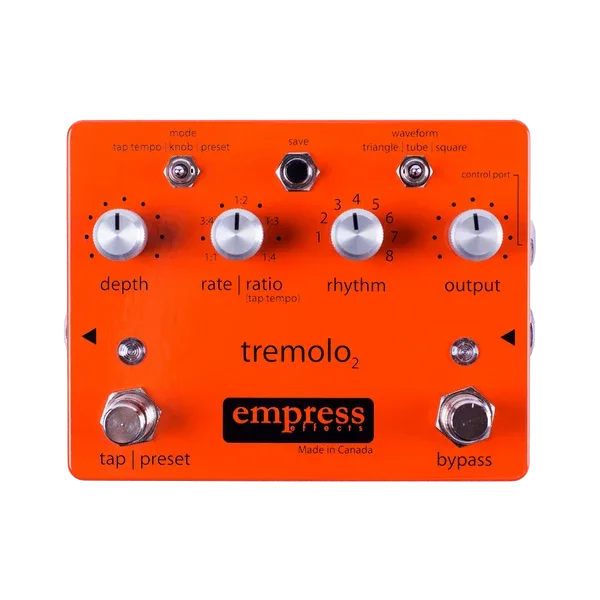
Against other analog optical tremolos, the DLS pedal's distinguishing features are the true stereo routing with Ping Pong mode and the Warmth bias control. The Walrus Audio Monumental Harmonic Stereo Tremolo is also an analog optical stereo tremolo, but without the DLS's dual-optical blend. The Empress Effects Tremolo uses an analog signal path with the tremolo controlled digitally via opto technology, a different architecture. For a deeper look at the TR1 itself, see the DLS Effects TR1 Tremolo page235.
Questions
Is the DLS Tremolo stereo?
Yes. The pedal has two channels for true stereo, with stereo input and output jacks. The two outputs can run in sync, or in a Ping Pong mode that pans the tremolo from amp to amp. It also works in mono with a single input and output.
How much current does the DLS Effects Tremolo draw?
The current DLS Effects Tremolo draws 40mA. That is modest by tremolo pedal standards, low enough that it will run comfortably from a typical isolated pedalboard power supply alongside other 9V pedals.
Can you control the DLS Tremolo speed with an expression pedal?
Yes. Speed can be set three ways: the traditional Rate knob, tap tempo (with the tapped speed multipliable by 1, 2, 3 or 4), or an external expression pedal connected to the pedal's expression input. On the TR1, the expression input takes a standard TRS expression pedal.
What power supply does the DLS TR1 Tremolo need?
The current DLS Effects Tremolo runs on 9V DC with a center negative plug and draws 40mA. The original TR1 ran from 9V DC of any polarity, internally charge pumped to near 15V for headroom, and also worked off most pedalboard power supplies.
Sources (5)
- Tremolo by DLS Effects, RockBoard PedalPedia, 2026
- DLS Effects Announces the TR1 Tremolo Pedal, Premier Guitar, 2012-08-17
- DLS TR1 Tremolo and RotoSim, Vintage Guitar magazine, 2014-04-21
- DLS Effects Intros TR1 Tremolo, Vintage Guitar magazine, 2012-08-31
- Monumental Harmonic Stereo Tremolo, Black Friday 2024 Floral Series, Walrus Audio