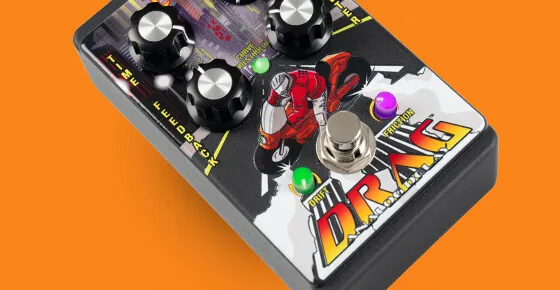



The DOD Drag is an analog delay pedal from DOD, built around a fully analog bucket-brigade device (BBD) circuit, the technology behind the warm, dark repeats of classic analog delays. DOD describes it as a "warm-sounding BBD analog delay pedal built for players who want rich, organic repeats with plenty of room to roam"1. What sets it apart from a straightforward analog delay is a set of performance controls, Drift and Friction, that let you warp the repeats in real time while you play.
The pedal offers up to 750ms of delay time, stretching to 1.5 seconds in Rubberneck mode1. Delicious Audio's write-up characterized it as a pedal engineered "to inject performance-oriented chaos into a traditional BBD circuit," ranging "from crisp, punchy slap-back echoes to expansive, self-evolving ambient soundscapes"2. It was designed in Salt Lake City, Utah, and made in China13.
An analog BBD delay with time-warping effects
Under the hood the Drag is a bucket-brigade delay: the repeats pass through an analog BBD chip, which gives analog delays their characteristic dark, degraded echo as each repeat loses a little top end. Guitar World's reviewer, Alex Lynham, found it "got a dark, rich voicing, which means I prefer bridge pickups so that it will cut through the mix"4.
On top of that analog engine sit two performance controls. Drift is a modulation control with four selectable waveforms, and Friction is a set of hold-the-footswitch effects divided into three categories: Rubberneck, SlideStop and Evade12. MusicRadar's reviewer, Trevor Curwen, noted that "performance features seem to be what the Drag is all about and DOD has themed these after anime motorcycle manoeuvres"3.
The Friction categories break down as follows2:
- Rubberneck: pitch bending, including octave-up and octave-down bends
- SlideStop: Shallow and Deep variations that slow the repeats to a stop
- Evade: HopStop and Slide-N-Go stutter and pitch variations
Guitar World's reviewer singled out the tape stop effect as "the most fun, although admittedly it is an effect that's easy to replicate on record or in a DAW"4.
The controls
The Drag has six rotary controls: Time, Feedback, Filter, Level, Drift and Friction1.
| Control | What it does |
|---|---|
| Time | Sets the delay time, up to 750ms, doubling to 1.5s in Rubberneck mode12 |
| Feedback | Sets how many repeats regenerate |
| Filter | Shapes the tone of the repeats |
| Level | Sets the delay's volume against your dry signal |
| Drift | Modulation control, with four selectable waveforms1 |
| Friction | Sets the behavior of the hold-down performance modes2 |
A single Curve/Tails switch does several jobs. A short press cycles through the four Drift modulation waveforms; each one-second press cycles through the SlideStop, Rubberneck and Evade Friction categories; and while the pedal is bypassed it cycles through the three bypass modes1.
Guitar World's reviewer had one build-quality reservation: the two mini knobs placed either side of the footswitch. "Now, only time can tell whether or not these will break, but it's enough to make them look precarious, an accident waiting to happen"4.
Power and connections
The Drag runs on a standard 9V DC tip-negative 2.1mm barrel jack, and DOD lists its PS0913DC supply or another well-regulated 9V center-negative supply1. There is no battery option in the listed power specifications. On current draw the published figures disagree: Guitar World lists 120mA4, while Guitar Pedal X lists approximately 200mA5, so it is worth planning power headroom around the higher figure.
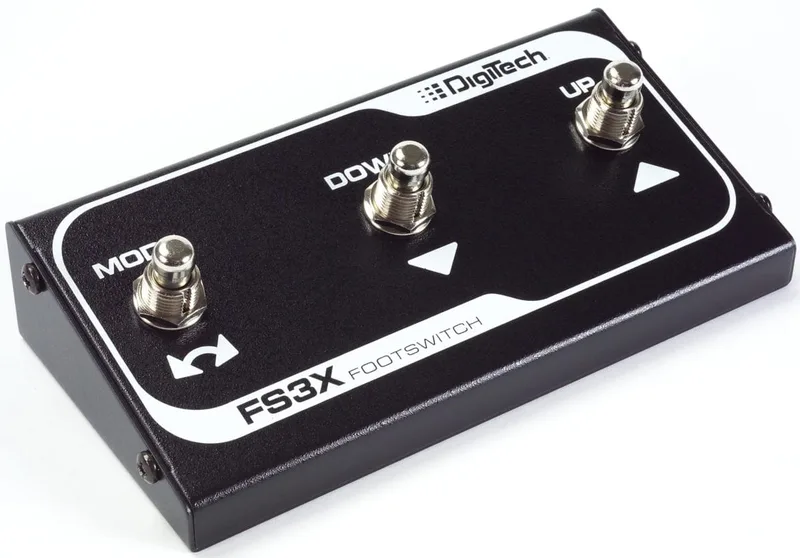
Signal connections are mono in and mono out on 1/4-inch instrument jacks, with a space-saving top-jack layout52. There is also a 3.5mm external control jack for the optional DigiTech FS3X three-button footswitch5. Input impedance is greater than 500kΩ1.
The enclosure is aluminum, measuring 4.8 by 2.8 by 1.5 inches (121 by 71 by 38mm), 2.1 inches tall with the switch, and weighing 0.67 lbs (0.30 kg)15.
History and versions: from the Rubberneck
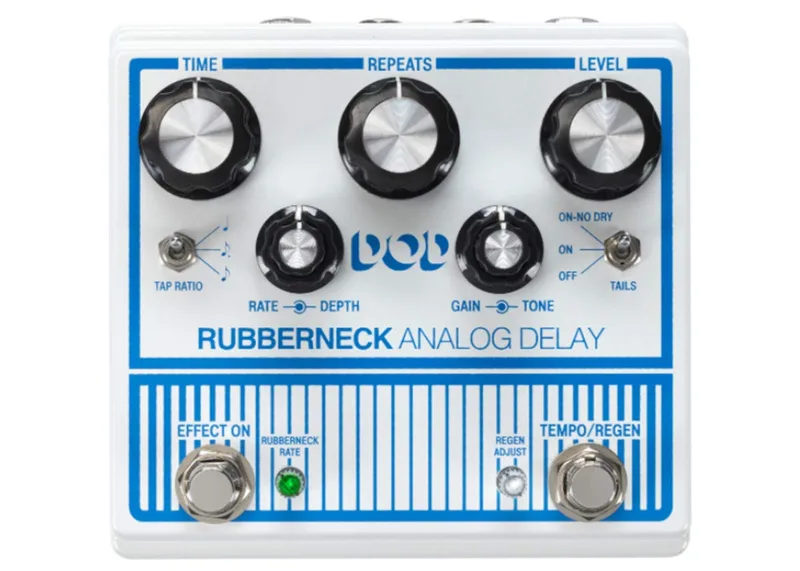
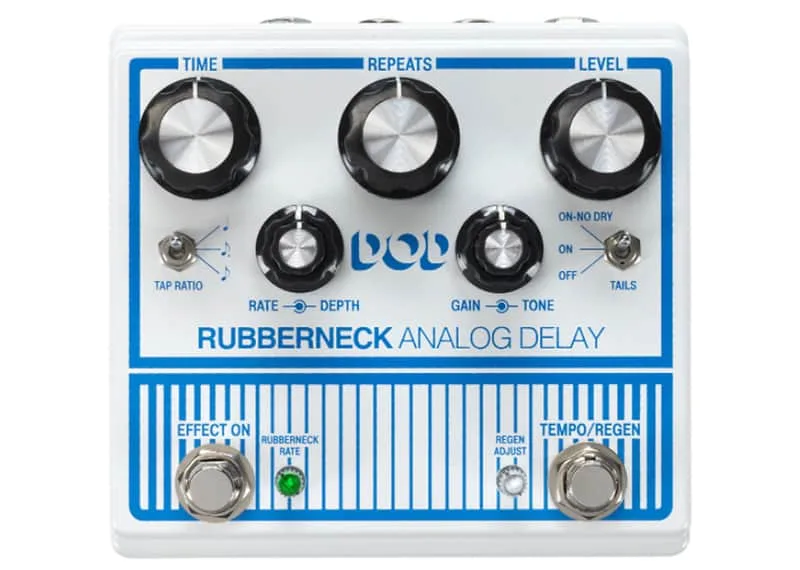
The Drag is a descendant of the DOD Rubberneck, an analog delay DOD introduced at the winter NAMM Show in January 201741. The Rubberneck's signature feature let players "pitch shift from one time setting to another in real-time"6, and its time-stretching feature allowed delay repeats to be stretched or compressed in time7. Guitar World called the Rubberneck "a cult classic pedal that is still sought after on the used market," and notes the Drag "is a new analog delay pedal designed by the minds behind the Rubberneck"4.
The Drag carries that lineage forward: its Rubberneck Friction mode reproduces the real-time pitch bending of the original, and the delay time doubles from 750ms to 1.5 seconds when it engages, matching the 1.5 seconds the Rubberneck offered12. Where the Rubberneck included a TRS send/return effects loop for processing its repeats7, the Drag's listed connections cover input, output, power and the FS3X jack4.
Availability has been uneven by region. As of July 2026, Guitar Pedal X reported the Drag was widely available in the UK, less so in Europe, and "almost non-existent in the USA so far," priced at $219 / €229 / £199, with a bundle including the FS3X footswitch at $239 / €250 / £2195. Guitar World's review lists the US price as $219.994.
What reviewers said
Guitar World's Alex Lynham was positive about the core delay: "At its core, the DOD Drag is an excellent-sounding analogue delay. Depending on where you are in the world, its base price point might be competitive enough to purchase as a BBD delay full-stop"4. MusicRadar's Trevor Curwen called it "a decent BBD analogue delay pedal"3. The main criticism across reviews was the placement of the mini knobs near the footswitch4.
Videos
collector//emitter
DigiTech
Get Offset
Questions
What is Rubberneck mode on the DOD Drag?
Rubberneck is one of the Drag's Friction footswitch modes. Holding the footswitch lets you bend the delay's pitch in real time, shifting between time settings the way the original DOD Rubberneck pedal did. It also doubles the maximum delay time from 750ms to 1.5 seconds while it is engaged.
Is the DOD Drag true bypass?
Yes, and it offers more than that. A green mode is true hardwired bypass with tails off, a blue mode is buffered bypass that lets delay tails ring out, and a teal mode is buffered bypass with tails and dry-kill. You cycle the three modes with the Curve/Tails switch while the pedal is bypassed.
What is the maximum delay time on the DOD Drag?
The Time knob delivers up to 750ms of standard analog BBD delay time. When you use Rubberneck mode, the maximum stretches to 1.5 seconds.
Is the DOD Drag stereo?
No. The Drag is a mono pedal with one 1/4-inch instrument input and one 1/4-inch instrument output.
What footswitch works with the DOD Drag?
The optional DigiTech FS3X, connected through a 3.5mm external control jack on the pedal. DOD also sells a bundle of the Drag with the FS3X at a higher price than the pedal alone.
Sources (7)
- Drag - DigiTech, DigiTech, 2026-09-17
- DOD Drag Delay, Delicious Audio, 2026-09-29
- DOD Drag Delay review, MusicRadar, 2026-10-06
- DOD Drag Analog Delay Pedal review, Guitar World, 2026-08-27
- Guitar Pedal X, Guitar Pedal X, 2026-07-22
- HARMAN Introduces the DOD Rubberneck Analog Delay Pedal, Guitar Interactive Magazine, 2017-01-22
- DigiTech Rubberneck Analog Delay Effect Pedal, digitech.com, 2025-10-05