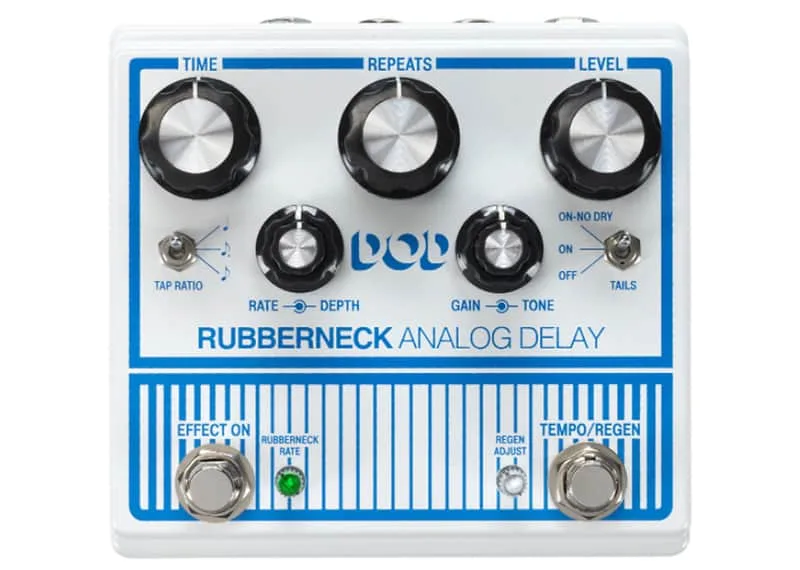


The DOD Rubberneck Analog Delay is an analog delay effects pedal from DOD, announced at the NAMM Show in January 2017 and released in late July or early August of that year1. It is built around bucket-brigade device (BBD) circuitry, the chip type behind classic analog delays, and DOD describes it as delivering "over a second of warm and musical 100% analog repeats" with modulation ranging from subtle chorusing to wild vibrato and tremolo textures2. Its delay time runs up to 1.5 seconds3.
What sets it apart from most analog delays is the feature it is named after: Rubbernecking. DOD describes it as a time-stretching feature that lets delay repeats be stretched or compressed in time, and you trigger it by pressing and holding the Effect On footswitch, which bends the delay time up or down at a rate you set with the Rubberneck Rate control2. Pedal of the Day's reviewer called it "a stretched rubber band kind of sound"4.
Controls and footswitches
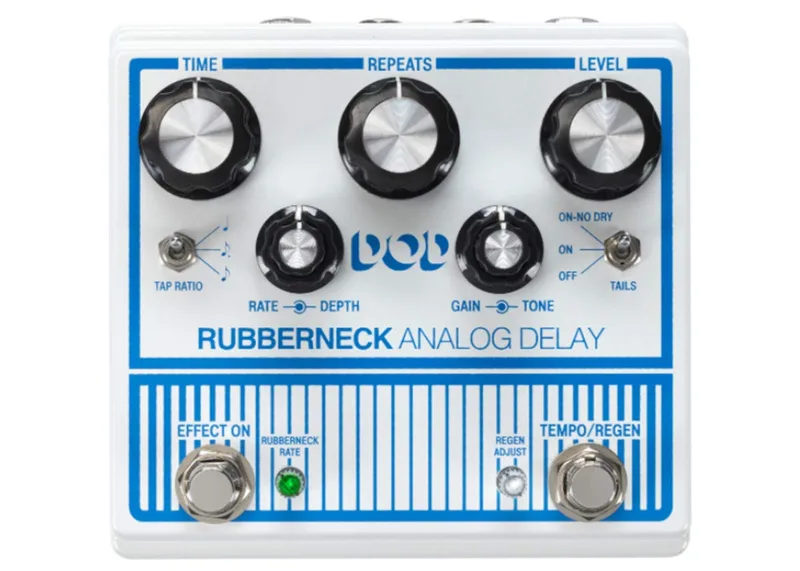
The Rubberneck carries a lot of controls packed into its front panel, housed in an all-metal, double-wide chassis21. The knobs and switches break down like this:
| Control | What it does |
|---|---|
| Gain | Shapes the delay signal by adding input gain into the bucket brigades, making the delay more overdriven at higher settings2 |
| Level | Controls the output level of the delay signal2 |
| Tone | Brightens or darkens the delay signal2 |
| Repeats | Controls the number of delay repeats heard; higher settings can create oscillating runaway feedback2 |
| Rubberneck Rate | Sets how fast the delay time bends up or down while Rubbernecking is engaged4 |
| Tap Ratio switch | Selects between three tempo ratios for tapped, triplet or doubled feel repeats2 |
There are two footswitches. The Effect On footswitch turns the delay on and off, and when pressed and held it engages the Rubbernecking feature, modifying the delay time up or down at the rate set by the Rubberneck Rate control2. The Tempo/Regen footswitch is used to tap in the delay time during performance, and DOD notes the double footswitches also allow user-customizable momentary control of oscillation2.
The Tap Ratio subdivisions are quarter, eighth and dotted eighth notes, which Pedal of the Day's reviewer found allowed for even more flexibility when matching repeats to a song's rhythm4.
Tap tempo and the Rubberneck feature
Yes, the Rubberneck has tap tempo, which is unusual for an analog delay. You tap your tempo on the Tempo/Regen footswitch and the Tap Ratio switch then offsets the repeats against that tempo: quarter notes for straight repeats, eighth notes for a doubled feel, and dotted eighth notes for the triplet-style pattern common in ambient and edge playing24.
The Rubbernecking feature itself works like a foot-controlled pitch bend for your repeats. Hold the Effect On footswitch and the delay time stretches or compresses, which shifts the pitch of the repeats as they slide, then snaps back when you release. DOD describes this as the pedal's unique time-stretching feature, letting repeats be stretched or compressed in time2. Pedal of the Day's reviewer heard it as "a stretched rubber band kind of sound, with a Rate control to adjust it"4.
"There's also the 'Rubbernecking' feature, which gives you a stretched rubber band kind of sound, with a Rate control to adjust to taste."
Both the modulation and Rubbernecking features can also be controlled by an external switch rather than the onboard footswitches4.
Power and connections
The Rubberneck runs on a 9V DC power supply, which DOD points out makes it easy to integrate into an existing pedalboard2. The power supply is optional, listed as an accessory rather than included2.
On the connection side, the pedal is more fully equipped than a basic analog delay2:
- Input: one 1/4" instrument jack2
- Output: one 1/4" instrument jack2
- Send/Return: one 1/4" TRS jack, send on tip and return on ring, forming a feedback loop that lets you insert other effects into the delay's repeats2
- External footswitch input: one 1/4" TRS instrument jack for an external three-button footswitch2
The feedback loop is the connection experienced players will notice. Because it sits in the delay's feedback path, any pedal you patch into the send and return affects only the repeats, not your dry signal. You can also remote control the Rubberneck using the external footswitch jack on the rear3.
Where it came from
DOD announced the Rubberneck Analog Delay at the NAMM Show in January 20171, where it was shown with its 1.5 seconds of delay, tap tempo, effects loop and tails switch3. Gearnews noted at the time that it looks a lot like a boutique-style pedal3. The pedal reached players in late July or early August 20171.
The launch price moved during 2017. DOD quoted USD $429 at NAMM in January, and by June the official price on the Digitech site had dropped to $312.44, a difference Gearnews suggested might come down to taxes not being included1. In Europe, Thomann later listed it at 199 €5.
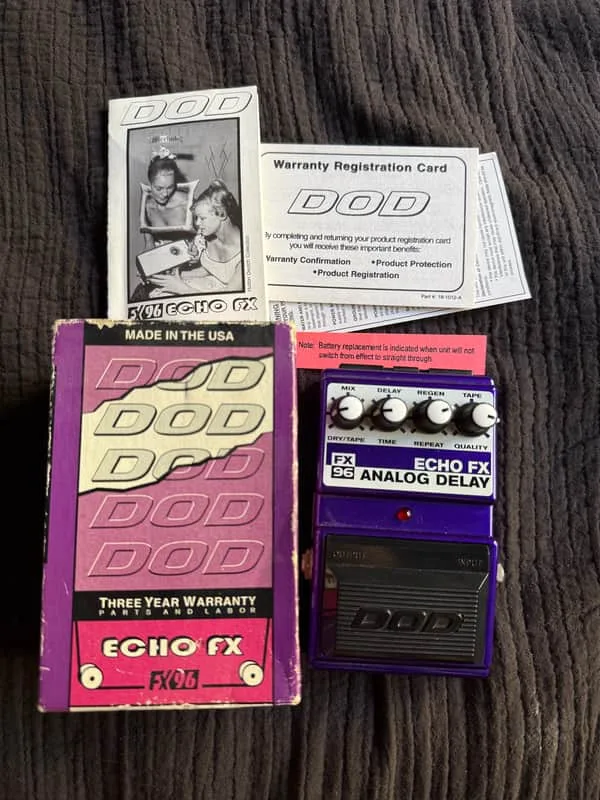
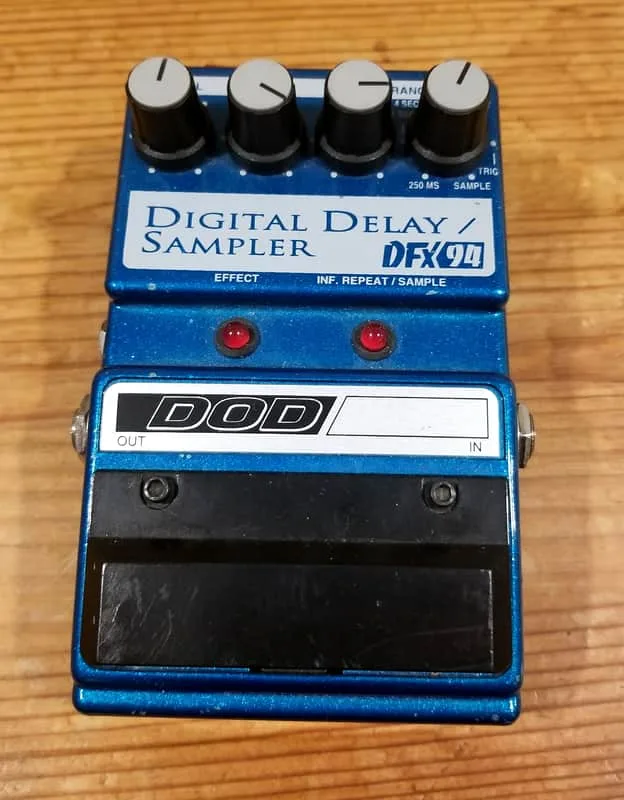
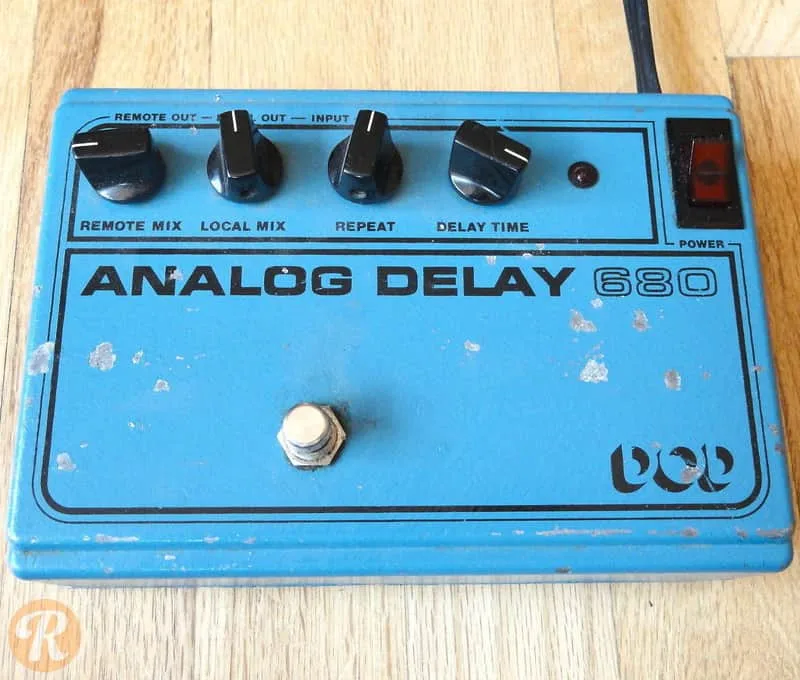
The Rubberneck arrived as part of a wider run of DOD delays. The DOD FX96 Echo FX Analog Delay was produced from 1997 until late 1999, and the DOD DFX94 Digital Delay/Sampler appeared in 1993 with four seconds of digital delay time. More recently the line has continued with pedals like the DOD Drag, a 750ms analog BBD delay with digitally controlled modulation. For the broader category, see delay pedals.
What reviewers said
Pedal of the Day reviewed the pedal in December 2017, shortly after release, and summed up its ambition:
"more options in an analog delay pedal than we may have ever seen"
The reviewer highlighted the three tempo ratio selections, the Rubbernecking feature with its Rate control, and the ability to drive both modulation and Rubbernecking from an external switch4. Gearnews' coverage through 2017 focused on the same ground: the packed front panel, the double-wide chassis, and the extended features the second footswitch unlocks1.
Videos
Knobs
ProGuitarShopDemos
ProGuitarShopDemos
Questions
Is the DOD Rubberneck true bypass?
Yes. DOD lists true bypass among the pedal's features, alongside its feedback loop send/return and remote footswitch control, so your dry signal passes through untouched when the effect is off.
How long is the delay time on the DOD Rubberneck?
Up to 1.5 seconds, which DOD describes as over a second of warm and musical 100% analog repeats. That is long for a bucket-brigade analog delay, where many classic designs stop well under a second.
Does the DOD Rubberneck have tap tempo?
Yes. The Tempo/Regen footswitch lets you tap in the delay time during performance, and a Tap Ratio switch selects three subdivisions: quarter, eighth and dotted eighth notes, for straight, triplet-style or doubled feels.
What does the Gain knob do on the Rubberneck?
It shapes the delay signal by adding input gain into the bucket-brigade chips, so higher settings push the repeats toward overdrive. It colors the repeats only, not your dry signal.
What footswitch works with the DOD Rubberneck?
A three-button external footswitch, connected via a 1/4-inch TRS jack on the rear. It gives remote control of features such as the modulation and Rubbernecking functions, which can also be triggered by holding the Effect On footswitch.
Sources (5)
- DOD Rubberneck Analog Delay 'official' overview video, gearnews.com, 2017-06-25
- DigiTech Rubberneck Analog Delay Effect Pedal, digitech.com, 2025-10-05
- NAMM 2017: Digitech DOD Rubberneck Analog Delay, gearnews.com, 2017-01-20
- DOD Rubberneck Analog Delay, Pedal of the Day (www.pedal-of-the-day.com), 2017-12-08
- Are the Digitech and DOD brands discontinued?, www.gearnews.com, 2022-04-12