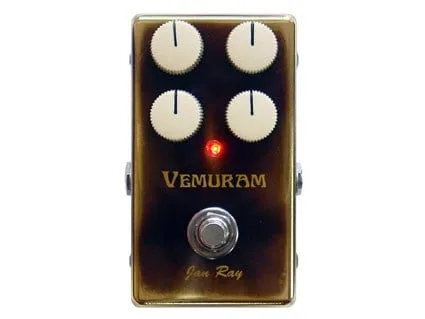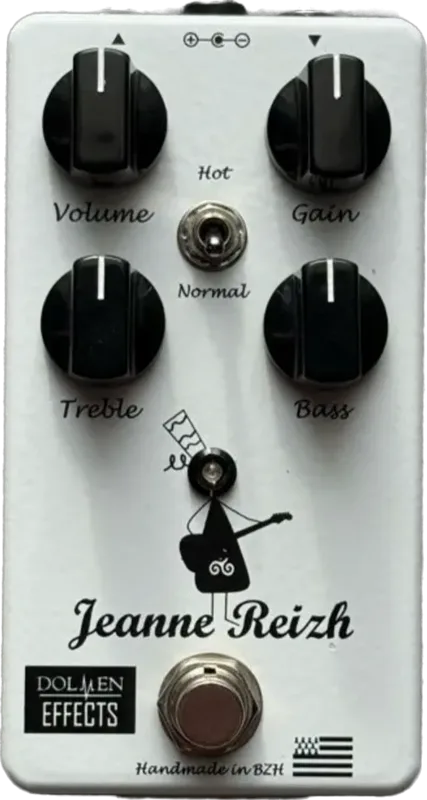


The Dolmen Effects Jeanne Reizh is an analog overdrive pedal described by its maker as "a versatile overdrive inspired by the Vemuram Jan Ray and Paul Cochrane Timmy, blending their tonal characters." The Jan Ray, from Vemuram, is itself a well-known overdrive1, and the Timmy is Paul Cochrane's low-to-mid-gain circuit, so the Jeanne Reizh sits in a family of pedals players reach for when they want an amp-like push rather than heavy distortion. Dolmen says it "delivers a punchy sound with warm bass, smooth mids, and a wide gain range while preserving natural dynamics," and that it "offers both clean boost and warm bluesy crunch through its controls and diode clipping modes." For players comparing the wider field, it sits among overdrive pedals rather than distortion or fuzz.
Controls and the ten clipping modes
The front panel is simple: four knobs covering Volume, Gain, Bass, and Treble1. That is the same broad layout players know from the Jan Ray and Timmy school of overdrives, with gain on one end and tone shaping on the other.
The deeper feature is inside. The pedal has "unique internal clipping options with ten modes mixing symmetrical and asymmetrical silicon and germanium diode feedback"1. In practical terms, diode clipping is what turns a boost into an overdrive: silicon and germanium diodes clip the signal differently, and symmetrical versus asymmetrical arrangements change how much and how evenly they do it. Ten combinations of those give the pedal a wide range of compression and texture from one circuit.
An external switch toggles between "Normal" for low gain and "Hot" for higher gain, which RockBoard's PedalPedia describes as a way to get "varied gain staging" without touching the knobs1. Between that switch, the Gain knob, and the clipping modes, the pedal covers everything from a clean boost to warm bluesy crunch1.
The ten clipping modes are internal options, not front-panel positions, so changing between them means getting inside the pedal rather than stomping through them live.
Power
The Jeanne Reizh runs on 9V DC, center negative, and draws 5mA1. That is a light load by pedal standards, so it fits comfortably on a shared supply output alongside other pedals.
Videos
Jean FONTANILLE
Thomas Sarrodie
La Chaîne Guitare
Questions
What pedals inspired the Dolmen Jeanne Reizh?
Dolmen Effects describes the Jeanne Reizh as a versatile overdrive inspired by the Vemuram Jan Ray and the Paul Cochrane Timmy, blending the tonal characters of those two circuits. The Jan Ray is itself an overdrive, and the Jeanne Reizh carries that family's approach with its own twist: ten internal clipping modes mixing symmetrical and asymmetrical silicon and germanium diode feedback.
Is the Jeanne Reizh analog or digital?
The Jeanne Reizh is an analog pedal. Its circuit type is listed as analog, and its clipping is done with silicon and germanium diodes rather than digital modeling.
What power supply does the Jeanne Reizh need?
The Jeanne Reizh runs on 9V DC, center negative, and draws 5mA. That low current draw means almost any standard pedalboard power supply can handle it.
Can the Jeanne Reizh work as a clean boost?
Yes. Dolmen Effects says the pedal offers both clean boost and warm bluesy crunch through its controls and diode clipping modes. With gain low and the clipping set accordingly, it can push an amp or add volume without heavy saturation.
What does the Normal/Hot switch do?
An external switch toggles between Normal for low gain and Hot for higher gain, giving two gain-staging ranges on the fly. It works alongside the Gain knob and the ten internal clipping modes to cover a wide gain range.
Sources (1)
- Jeanne Reizh by Dolmen Effects, RockBoard PedalPedia, 2026