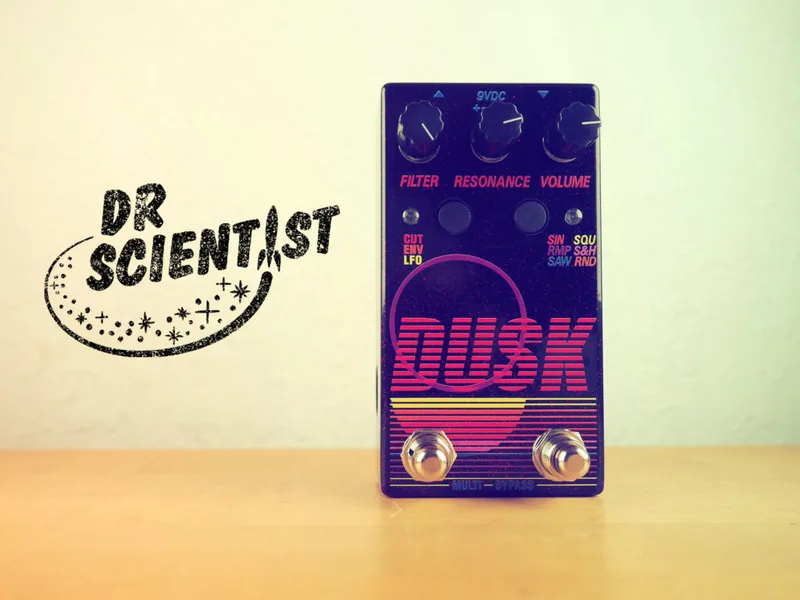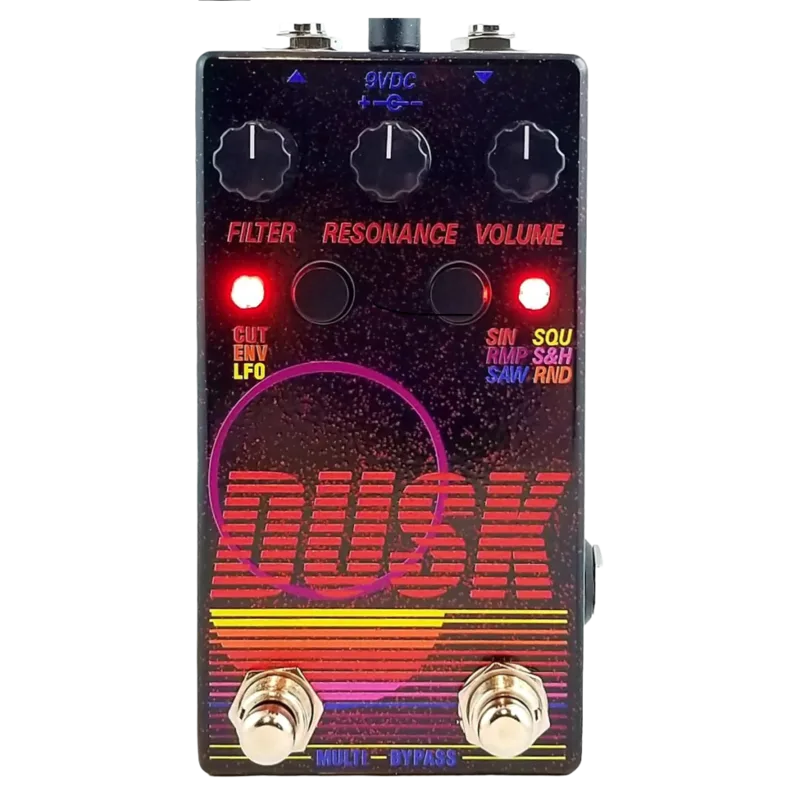


The Dr Scientist Dusk is a multi-mode low-pass filter pedal from Canadian maker Dr Scientist, designed and handmade in B.C., Canada1. It is a digitally controlled analog filter: the audio path is entirely analog, built around an old-school integrated circuit called an Operational Transconductance Amplifier (OTA), while a digital side handles the control features, including tap tempo, MIDI, presets and LFO waveforms12.
At its heart is an analog low-pass filter, and Dr Scientist says the OTA runs off split plus and minus 9V rails "for great audio quality and a deep filter sound"1. Delicious Audio describes it as behaving "like a regular synth filter with frequency cut selected" in its Cutoff mode3. The pedal was covered by Pedal of the Day in December 2020 and later placed 11th (with 2 points) in Delicious Audio's reader poll of the best guitar pedals of 202024.
How the filter works
Dusk's tone shaping comes from a resonant low-pass filter: it rolls off high frequencies above a cutoff point, and a RESONANCE control feeds back around the filter to emphasize the cutoff frequency, the way a synth filter does. Dr Scientist specs the filter control as a plus or minus 12dB/Octave analog, resonant low-pass filter1.
The OTA chip at the center is the same class of circuit used in vintage synth filters and many classic wah and envelope designs. Pedal of the Day framed the pedal as a hybrid that "encompasses everything you know and love about envelope filters" with modern digital conveniences added on top2.
The controls and modes
Dusk has three operating modes, selected by the MODE knob: Cutoff, Envelope and LFO1. Delicious Audio notes that in Cutoff mode the pedal behaves like a regular synth filter with a fixed frequency cut, while Envelope mode makes the filter respond to your playing dynamics and LFO mode sweeps it automatically3.
| Control | What it does |
|---|---|
| MODE | Selects 1 of 3 operating modes: Cutoff, Envelope, LFO1 |
| FILTER | Mode dependent: controls filter cutoff or filter range3 |
| MULTI | Mode dependent: automated filter sweep, envelope freeze, LFO speed ramping1 |
| WAVEFORM | Selects 1 of 6 waveforms for LFO mode1 |
| RESONANCE | Analog feedback control, adds resonance to the filter1 |
| VOLUME | Analog volume control1 |
| BYPASS footswitch | Engages or disengages the effect1 |
The MULTI knob is worth a closer look because it changes jobs with the mode: in Cutoff mode it can run an automated filter sweep, in Envelope mode it can freeze the envelope, and in LFO mode it ramps the LFO speed1. The WAVEFORM knob offers six LFO shapes, which Pedal of the Day called "a lot to choose from" alongside the three filter modes2.
The bypass stomp switch does double duty: as well as engaging the effect, it loads and scrolls through the four onboard presets2.
Power and connections
Dusk runs on 9V DC through a 2.1mm center negative plug and draws 150mA1. That draw is well above what a battery or a small daisy-chain output can comfortably supply, so plan on an isolated or adequately rated supply.
At 150mA, Dusk is a relatively hungry pedal for its size. A standard 100mA daisy-chain output may not be enough; check your power supply's rating per output before adding it to a board.
Connections are mono in and mono out, so the pedal is not stereo1. On the side there is a TRS expression input that also accepts a TS control voltage input, giving expression pedal or CV control over the filter cutoff; Dr Scientist says the expression input works with a TRS cable of any resistance value12. This makes Dusk usable with an expression pedal or with modular synth gear.
MIDI and digital control
The digital side of the pedal is where Dusk separates itself from a simple analog filter. It provides126:
- Tap tempo6
- MIDI implementation of all digital controls, over 5-pin DIN using standard CC and PC messages12
- Six LFO waveforms1
- Four onboard presets, scrolled by the bypass switch2
With MIDI, a controller can recall presets and change the filter settings, LFO speed and waveforms remotely, which puts Dusk in the small group of MIDI pedals in the filter category216.
Availability and price
Videos
Do Noise
Jackson Brooksby
The Bass Channel
Questions
Does the Dr Scientist Dusk have MIDI?
Yes. Dusk has a MIDI implementation of all its digital controls, over 5-pin DIN using standard CC and PC messages. That covers the filter setting, tap tempo and the six LFO waveforms, so the pedal can be recalled and automated from a MIDI controller.
Is the Dr Scientist Dusk analog or digital?
Both, in a hybrid arrangement. The signal path is all analog, built around an Operational Transconductance Amplifier (OTA) low-pass filter running on split plus and minus 9V rails. The digital side only controls that filter, adding tap tempo, MIDI, presets and LFO shapes.
Does the Dr Scientist Dusk have tap tempo?
Yes. Tap tempo is one of the digital-side features, alongside the filter setting control, MIDI and the six LFO waveforms. It is most useful in LFO mode, where the tapped speed sets how fast the filter sweeps.
Is the Dr Scientist Dusk stereo?
No. Dusk has a mono input and a mono output, plus a TRS expression input that doubles as a control voltage input. Players wanting a stereo filter would need to look at other pedals.
Is the Dr Scientist Dusk available yet?
Dr Scientist lists Dusk as coming soon on its product page, with an MSRP of $199 USD (CA$284.70). The pedal was first covered by the press in late 2020, so check the maker's site for current availability.
Sources (6)
- Dusk | Dr Scientist, Dr Scientist, 2026
- Dr. Scientist Dusk Multi Mode Low Pass Filter, Pedal of the Day, 2020-12-11
- Dr. Scientist Dusk Filter Pedal, Delicious Audio, 2022-10-03
- The Best Guitar Pedals Of 2020 according To The Internet Experts, Delicious Audio, 2021-01-21
- Dusk | Dr Scientist, Dr Scientist, 2026
- Dusk by Dr. Scientist, RockBoard PedalPedia, 2026