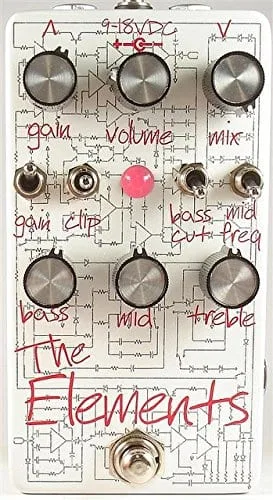


The Elements is a dual-channel overdrive/distortion pedal with a wide gain range and a full three-band equalizer, designed and handmade in British Columbia, Canada by Dr. Scientist12. Dr. Scientist positions it as a flexible drive: "Whether you're looking for high gain metal distortion or a clean equalizer, The Elements can fulfill a role on any pedalboard"1. Beyond the gain and EQ stages, the pedal adds toggle switches for clipping modes, bass cut frequencies, and midrange frequencies, plus a wet/dry mix knob and an expression input1.
The controls
The Elements front panel combines six knobs, three toggle switches and a bypass footswitch. The gain structure is op-amp based, with a range the maker describes as running from less than unity gain to very high saturation3.
| Control | What it does |
|---|---|
| Gain | Increases the amount of distortion2 |
| Volume | Controls the effect (wet) signal level2 |
| Mix | Adjusts the balance between the input signal (dry) and the effect signal (wet)2 |
| Bass | Adjusts the low frequencies2 |
| Mid | Adjusts the midrange frequencies2 |
| Treble | Adjusts the high frequencies2 |
| Gain toggle | Chooses between low- and high-gain channels2 |
| Clip toggle | Chooses between symmetrical, asymmetrical, or no clipping2 |
| Bass Cut toggle | Chooses between 3 levels of bass cut2 |
| Mid Freq toggle | Chooses between 3 center frequencies for the Mid control2 |
| Bypass footswitch | Engages or disengages the effect2 |
The three-band EQ is built from second-order peaking filters with +/-15dB of cut or boost each. The Treble control is centerd at 3kHz, the Bass control at 100Hz, and the Mid control at a center frequency chosen by the Mid Freq toggle from 400Hz, 800Hz, or 1200Hz2.
The two gain channels split the pedal's range. In a 2014 review, Pedal of the Day described the lower Gain toggle position as low gain mode, running from less than unity to medium overdrive, and the upper position as high gain mode, from medium overdrive to heavy saturation3.
The Clip toggle changes the character of the distortion itself. Symmetrical clipping comes from LEDs, asymmetrical clipping from a germanium diode, and the third position removes the clipping diodes entirely2. That third option means the pedal can run as a clean boost or EQ platform, which is what sits behind the maker's "clean equalizer" claim1.
The Mix knob is the clean blend: dry at 0, wet at full, in the words of the 2014 review2. Because the Volume knob controls only the wet signal level, the two knobs together let a player set the distorted sound and then blend it under the untouched dry signal2.
Power and connections
The maker specifies 100mA at 9VDC through a 2.1mm center negative plug, with top mounted audio and power jacks2. A 2014 Pedal of the Day review lists the power requirements differently, as 9VDC at 50mA or 18VDC at 100mA23. The maker's own product page is the more recent specification.
Signal connections are mono input and mono output, with input and output impedance of 500kΩ and 1kΩ respectively3.
The expression input takes a TRS cable with a resistance range of 10kΩ to 100kΩ, and controls the Mix parameter2. That means an expression pedal can sweep the wet/dry blend in real time, from fully dry to fully wet, which is a common trick for swelling into a distorted tone.
The standard Elements was not available to order on the maker's page at the time of the 2026 listing, and shipping from Canada takes 2 weeks1. The limited Gold Bar color variant was available at the time of the same listing4.
Versions and editions
The Elements has one main variant: the Gold Bar Elements, a limited edition gold bar color variant of the same circuit, listed at US$ 199.00, the same price as the standard pedal4. Dr. Scientist describes it identically to the standard version, as a dual-channel overdrive/distortion with a wide gain range, a full three-band equalizer, and the same toggle switch options for clipping modes, bass cut frequencies, and midrange frequencies4. Like all Dr. Scientist pedals, it can be used with guitar, bass, synths, and many other instruments4. See the Dr Scientist Gold Bar Elements page for more.
What reviewers said
Pedal of the Day reviewed the Elements in October 2014 and was positive about its range:
"There's really not a bad tone to be found coming out of The Elements, as is the case for Dr. Scientist pedals in general, and this guy has range, depth, boost, distortion and more, all at your disposal quickly and efficiently (once you figure out how all the controls works for you and your setup, of course)."
The same review noted the caveat in that last clause: with six knobs and three toggles, the pedal takes some time to map onto a particular rig3. More recently, a 2026 MusicRadar review of another pedal suggested the Elements as a drive pedal to "also consider"5.
Where it sits among drive pedals
The Elements covers ground that would otherwise take several pedals: its low gain channel and no-clipping toggle put it in boost and overdrive territory, the high gain channel reaches distortion levels, and the three-band EQ with +/-15dB filters does the work of a dedicated EQ pedal23. Players comparing it against Dr. Scientist's newer high-gain offering can also look at the Dr. Scientist Dungeon Crawler, a MOSFET distortion aimed squarely at extreme metal, where the Elements is the broader, more configurable tool.
Videos
ProGuitarShopDemos
ProGuitarShopDemos
Prymaxe
Questions
Is the Dr. Scientist The Elements true bypass?
Yes. Dr. Scientist specifies true bypass with soft touch relay switching, so the pedal uses a relay to take the effect out of the signal path when disengaged, and the switch itself is a soft touch type. A 2014 Pedal of the Day review lists the same bypass arrangement.
Can The Elements be used on bass?
Yes. Dr. Scientist states that, like all of its pedals, the Elements can be used with guitar, bass, synths, and many other instruments. The Bass Cut toggle, which selects between three levels of bass cut, and the three-band EQ give bass players a way to shape the low end.
What expression pedal works with The Elements?
Dr. Scientist specifies a TRS cable connection with a resistance range of 10kΩ to 100kΩ for the expression input. The expression pedal controls the Mix knob, which adjusts the balance between the dry input signal and the wet effect signal.
Does The Elements have a clean blend?
Yes. The Mix knob adjusts the balance between the input signal (dry) and the effect signal (wet), giving full control over the wet/dry mix. A 2014 Pedal of the Day review describes the Mix control as dry at 0 and wet at full, and the expression input can control it.
Sources (5)
- The Elements, Dr. Scientist, 2026
- The Elements, Dr. Scientist, 2026
- Dr. Scientist The Elements Boost / Overdrive / Distortion, Pedal of the Day, 2014-10-18
- Gold Bar Elements, Dr Scientist, 2026
- Redbeard Effects Angry Rhubarb Paradynamic MKII review, MusicRadar, 2021-11-22