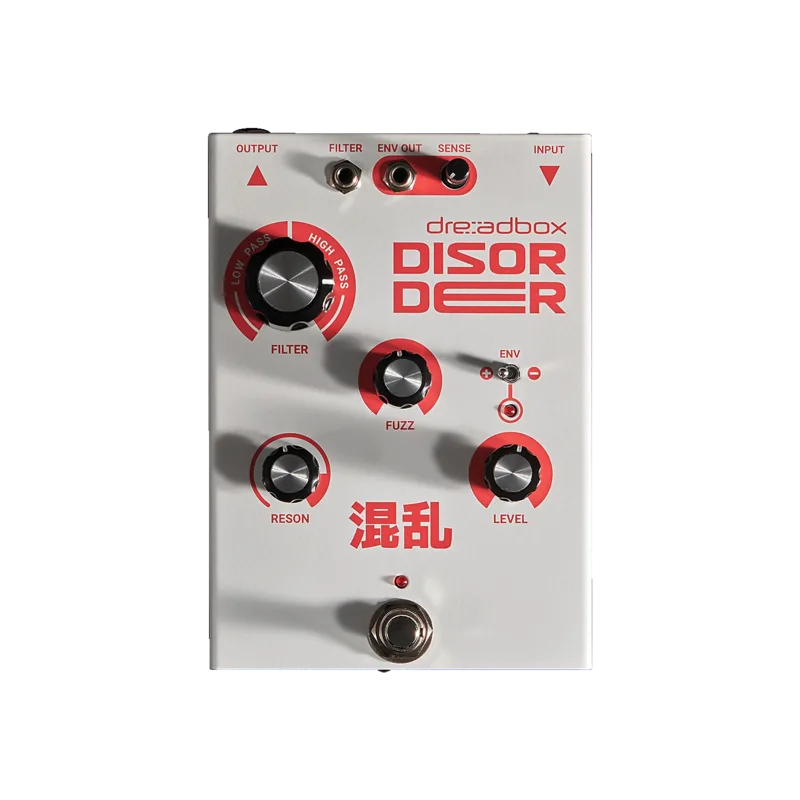
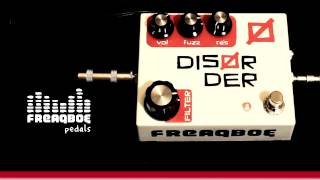

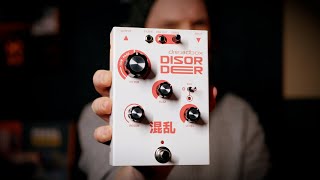
The Dreadbox Disorder is an analog filter fuzz effect pedal: a vintage transistor based aggressive gated fuzz feeding a synth-style resonant filter that can self-oscillate1. Dreadbox, a Greek maker formerly known as Freaqbox, built it for guitar, bass and synthesizers, and describes it as a wildly aggressive fuzz pedal with a self-oscillating filter, designed for players who crave intensity, chaos and unpredictability2.
What makes the Disorder different from most fuzz pedals is the filter half of the circuit. Guitar.com's reviewer described it as a full-on CMOS fuzz with a separate envelope-following filter circuit, a filter that works the way synth filters do, meaning low pass with resonance34. The filter accommodates both low pass and high pass via a single cutoff knob, and pushing the feedback up can drive the filter into self-oscillation, at which point it makes sound on its own5. Delicious Audio's Paolo De Gregorio found the new filter can produce mid-range telephone-style tones, screaming fuzz or upper-range mosquito buzz sounds3.
A gated fuzz into a resonant filter
The Disorder pairs two stages. The first is a vintage transistor gated fuzz, the kind that cuts off when your signal drops below a threshold, leaving silences between notes instead of a wall of hiss15. The second is what Dreadbox calls an Advanced Oscillating Low Pass or High Pass Filter: a resonant filter like the ones on analog synthesizers, which follows the envelope of your playing and can be pushed into self-oscillation with the Feedback knob15.
The pedal has two operating modes. In fixed mode you set the cutoff and it stays there. In envelope mode the filter moves with your playing, with notes and chords getting either brighter or darker as they fade, depending on the polarity you select7. The Envelop toggle on the newer version reverses the direction of the filter's sweep, so that in low pass mode the filter stays shut when a note is played and progressively opens toward the cutoff point, producing a synthy swell effect3.
Dreadbox states the pedal works well on both regular guitars and bass guitars, and the maker's own description covers all three: guitar, bass and synths25. Gearnews reported the maker giving examples of great low end response for bass guitars and a screaming high pass for guitars5. The input accepts a wide range of levels, and an inner trimmer sets the gain of the effect, which is what lets the same box handle passive guitar pickups and hot synth outputs2.
The Disorder is mono and has no battery option. It runs on a 9V DC BOSS-style center pin negative 2.1mm supply only, which is not included, so plan on a wall supply or a pedalboard power brick24.
The controls
The Disorder keeps its control set small, five knobs plus a toggle, which is part of why Delicious Audio called it a pretty cool pedal that delivers a wide range of creative sounds without being overly complicated23.
| Control | What it does |
|---|---|
| Fuzz | Sets the fuzz amount2 |
| Cutoff | Sets the cutoff amount of the low pass or high pass filter2 |
| Feedback | Sets the filter's feedback amount, up to self-oscillation2 |
| Envelope Polarity | Selects the envelope's polarity, so the filter sweeps brighter or darker as notes fade2 |
| Level | Sets the effect's level2 |
| Envelop toggle | Reverses the direction of the filter's sweep for a synthy swell effect (newer version)3 |
The newer version also adds a Sens knob, which outputs CV through the Sensitivity control, letting the pedal talk to synthesizers and other CV gear38.
CV, expression and synths
The Disorder carries CV patch points, which is unusual for a guitar pedal and reflects Dreadbox's background in synthesizers. The filters can be controlled from an external device via CV, but not with a standard expression pedal, as Guitar.com's Richard Purvis noted in the site's fuzz buying guide7. In the other direction, the Disorder V2 outputs CV through its Sensitivity knob, so it can drive other CV equipment, which is why it appears in Delicious Audio's roundup of pedals for synths with CV in and out38. For players building around synth pedals or filter pedals, that two-way CV makes the Disorder more of a system module than a simple stompbox.
Where it came from
The Disorder is not a new design. The original version dates back to 2014, when Dreadbox was still making pedals under its earlier identity3. After almost a decade focused on its synth line, the company returned to stompboxes in the early 2020s, and the reborn Disorder arrived in May 2022354. The new version adds an Envelop toggle that reverses the direction of the filter's sweep3. As of October 2026 the current version lists at 123.00 EUR exc VAT61.
What reviewers said
Guitar.com reviewed the Disorder in May 2022, describing it as an analog fuzz and envelope filter pedal made in Greece4. Delicious Audio's Paolo De Gregorio, covering the V2, summed it up:
"This is a pretty cool pedal that delivers a wide range of creative sounds without being overly complicated."3
Guitar.com's fuzz buying guide includes the Disorder alongside its coverage of the fuzz field, noting the CV control of the filters as its distinctive capability, while pointing out the limitation that a standard expression pedal will not work with them7.
Videos
Dreadbox
Dreadbox
The Pedal Zone
Questions
Does the Dreadbox Disorder take a battery?
No. The Disorder is powered by a nine-volt mains supply only, using a 9V DC BOSS-style center pin negative 2.1mm supply, which is not included with the pedal. There is no battery option, so you will need a wall supply or an isolated pedalboard power brick to run it.
Can you use an expression pedal with the Dreadbox Disorder?
No. You can control the Disorder's filters from an external device via CV, but not with a standard expression pedal. The V2 also outputs CV through its Sensitivity knob, so it can interface with synthesizers and other CV gear rather than conventional expression pedals.
Does the Dreadbox Disorder work on bass?
Yes. Dreadbox states the Disorder works well on both regular guitars and bass guitars, and the maker designed it for guitar, bass and synths. Gearnews reported the maker citing great low end response for bass guitars and a screaming high pass setting for guitars.
Is the Dreadbox Disorder true bypass?
The Disorder uses CMOS bypass with a soft touch switch rather than true bypass. CMOS switching is an electronic bypass that passes the signal when the pedal is off, engaged by a momentary soft touch footswitch rather than a mechanical true bypass switch.
Where is the Dreadbox Disorder made?
The Dreadbox Disorder is made in Greece, by Dreadbox, a company formerly known as Freaqbox that spent almost a decade focused on its synthesizer line before returning to effect pedals in the early 2020s.
Sources (8)
- Disorder, Dreadbox Synthesizers (dreadbox-fx.com), 2026-08-26
- Disorder, Dreadbox Synthesizers, 2024-08-09
- Dreadbox Disorder Fuzz, Delicious Audio, 2023-01-20
- Dreadbox Disorder review: Could this fuzz pedal be your passport to analogue synth mayhem?, Guitar.com, 2022-05-24
- Dreadbox Disorder fuzz pedal with a self-oscillating filter, gearnews.com, 2022-05-03
- Komorebi, Dreadbox Synthesizers
- The best fuzz pedals for all styles and budgets, Guitar.com, 2026-01-14
- The Best Pedals For Synths With CV In/out In 2022, Delicious Audio, 2020-10-01