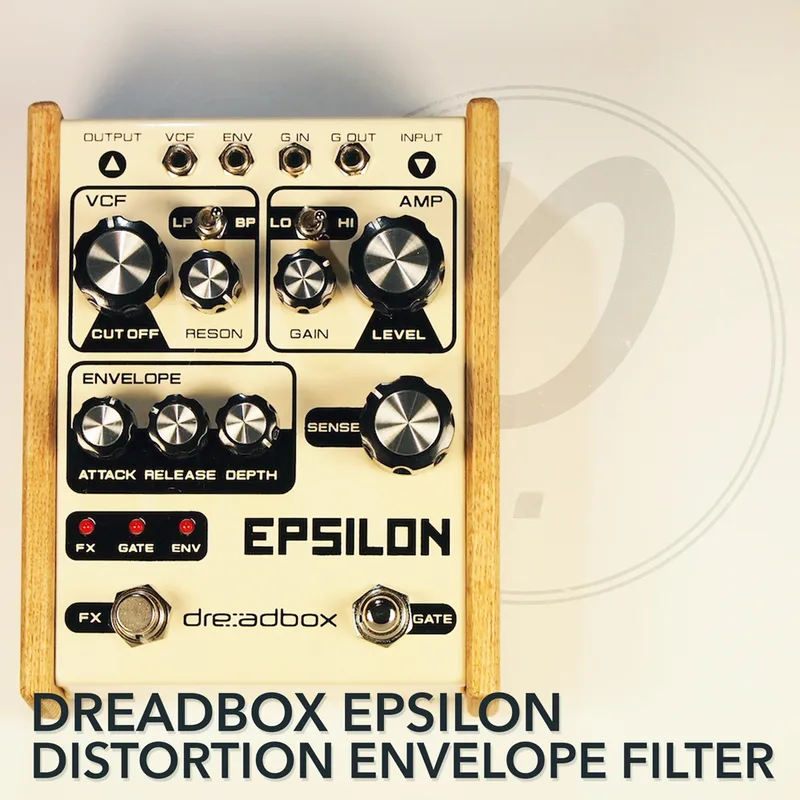


The Dreadbox Epsilon Distortion Envelope Filter is a pedal that puts two effects in one box: a distortion stage and a voltage controlled envelope filter. Rather than a typical stompbox layout, it is arranged like a compact synthesizer voice, with its controls grouped into VC Filter, Amp and Envelope sections and a set of CV jacks for patching1. For players drawn to filter effects, it sits alongside the wider family of filter pedals and wah-wah pedals, but with a distortion built in.
The controls by section
The Epsilon's front panel is divided into three sections, each with its own job1.
| Section | Controls | What they do |
|---|---|---|
| VC Filter | Cut Off (frequency), Resonance (feedback), plus a Low Pass / Band Pass toggle | Sets the filter's frequency and feedback, and selects the filter type1 |
| Amp | Volume, Gain, plus a Low / High gain spectrum toggle | Drives the dirt portion of the pedal1 |
| Envelope | Attack, Release, Depth | Shapes how the envelope responds to your playing1 |
The Amp section is where the distortion lives, using Volume and Gain controls to drive the dirt portion of the pedal, with a toggle that selects either a Low or High gain spectrum1. The VC Filter section features Cut Off (frequency) and Resonance (feedback) control knobs, and a toggle to switch between Low Pass and Band Pass filters1. The Envelope section highlights three control knobs: Attack, Release and Depth1.
CV jacks
Unusually for a guitar pedal, the Epsilon carries several CV jacks, the kind of patching more often seen on modular synthesizers1:
- VCF Input
- Envelope Voltage Out
- G In (envelope trigger)
- G Out (audio to gate converter)
These jacks let the filter and envelope sections interact with outside control voltages, which is part of what the reviewer meant by calling the pedal a unique and creative environment1.
What reviewers said
Pedal of the Day reviewed the Epsilon in May 2016 and came away favorable1:
"We love combined effects here at Pedal of the Day"
Videos
Dreadbox
Dreadbox
Dreadbox
Questions
What is an envelope filter?
An envelope filter is an effect that opens and closes a filter automatically in response to how hard you play. Louder picking sweeps the filter, producing the dynamic, vowel-like tones familiar from wah-style and auto-wah effects. On the Epsilon, the Envelope section's Attack, Release and Depth controls shape that response, and a G In jack can trigger the envelope externally.
What filter types does the Dreadbox Epsilon offer?
The VC Filter section has a toggle to switch between Low Pass and Band Pass filters. A Low Pass filter lets the lows through and trims the top end as it closes, while a Band Pass filter emphasizes a narrower band of frequencies. The section's Cut Off and Resonance knobs set the filter's frequency and feedback.
What do the CV jacks on the Dreadbox Epsilon do?
The Epsilon has several CV jacks: VCF Input, Envelope Voltage Out, G In (envelope trigger) and G Out (audio to gate converter). These allow the pedal's filter and envelope to be controlled or to send control voltages out, in the manner of modular synthesizer patching.
Does the Dreadbox Epsilon have a high gain setting?
Yes. The Amp section, which uses Volume and Gain controls to drive the distortion portion of the pedal, includes a toggle that selects either a Low or High gain spectrum.
Sources (2)
- Dreadbox Epsilon Distortion Envelope Filter, Pedal of the Day, 2016-05-02
- Dreadbox Epsilon Distortion Envelope Filter, Pedal of the Day, 2016-04-28