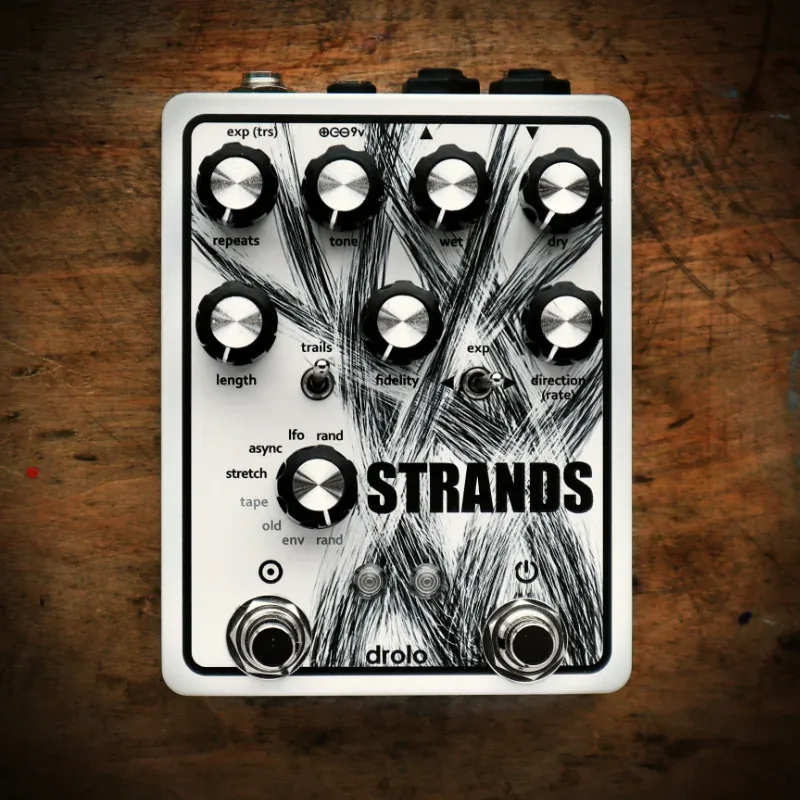


The drolo Strands is a granular delay and micro looper pedal from Drolo FX, a Belgian builder. It sits between a delay and a looper: the maker describes it as a pedal that "can be used like a delay pedal, loop short audio bits, create evolving rhythmic or melodic patterns". Its audio memory is deliberately tiny, varying between a bit less than a second and a bit over 3 seconds, and that constraint is the whole character of the pedal: instead of long repeats, it manipulates very short fragments of your playing in real time.1
The two modes: time stretch and tape looper
The Strands has two main operation modes, time stretch and tape looper, and each comes in four variations.2 The two modes treat your signal in different ways, and the direction knob does different work in each.
Time stretch mode stretches the audio in time. The direction knob alters the amount of stretching and the direction of playback, with maximum stretching at noon; from noon to the right it plays forwards, and from noon to the left it plays backwards.4 The length knob sets the size of the grains that overlap each other, which is the raw material of the granular effect: the pedal cuts the audio into short grains and layers them to stretch it.4
Tape looper mode records short loops that are played back at a speed and direction set by the direction knob, with settings ranging from reversed double speed an octave above to forward double speed an octave above.4 The length knob sets the size of the samples.4
The other variations extend these ideas:
- Old (tape): the direction knob sets the direction and speed of playback, from reverse on the left to forward on the right, with playback stopping at noon. The length knob defines the amount of degradation, with the loop becoming increasingly muffled and wobbly as it is turned up.4
- Fourth tape mode: the direction and speed of playback randomly jump to different settings, at a rate set by the direction knob.4
- LFO (stretch): the same as stretch, but the amount and direction of stretching varies continuously over its whole range, from backwards to forwards and back, at a rate set by the direction knob.4
Controls and looping
The fidelity knob is central to how the pedal behaves. It adjusts the overall memory size, and so the delay and looping time: turning it up increases audio quality but reduces memory size, and vice versa. It also affects the filter ranges, LFOs and envelope detectors.4 In practice, a higher fidelity setting gives you cleaner but shorter repeats and loops, while a lower setting gives you more time to work with at the cost of fidelity.
The left footswitch loops the current content of the buffer. Because the looped audio recirculates through the pedal's memory, it degrades after a few minutes, depending on the fidelity setting.4 That degradation is a feature of the design rather than a fault: the loop is meant to evolve as it repeats.
Using it as a delay
Although the Strands is built around granular manipulation, the maker positions it as usable "like a delay pedal" alongside its looping and pattern-making roles.2 If you are comparing it with conventional delay pedals, the difference is the memory: a conventional digital delay holds seconds of audio at full quality, while the Strands trades memory length against fidelity with the fidelity knob, and its repeats can be stretched, reversed, degraded or randomized rather than simply repeated. For pure looping of longer passages, a dedicated looping pedal is a different tool; the Strands works with fragments of a second to a bit over 3 seconds.4
Power, availability and buying in the US
The Strands runs on 9V DC with a center negative plug and draws 100mA, per RockBoard's PedalPedia listing.3 A standard isolated 9V supply with enough current headroom will run it; check that any daisy-chain output you use can supply the full 100mA.
The pedal was listed as out of stock on the maker's site as of October 2026. Preorders are not available, but the maker says restocks occur regularly.1
For players in the United States and Canada, the maker directs buyers to Soundshoppe NYC (soundshoppe.nyc) while stock lasts.2 The maker's list price is EUR 270.00, with VAT added at checkout for EU countries;2 US pricing is set by the US retailer. The pedal weighs 0.5 kg and is made in Belgium.2
Videos
drolofx
Pedalgaze
Roadside Picnics
Questions
Is the drolo Strands analog or digital?
RockBoard's PedalPedia lists the Strands' circuit type as analog. That describes the pedal's audio circuit; its granular processing and looping behavior come from the way the pedal manipulates its short audio memory, which the maker describes in terms of grains, samples and playback direction rather than circuit topology.
What power supply does the drolo Strands need?
The Strands runs on 9V DC with a center negative plug and draws 100mA, according to RockBoard's PedalPedia listing. Use a supply rated for at least that current and do not share it with lower-current pedals on a daisy chain.
How long can the drolo Strands record?
The audio memory varies between a bit less than a second and a bit over 3 seconds, set with the fidelity knob. Turning fidelity up increases audio quality but reduces the available memory size, and vice versa.
Can the drolo Strands be used as a regular delay?
Yes. The maker says it can be used like a delay pedal, as well as looping short audio bits and creating evolving rhythmic or melodic patterns. Its delay and looping time is set by the fidelity knob, which trades memory length against audio quality.
Where is the drolo Strands made?
The Strands is made in Belgium, according to the maker's product page.
Can I buy the drolo Strands in the US?
Yes. The maker directs US and Canadian customers to Soundshoppe NYC (soundshoppe.nyc) while stock lasts. The pedal was listed as out of stock on the maker's own page as of October 2026, and preorders are not available, though the maker says restocks occur regularly.
Sources (4)
- STRANDS - drolo, drolofx.com
- Strands (test), drolofx.com
- Strands by Drolo, RockBoard PedalPedia, 2026
- Strands - drolo, drolofx.com