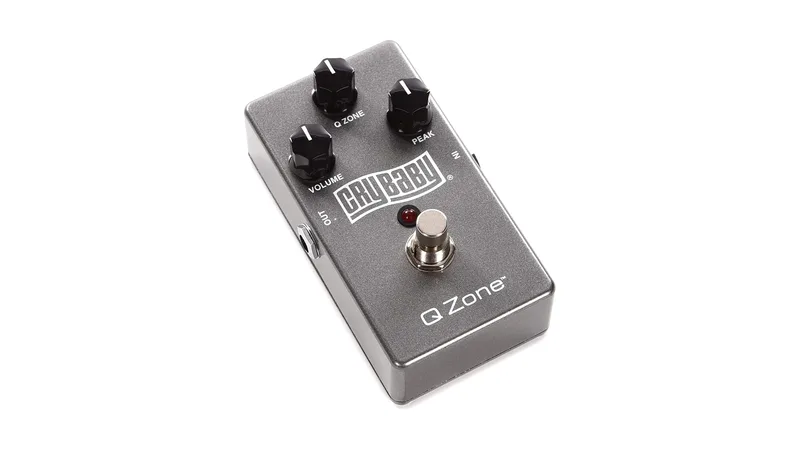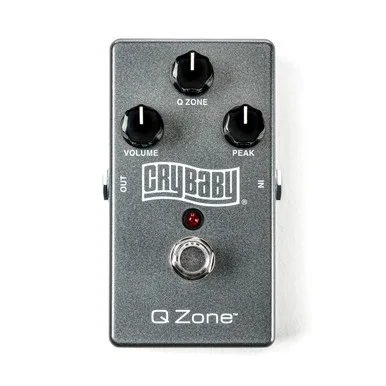


The Dunlop Cry Baby Q Zone is a fixed wah: it produces the sound of a Cry Baby wah held in one position, but in a standard pedal box with knobs instead of a rocker treadle. Dunlop describes it as delivering "the rich, resonant vocality of a fixed-position Cry Baby Wah in a standard pedal box," so a player can dial in that parked, vocal filter sound and leave it there, with no rocking motion and no need to find and hold a sweet spot by ear1.
Dunlop positions it plainly: "With this reissue of the Cry Baby Q Zone Fixed Wah, there's no need to mess around with the rocker and try to listen for" the right position1. The pedal is a legacy product and no longer in production1. It was reissued in 2020 at a recommended price of $149.992, and Guitar World's Trevor Curwen reviewed the QZ1 version in 2026 at a UK street price of £1593.
A Cry Baby wah fixed in place, with no rocker
A wah pedal normally works by rocking a treadle back and forth, sweeping a resonant filter across the frequency range. The Q Zone takes the same kind of filter and locks it in place. Gearnews introduced it at NAMM 2020 in exactly those terms: "If you like that 'cocked' wah sound but don't get on with wah pedals, then the Cry Baby Q Zone could be for you"2.
The "cocked wah" is a long-standing technique: a player leaves a wah treadle parked partway down and plays through it, getting a resonant, honking filter tone without moving the pedal. Guitar World's reviewer describes the Q Zone as mimicking "a 'cocked [wah]' - the sound of a wah pedal held in a fixed position, a favored technique of many players," typically a resonant treble boost that enhances harmonic content3.
Dunlop says the reissue came about because players asked for it. At the pedal's launch, Bryan Kehoe of Dunlop Manufacturing demonstrated it for Sweetwater and explained the reasoning: "the market said something and we answered we said what they say we want a fixed wall [wah]"6. In the same demo he walked through the three knobs and their jobs6.
The controls: Volume, Q Zone and Peak
The Q Zone has a simple three-knob layout controlling volume, bandpass shape and frequency center2. Dunlop's own buying guide describes the interface as allowing "adjustment of boost, bandpass shape, and frequency center"7.
| Control | What it does |
|---|---|
| Volume | Sets the output level of the effect, from 0 dBV to 20 dBV4 |
| Q Zone | Adjusts the bandpass shape from wide to narrow4 |
| Peak | Sets the frequency center of the effect, like the rocker pot of a wah pedal4 |
The Peak control is the heart of the pedal. Dunlop says it "acts like the rocker pot of a wah pedal, setting the frequency center of the effect exactly where you w[ant it]"1, and Guitar World's reviewer agrees: it "has the same function as the rocker pot of a wah pedal, setting the centre frequency and essentially mimicking the treadle position"3. Its range runs from 380 Hz to 2000 Hz4.
The Q Zone knob shapes how sharp that peak is. Guitar World's reviewer found it "sets the bandpass shape (broad or narrow) and effectively dials in the intensity for more throatiness or quack"3. In the Sweetwater demo, Kehoe put it more colorfully: the Q control "makes the peak frequency less or more the more it is the more quacky ER and wall like it is," and less of it sounds more mellow6.
The Volume knob is effectively a boost. Guitar World's reviewer found it "has plenty extra to drive your amp if you want to incorporate a boost"3, and Kehoe described it as "a volume that's like a boost"6. The manual gives a maximum gain at the center frequency of +16 dBV with the Q Zone control fully clockwise, a volume range of 0 dBV to 20 dBV, and a noise floor of -91 dBV A-weighted with all controls at mid4.
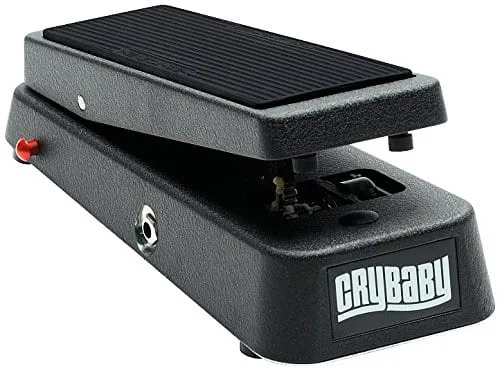
Dunlop notes the circuit lineage: "Like the Cry Baby 95Q Wah, this pedal allows you to boost your effect signal and adjust the bandpass shape from wide to narrow"1. The Cry Baby 95Q is a rocking wah with a variable Q knob and an adjustable boost of up to +15 dB89, so the Q Zone can be read as the 95Q's filter and boost controls with the treadle replaced by the Peak knob.
Power and connections
The QZ1 runs on 9 volts DC4. Power options are one 9-volt battery, installed by removing the bottom plate, an AC adapter such as the Dunlop ECB003 or ECB003EU, or the DC Brick and Iso-Brick power supplies14. Dunlop's product page adds the Mini Iso-Brick to the compatible list1. The adapter and power supplies are not included4.
Hookup is straightforward: an instrument cable from the guitar into the QZ1's INSTRUMENT jack, and another from the QZ1's AMPLIFIER jack into the amplifier's input4. The manual lists an input impedance of 1 MΩ and an output impedance of less than 2.2 KΩ4.
Versions, history and what reviewers said
The Q Zone has a small family tree. Guitar World's review notes the current QZ1 is "Back in original three-knob guise after the four-knob CSP030 Custom Shop version"3. The 2020 reissue was announced at NAMM alongside other Dunlop gear2.
Reviewer opinions were mixed. Gearnews' writer was skeptical on value: "Personally, I think this is a really expensive way of getting a 'Cocked Wah' tone. I get that not everyone wants a wah p[edal]"2. Guitar World's review took the pedal on its own terms, detailing the Peak and Q Zone controls and the boost-capable Volume knob3.
"The volume knob has plenty extra to drive your amp if you want to incorporate a boost."
In Sweetwater's launch demo, Kehoe showed the pedal's sounds and its three controls, closing with the price: "that my friends is the crybaby Qzone 1 $49.99"6.
Replacement parts
Although the Q Zone is out of production, Dunlop still offers electronic replacement parts for the QZ1 through its parts listings5. The parts are sold with the qualified technician in mind, and Dunlop advises that "If you do not have experience installing electronic parts, please have your installation or repair performed by a qualif[ied technician]"5.
Videos
Premier Guitar
Gear4music Guitars
Questions
Does the Q Zone take a 9V battery?
Yes. Dunlop says the Q Zone can be powered by a 9-volt battery, a Dunlop ECB003 9-volt adapter, or the DC Brick, Iso-Brick and Mini Iso-Brick power supplies. The manual notes the battery is installed by removing the bottom plate. The adapter and power supplies are not included.
What frequency range does the Peak knob cover?
According to the QZ1 manual, the Peak range runs from 380 Hz to 2000 Hz. The Peak knob sets the frequency center of the effect, doing the same job as the rocker pot on a standard wah pedal, so you can park the resonant peak anywhere in that range.
Is the Dunlop Q Zone still made?
No. Dunlop lists the Cry Baby Q Zone Fixed Wah as a legacy product that is no longer in production. It was reissued in 2020 at a recommended price of $149.99, and Guitar World reviewed the QZ1 version in 2026, but new units are not being made.
What is a cocked wah sound?
It is the sound of a wah pedal held still in one position rather than rocked back and forth. Guitar World describes it as typically a resonant treble boost that enhances harmonic content, a favored technique of many players. The Q Zone mimics that sound without a treadle.
Can you still get replacement parts for the QZ1?
Yes. Dunlop offers electronic replacement parts for the QZ1 through its parts listings. The parts are aimed at qualified technicians, and Dunlop advises having installation or repair done by a qualified technician if you lack experience installing electronic parts.
What is a fixed wah?
A fixed wah is a wah effect locked in one position, with no rocker treadle to move. Dunlop describes the Q Zone as putting the rich, resonant vocality of a fixed-position Cry Baby Wah in a standard pedal box, with knobs setting the frequency center and bandpass shape instead.
Sources (9)
- CRY BABY® Q ZONE™ FIXED WAH, Jim Dunlop (www.jimdunlop.com)
- NAMM 2020: New from Dunlop/MXR: Cry Baby Q Zone Fixed Wah & MXR Thump Bass Preamp, gearnews.com, 2020-01-16
- Dunlop Cry Baby QZ1 Q Zone review, Guitar World, 2020-07-14
- QZ1.pdf, Jim Dunlop, 2020
- CRY BABY® Q ZONE™ FIXED WAH, Jim Dunlop
- Dunlop Cry Baby Q Zone Fixed-wah Pedal at Winter NAMM 2020, Sweetwater (YouTube channel), 2020-01-18
- RANGE OF EXPRESSION: FIND YOUR CRY BABY® WAH, Dunlop (lifestyle.jimdunlop.com), 2021-10-08
- Evolution of the Cry Baby Wah at Dunlop, Dunlop (lifestyle.jimdunlop.com), 2017-04-27
- 95Q.pdf, Dunlop Manufacturing, Inc., 2019