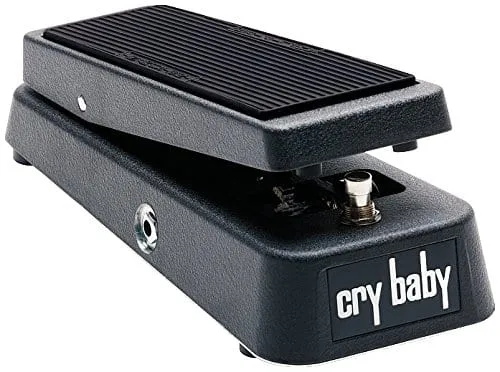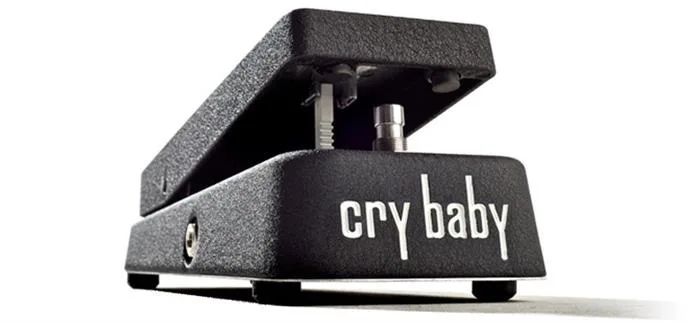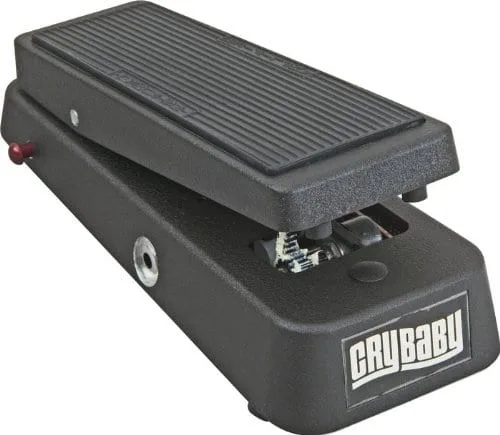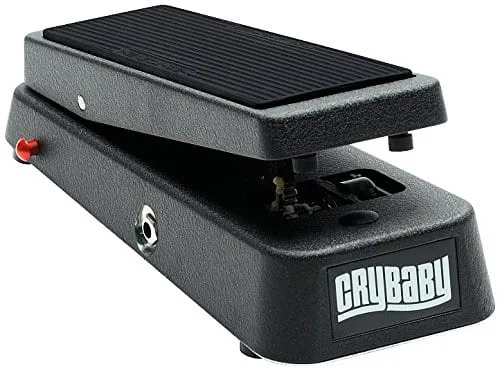


The Dunlop 95Q Cry Baby is a wah pedal from Dunlop, built on the same circuit as the GCB95 Cry Baby Standard and fitted with three of Dunlop's most popular upgrades: a Q control, an adjustable boost, and auto-return switching12. Dunlop describes it as the original Cry Baby Wah with those three additions, so a player who knows the standard Cry Baby can think of the 95Q as that pedal with its two most requested controls and a different way of switching1.
A wah pedal sweeps a bandpass filter across the frequency range as you rock the treadle, and the 95Q's filter sweeps from 390 Hz to 2 kHz3. What sets the 95Q apart from the basic GCB95 is that the shape of that filter is adjustable, and the pedal can push the effect forward in the mix with a built-in boost.
A GCB95-based wah with Q and boost
Dunlop's Cry Baby buying guide places the 95Q in the lineup as based on the GCB95, the standard Cry Baby wah that Dunlop gives an aggressive modern sound4. The 95Q keeps that character and adds the two controls players most often mod into a Cry Baby: a Q control and a boost.
The Q control matters because it changes how pronounced the wah sounds. Dunlop's buying guide describes it as shaping the effect response from sharp to smooth4, and the product page explains that it works by adjusting the effect's bandpass shape1. Set one way the wah is narrow and vocal, set the other it is wide and subtle. The same idea appears across the Cry Baby range, from the 535Q Multi-Wah to the 105Q Bass Wah, and Dunlop also used the 95Q's aggressive sound as the starting point for the Geezer Butler signature wah4.
The boost is the second upgrade. Dunlop's buying guide calls it an adjustable boost of up to +16dB4, and the manual gives the detail: the BOOST switch increases output as set by the VOLUME knob, with a boost range of 0.1 dB to 15 dB and a maximum gain of 17 dB3. In practice this is a level control for the effect, letting the wah cut through a band rather than getting buried.
The controls
The 95Q has three controls on the pedal itself, plus the treadle:
| Control | What it does |
|---|---|
| VARIABLE Q knob | Adjusts the frequency range and width of the wah effect3 |
| VOLUME knob | Sets the amount of gain the BOOST switch adds3 |
| BOOST switch | Increases output as set by the VOLUME knob3 |
| Treadle (rocker) | Sweeps the filter from heel down to toe down3 |
The manual describes the VARIABLE Q control as letting you adjust the frequency width of the effect3, which is the same sharp-to-smooth behavior Dunlop's buying guide summarizes4. The VOLUME knob and BOOST switch work together: set the knob for how much push you want, then use the switch to bring it in.
Auto-return switching
The 95Q's most distinctive feature is how it switches. Instead of a separate bypass footswitch beside the treadle, the pedal uses what Dunlop calls auto-return switching: the Auto-Return function automatically engages the effect when you place your foot on the pedal1.
The manual gives the operating detail:
- To turn the effect on, press the toe of the pedal down with your foot3.
- Rock the treadle as you play, as with any wah.
- When you take your foot off, silent auto-off switching puts the pedal into bypass mode3.
Dunlop's buying guide frames the benefit plainly: convenient auto-return switching so you can step in and out of the effect4. For a player who uses wah in short bursts, a solo accent or a rhythm figure, there is no click to hunt for at the side of the pedal. The same switching appears elsewhere in the Cry Baby line, including the Cry Baby Q Mini 535Q Auto-Return Wah and the Cry Baby Rack Foot Controller564.
One thing to know about the bypass itself: the 95Q is buffered, not true bypass3. When the effect is off, the signal passes through the pedal's buffer. Players who want a hardwired signal path when bypassed can find true bypass or hardwire bypass elsewhere in the Cry Baby range, for example the GCB95F Cry Baby Classic, which the manual lists as true bypass7.
Power and connections
Setting the 95Q up is straightforward. Run an instrument cable from your guitar to the 95Q's Instrument jack, then another from the Amplifier jack into your amplifier's input3.
- One 9-volt battery, accessed via the bottom of the pedal
- A Dunlop ECB003 or ECB003E 9-volt adapter
- A DC Brick power supply; the product page also lists compatibility with the Iso-Brick and Mini Iso-Brick, not included
At 1.8 mA of current draw3, the 95Q is light on a power supply, and the 9-volt battery option means it can run standalone on a small board. The manual also lists the pedal's noise floor as -98 dBV heel down and -90 dBV toe down, A-weighted3, figures that sit alongside the 1 MΩ input impedance in the specifications3.
The 95Q next to the GCB95
The GCB95 Cry Baby Standard is the reference point for the whole line, listed by Dunlop at $99.992. The 95Q is that circuit plus the Q control, the boost, and auto-return switching14. A player choosing between them is choosing between the simplest version of the Cry Baby and one with the two most common mods already installed, at the cost of a buffered bypass rather than the true bypass switch GuitarPCB's technical analysis attributes to the GCB-958.
Videos
Simon Skipper
Brian Bower
Late Honkola
Questions
How does auto-off work on the 95Q?
Press the toe of the pedal down with your foot to switch the effect on. When you lift your foot off the pedal, silent auto-off switching puts it back into bypass mode, so there is no separate on/off stomp switch to hit. Dunlop calls this auto-return switching, and it lets you step in and out of the wah quickly.
Is the Dunlop 95Q true bypass?
No. The 95Q manual lists its bypass as buffered. When the effect is off, your signal passes through a buffer rather than a true bypass switch. Some other Cry Baby models, such as the GCB95F Cry Baby Classic, use true bypass instead.
How much boost does the 95Q have?
The manual gives a boost range of 0.1 dB to 15 dB, with a maximum gain of 17 dB. Dunlop's buying guide describes it as an adjustable boost of up to +16dB. The BOOST switch raises the output by the amount set on the VOLUME knob.
What is the difference between the 95Q and the GCB95?
The 95Q is based on the GCB95 circuit but adds three upgrades: a Q control that adjusts the bandpass shape of the effect, an adjustable boost with a VOLUME knob and BOOST switch, and auto-return switching. The GCB95 is the standard Cry Baby wah without these features.
Does the 95Q take a 9V battery?
Yes. The 95Q runs on one 9-volt battery, accessed through the bottom of the pedal. It can also be powered by a Dunlop ECB003 9-volt adapter or a DC Brick power supply, and the current draw is 1.8 mA.
Does the Cry Baby 95Q have true bypass?
No. According to Dunlop's manual for the 95Q, the pedal uses a buffered bypass. The signal is not hardwired around the circuit when the effect is off.
Sources (8)
- CRY BABY® 95Q WAH, Jim Dunlop (www.jimdunlop.com)
- TOM MORELLO CRY BABY® WAH, Dunlop (jimdunlop.com)
- 95Q.pdf, Dunlop Manufacturing, Inc., 2019
- RANGE OF EXPRESSION: FIND YOUR CRY BABY® WAH, Dunlop (lifestyle.jimdunlop.com), 2021-10-08
- CRY BABY® Q MINI 535Q AUTO-RETURN WAH, Dunlop (www.jimdunlop.com)
- CRY BABY® RACK MODULE, Dunlop (www.jimdunlop.com)
- GCB95F.pdf, Jim Dunlop, 2020
- Dunlop CryBaby GCB-95 Cicuit Analysis, GuitarPCB