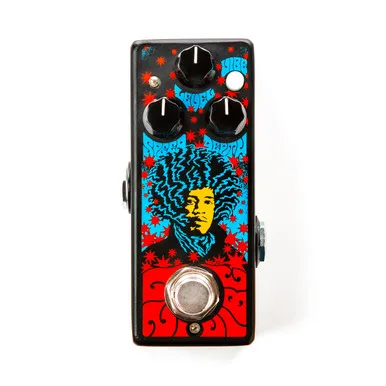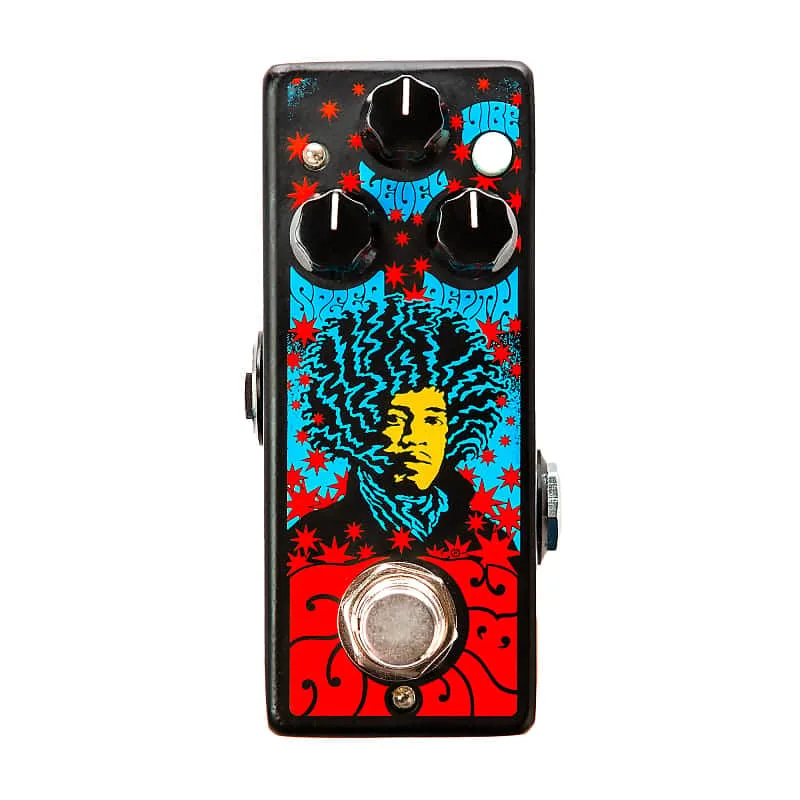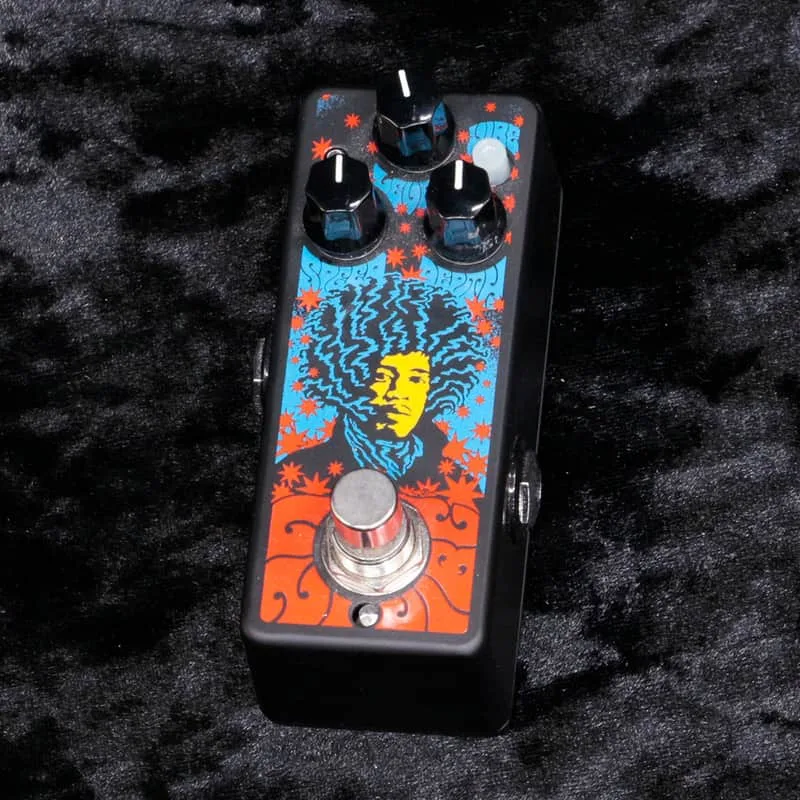

The Dunlop JHMS3 Authentic Hendrix '68 Shrine Series Uni-Vibe Chorus/Vibrato is a mini chorus and vibrato pedal from Dunlop, packed into an MXR mini housing1. It is a smaller version of the vintage Shin-ei Uni-Vibe unit that Jimi Hendrix used from 1969 to 1970, and Dunlop says it delivers the thick wash of tones and textures of the Band of Gypsys album in analog form1.
The pedal is part of the Authentic Hendrix '68 Shrine Series, and its custom finish remixes rock artist John Van Hamserveld's famous 1968 Shrine Auditorium concert poster art1.
The controls
The JHMS3 keeps the control set simple, in keeping with its mini housing. Three controls and a mode switch cover everything:
| Control | What it does |
|---|---|
| SPEED knob | Controls the sweep rate of the effect1 |
| LEVEL knob | Controls overall volume of the effect1 |
| VIBE switch | Toggles between chorus mode and vibrato mode1 |
| FOOTSWITCH | Toggles effect on/bypass, with a white LED indicating on1 |
With the VIBE switch in its OUT position, the pedal is set to chorus mode. Push the VIBE switch IN to engage vibrato mode, which is indicated by an associated LED1. The speed control range runs from 0.5 Hz to 10.5 Hz, so the sweep can go from a slow, deep swirl to a fast warble1.
Setting up is a two-step process:
- Run a cable from your guitar to the JHMS3's INPUT jack1.
- Run another cable from the JHMS3's OUTPUT jack to your amplifier1.
Power: 9V, 5mA
The JHMS3 runs on 9 volts DC and draws only 5 mA1. Dunlop specifies the Dunlop ECB003 9-volt adapter or an MXR Brick Series power supply, each sold separately1.
This pedal cannot be powered by a battery1. Plan on a wall adapter or a pedalboard power supply from day one.
The low 5 mA draw means the pedal is light on a power supply's budget, leaving plenty of headroom for the rest of a pedalboard.
Specifications
| Specification | VIBE OFF | VIBE ON |
|---|---|---|
| Input impedance | 600 kΩ1 | 730 kΩ1 |
| Max input | 0 dBV1 | |
| Max output | 8 dBV1 | 27 dBV1 |
| Output impedance (full volume) | 29 kΩ1 | 180 kΩ1 |
| Output impedance (half volume) | 33 kΩ1 | |
| Noise floor | -97 dBV1 |
The higher output impedance in vibrato mode (180 kΩ at full volume versus 29 kΩ bypassed)1 is worth knowing if the pedal feeds a long cable run or a low-input-impedance device; placing it earlier in the signal chain or after a buffer avoids tone loss.
Where it came from
The JHMS3 traces its circuit lineage to the vintage Shin-ei Uni-Vibe that Jimi Hendrix used from 1969 to 19701. Dunlop positions it as delivering the thick wash of tones and textures that permeate the Band of Gypsys album, in analog form, at a fraction of the size of the original unit1. The Shrine Series finish ties it to 1968 through John Van Hamserveld's Shrine Auditorium concert poster art1.
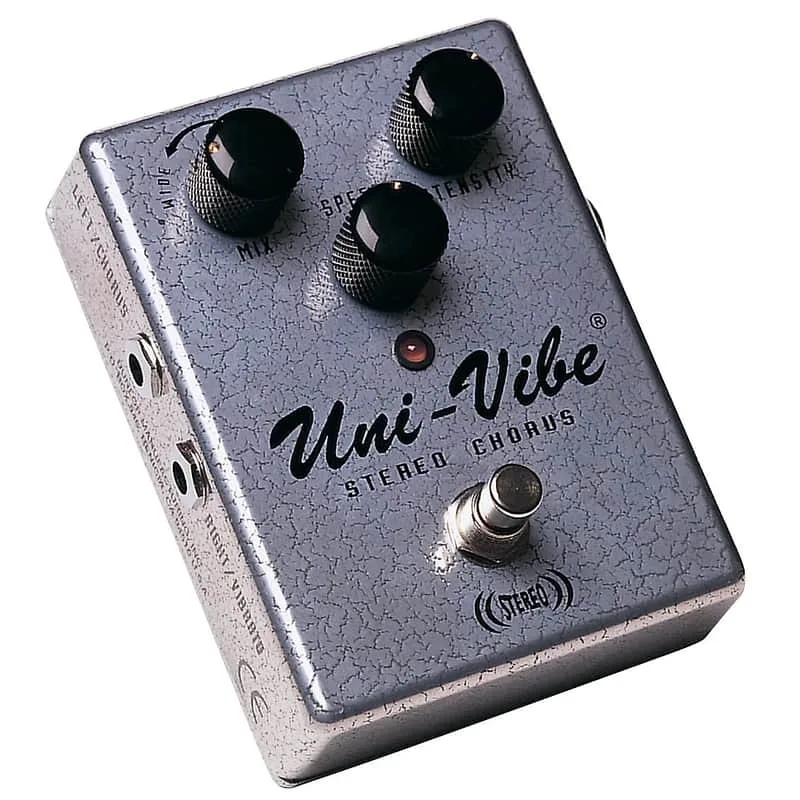
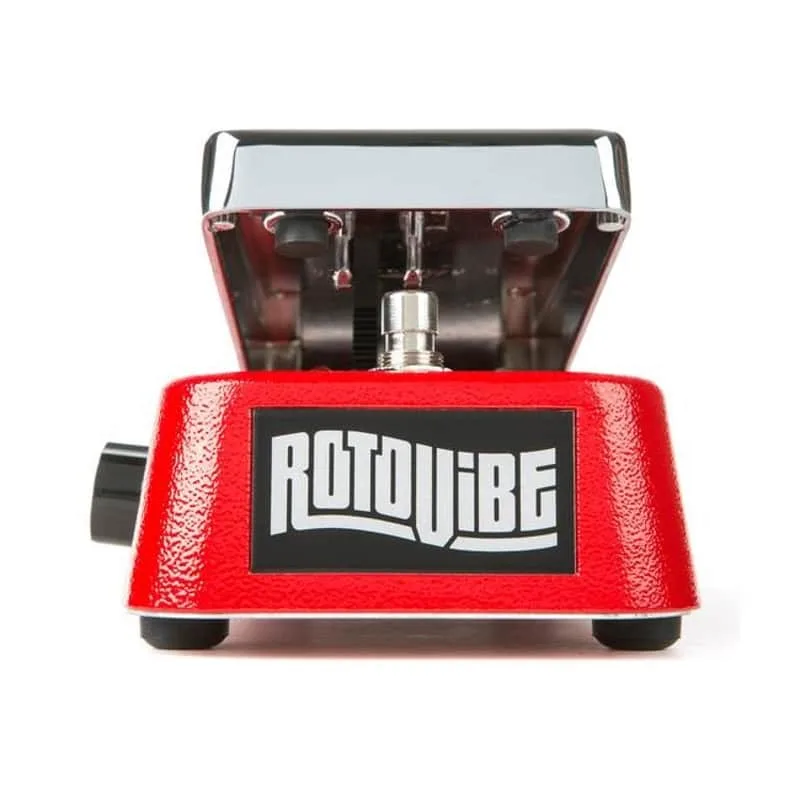
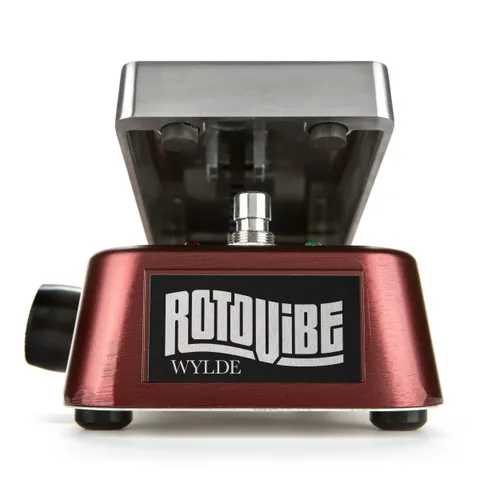
Players comparing Uni-Vibe options from Dunlop can also look at the larger Dunlop UV1SC Uni-Vibe Stereo Chorus, the Dunlop Authentic Hendrix '69 Uni-Vibe, and the Dunlop Authentic Hendrix '68 Shrine Series Uni-Vibe, as well as the Rotovibe family in the Dunlop JD4S Rotovibe Chorus Vibrato and the Dunlop WA357 Wylde Audio Rotovibe Chorus/Vibrato.
Videos
MaxReviews Pro
Questions
Can the Dunlop JHMS3 run on a battery?
No. The manual states plainly that this pedal cannot be powered by a battery. It needs an external 9-volt DC supply, either the Dunlop ECB003 adapter or an MXR Brick Series power supply, each sold separately.
Is the Dunlop JHMS3 true bypass?
Yes. Dunlop lists the bypass as True Hardwire, so with the effect switched off the signal passes through without the active circuitry in the path. A white LED on the footswitch lights when the effect is on.
How do I switch between chorus and vibrato on the JHMS3?
Use the VIBE switch. With the switch in its OUT position the pedal is in chorus mode; push it IN to engage vibrato mode, which is indicated by an associated LED. The switch toggles between the two modes at any time.
How fast does the JHMS3 Uni-Vibe sweep?
The SPEED knob controls the sweep rate of the effect, and the speed control range runs from 0.5 Hz to 10.5 Hz. That covers slow, thick swirls at the low end through to fast warble at the top of the range.
What power supply does the JHMS3 need?
It runs on 9 volts DC with a current draw of 5 mA. Dunlop specifies the Dunlop ECB003 9-volt adapter or an MXR Brick Series power supply, each sold separately. No battery option exists.
What Hendrix album sound is the JHMS3 based on?
Dunlop says it delivers the thick wash of tones and textures of the Band of Gypsys album in analog form, in a smaller version of the vintage Shin-ei Uni-Vibe unit Jimi Hendrix used from 1969 to 1970.
Sources (1)
- JHMS3.pdf, Jim Dunlop (jimdunlop.com), 2023