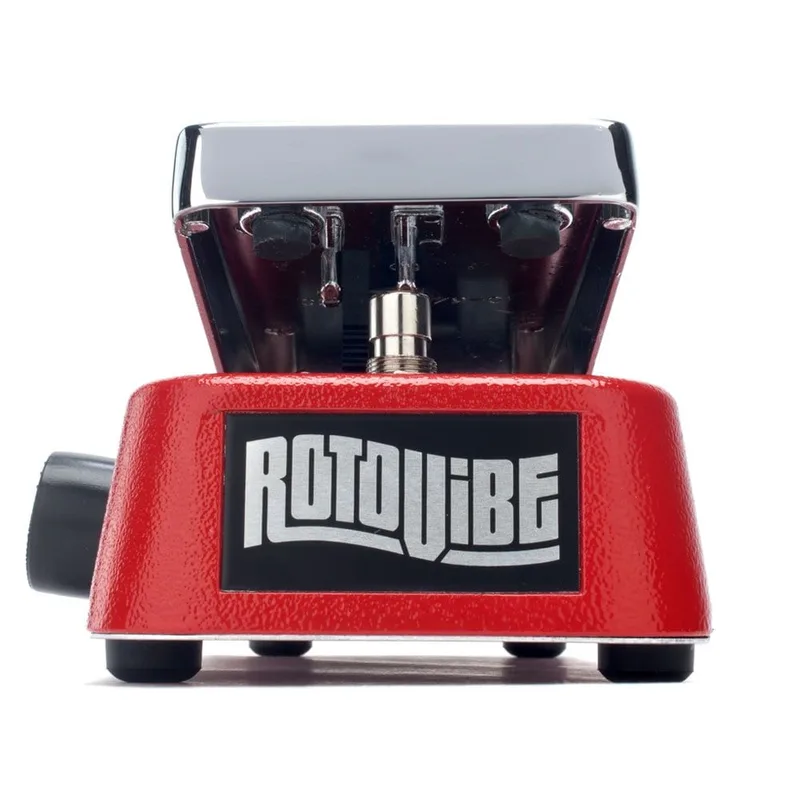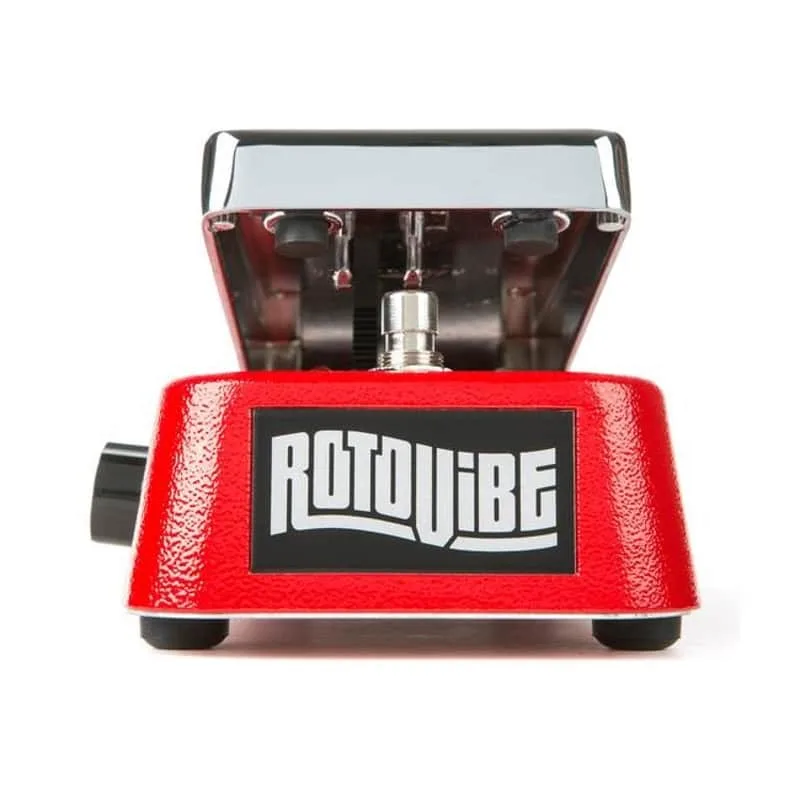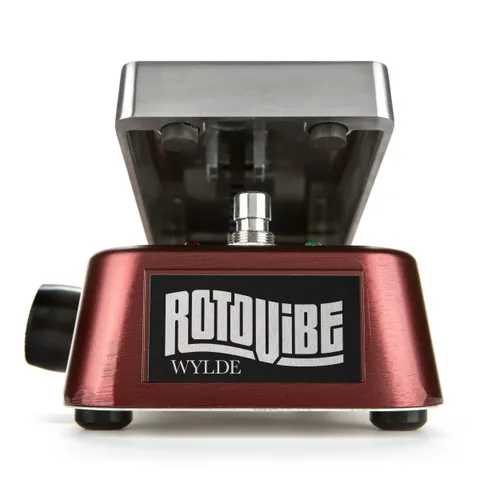
The Dunlop WA357 Wylde Audio Rotovibe Chorus/Vibrato is a chorus and vibrato pedal from Dunlop, built as part of the Wylde Audio Pedal Series created with Zakk Wylde. It reproduces the rotating-speaker modulation of the classic Rotovibe in a red-and-silver enclosure with custom Wylde Audio graphics, and it was announced at NAMM 2024 with availability from May 1 of that year12.
Guitar World described it as offering "the same rich rotating speaker effect of the classic version with all-new custom graphics"2. In other words, this is a cosmetic reworking of the existing Rotovibe rather than a new circuit, aimed at players who want the Wylde Audio look on their board.
A Wylde Audio version of the Rotovibe
The WA357 sits in the Wylde Audio Pedal Series2. The manual calls the pedal a celebration of the collaboration's milestone: "Celebrate the 20th anniversary of the explosive collaboration between Dunlop and Zakk Wylde"1.
The WA357 is a red-and-silver unit whose footswitch rubber grip strip carries Wylde's trademark bullseye-style logo2. Dunlop describes it as delivering "the same rich rotating speaker effect of the classic version with all-new custom graphics"2.
Whether the WA357 itself is a limited run is an open question. Guitar World noted at announcement that "There's been no indication whether this new version will be standard or limited"2.
The controls and LED indicators
The WA357 keeps the Rotovibe's simple control layout. There are only two things to set, plus the rocker-style footswitch21:
| Control | What it does |
|---|---|
| EFFECT SELECTOR switch | Push in for chorus (green LED) or out for vibrato (red LED)1 |
| INTENSITY knob | Controls the intensity of the effect1 |
| FOOTSWITCH | Toggles the pedal on or to bypass; a green or red LED shows when it is on1 |
The LED color tells you at a glance which mode is active: green for chorus, red for vibrato, and the same LED lights when the pedal is engaged1.
The modulation rate is tied to the pedal's rocker position. Dunlop's manual lists the rate at heel down as 1 Hz1.
How it compares with the JD4S Rotovibe
Functionally, the WA357 is the JD4S Rotovibe in new clothes. The JD4S manual describes the same feature set: "Select Chorus or Vibrato modes with adjustable intensity"51. Guitar World made the same observation, noting that the WA357 looks "for all intents and purposes, like the standard Dunlop JD4S Rotovibe, aside from the small 'Wylde' text" and the new graphics2.
The practical difference for a player choosing between them comes down to appearance and price. The WA357 carried a $399 price at announcement2, and Dunlop's own site lists it at $419.99 as of 20263.
The WA357 uses a buffered bypass, not true bypass1. If you run a long signal chain or several buffered pedals, that is worth factoring in when deciding where it sits on your board.
Powering it
The pedal runs three ways: a single 9-volt battery accessed through the bottom of the pedal, a 9-volt AC adapter such as the Dunlop ECB003, or an MXR Brick Series power supply1. RockBoard lists the adapter requirement as 9V DC, center negative4. At 900 uA of current draw1, it is a very light load, so it will not strain a shared power supply.
Questions
Is the Dunlop WA357 Rotovibe true bypass?
No. The WA357 uses a buffered bypass, according to Dunlop's manual. When the pedal is switched off, the signal passes through its buffer rather than a true-bypass wire, which is worth knowing if you plan to run it alongside other buffered or true-bypass pedals on your board.
Does the WA357 take a battery?
Yes. The manual specifies a single 9-volt battery, accessed through the bottom of the pedal. It can also be powered by a 9-volt AC adapter such as the Dunlop ECB003 or an MXR Brick Series power supply, so it works either way on a pedalboard.
What is the difference between the WA357 and the JD4S Rotovibe?
Functionally they are the same pedal: both offer chorus or vibrato modes with adjustable intensity. Guitar World described the WA357 as looking like the standard Dunlop JD4S Rotovibe apart from the small Wylde text and the new red-and-silver graphics, including a bullseye-style logo on the footswitch grip.
How do I switch between chorus and vibrato on the WA357?
Use the EFFECT SELECTOR switch. Push it in for the chorus effect, which lights a green LED, or pull it out for the vibrato effect, which lights a red LED. The INTENSITY knob then sets how strong the selected effect is.
Is the WA357 a limited edition?
That has not been settled. When Dunlop announced the pedal in January 2024, Guitar World reported there was no indication whether the new version would be a standard or limited release. It was announced as part of the Wylde Audio Pedal Series marking 20 years of the Dunlop and Zakk Wylde collaboration.
How much current does the WA357 draw?
Dunlop's manual lists the current draw as 900 microamps, which is very low. That means it places almost no demand on a power supply and can share an output with other low-draw pedals without trouble.
Sources (5)
- WA357.pdf, Jim Dunlop, 2024
- NAMM 2024: “A core component of Zakk's sound since 1988”: Dunlop has reissued Zakk Wylde's go-to Rotovibe pedal to celebrate 20 years of partnership, Guitar World, 2024-01-28
- Artists - Zakk Wylde - Dunlop, Dunlop (jimdunlop.com)
- WYLDE AUDIO ROTOVIBE® CHORUS/VIBRATO WA357 by Dunlop, RockBoard (rockboard.de PedalPedia), 2026
- JD4S.pdf, Dunlop Manufacturing, Inc., 2019