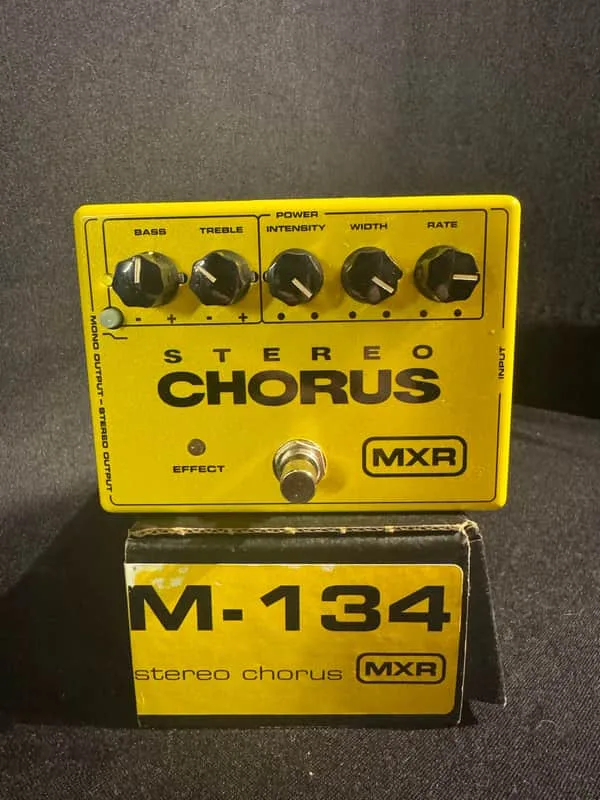


Chorus works by delaying the signal slightly and modulating that delay, then blending it back with the dry sound. The M134's bucket-brigade circuit gives it a maximum delay of 16 ms, and its Rate control sweeps from 0.1 Hz to 10 Hz, from slow, wide swirl to fast shimmer1.
Controls and tone shaping
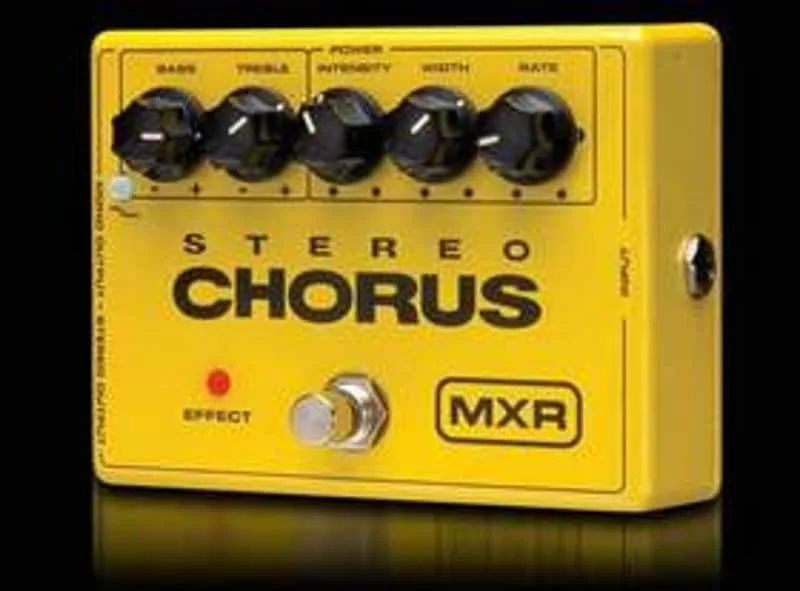
The M134 goes beyond a basic two-knob chorus by adding tone controls and a filter switch1:
| Control | What it does |
|---|---|
| Rate | Sets chorus speed, 0.1 Hz to 10 Hz1 |
| Bass | Cuts or boosts lows, ±12 dB at 100 Hz1 |
| Treble | Cuts or boosts highs, ±12 dB at 3 kHz1 |
| Bass Filter switch | Reduces chorusing on the low end1 |
The Bass Filter switch is the control that matters most for players who find chorus thins out their low end. Switching it in reduces the chorusing applied to bass frequencies, which keeps the foundation of the sound steadier while the upper register shimmers. The Bass and Treble controls then shape the tone of the effect itself, ±12 dB at 100 Hz and 3 kHz respectively1.
Stereo and mono operation
Despite the name, the pedal works well in a single-amplifier setup. Guitar World noted that "you can get some great mono chorus as well, but don't forget those stereo outputs"2. The signal chain is straightforward: a cable runs from the guitar to the Input jack, and a second cable runs from the Mono Output jack to the amplifier. For stereo, a third cable from the Stereo Output jack feeds a second amplifier, giving the effect its wide, two-amp spread1.
Power
The M134 runs on 18 volts DC and draws 26 mA1.
The 18-volt requirement means the M134 cannot run from a standard 9-volt pedalboard output. Dunlop specifies an 18-volt AC adapter such as the ECB004/ECB004E, or a DC Brick power supply. Two 9-volt batteries inside the pedal are the other option1.
Specifications
| Specification | Value |
|---|---|
| Frequency response | 20 Hz to 20 kHz, ±1 dB1 |
| Maximum input level | +10 dBV, 1 kHz, all controls at mid position1 |
| Maximum output level | +13 dBV1 |
| Maximum delay | 16 ms1 |
| Maximum phase shift | 2.88 k degrees, 1 kHz1 |
| Total harmonic distortion | <0.1%1 |
| Noise floor | -100 dBV, all controls at mid position, A-weighted1 |
| Noise reduction | 2:11 |
| Input impedance | 2.2 MΩ1 |
| Output impedance | 3.3 kΩ1 |
The low noise floor and sub-0.1% total harmonic distortion figures describe a clean circuit: the chorus effect comes from the modulated bucket-brigade delay, not from added distortion or hiss. The 2.2 MΩ input impedance is high enough that it loads passive pickups lightly, and the buffered bypass means the pedal always presents that impedance to the signal chain, even when the effect is off1.
What reviewers said
Guitar World's 2013 roundup of pedals recreating 1970s sounds praised the pedal's build and sound2:
Guitar World's 2013 review described the M134 as a sturdy, good-looking pedal, and noted that MXR's own press material says it will remind you how cool chorus can be2.
The same guide described it as "one of the best stereo chorus pedals on the market," while pointing out that its mono output is also worth using2.
Related Dunlop chorus and vibrato pedals
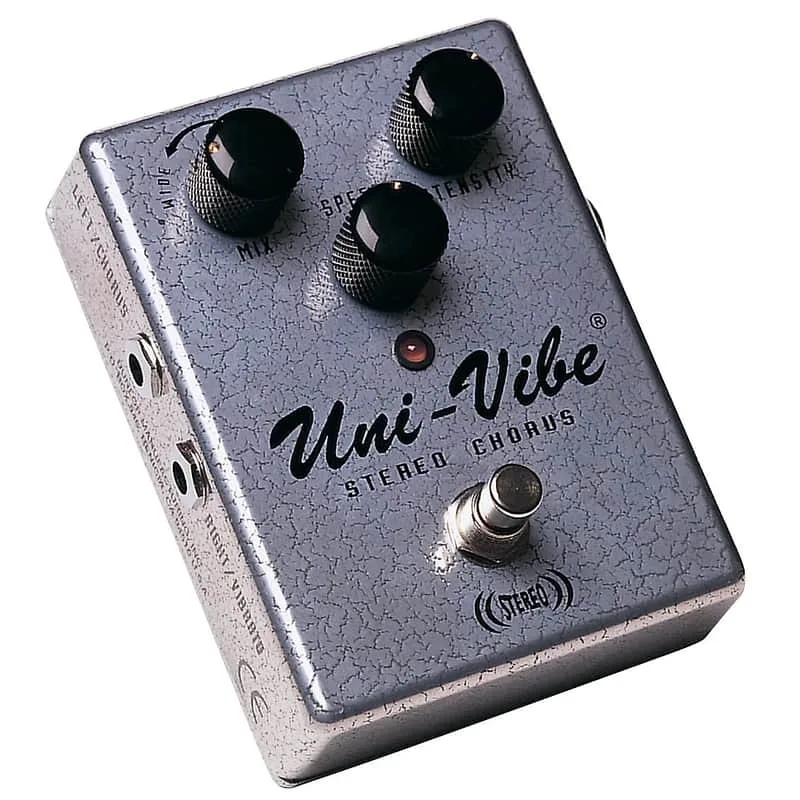
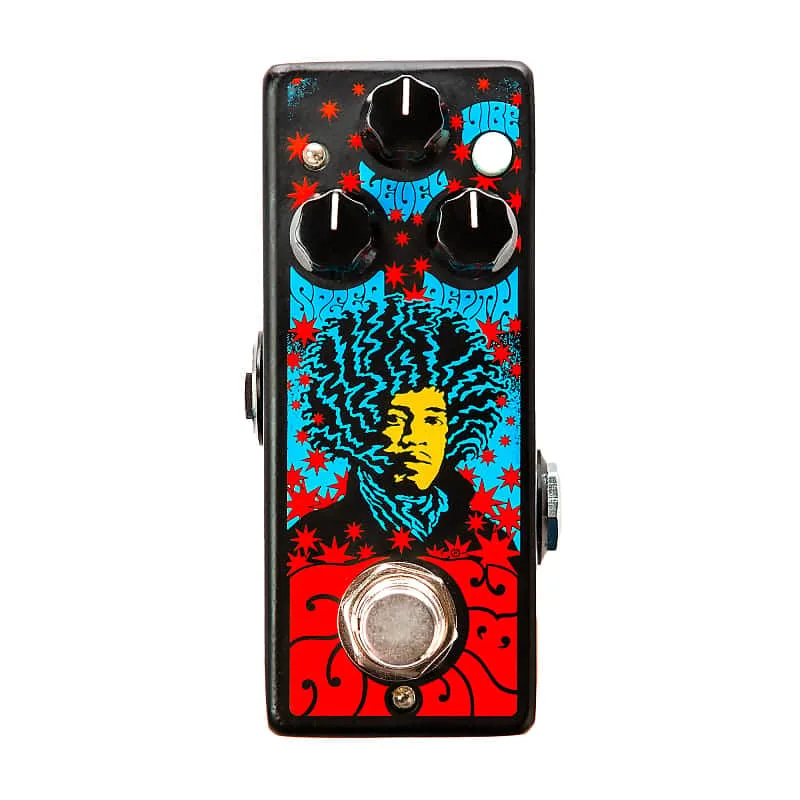
Dunlop's MXR and associated lines include several other chorus and vibrato pedals, including the MXR M-134 Stereo Chorus product page, the JD4S Rotovibe Chorus Vibrato, the Zakk Wylde Signature Rotovibe, and the WA357 Wylde Audio Rotovibe Chorus/Vibrato announced at NAMM 2024. The Uni-Vibe family, which blends chorus and vibrato sounds, includes the UV1SC Uni-Vibe Stereo Chorus and the Authentic Hendrix '68 Shrine Series Uni-Vibe.
Videos
ProGuitarShopDemos
tunnelvisionmusic
gearwire
Questions
Does the Dunlop M134 take batteries?
Yes. The manual specifies that the pedal can be powered by two 9-volt batteries. It can also run from an 18-volt AC adapter such as the Dunlop ECB004/ECB004E, or a DC Brick power supply.
Is the M134 true bypass?
No. The manual lists the bypass as buffered, so the signal passes through the pedal's circuitry when the effect is switched off rather than being routed around it.
Can the M134 run in stereo?
Yes. It has a Mono Output jack and a Stereo Output jack, so it can feed two amplifiers. Guitar World noted it also produces good mono chorus from the mono output.
What voltage does the M134 need?
The power supply requirement is 18 volts DC, with a current draw of 26 mA. Dunlop recommends an 18-volt AC adapter such as the ECB004/ECB004E, or a DC Brick power supply. Two 9-volt batteries also work.
Is the M134 an analog chorus?
Yes. The manual describes it as analog bucket-brigade technology delivering rich analog chorusing, with a maximum delay of 16 ms and total harmonic distortion under 0.1%.
Sources (2)
- M134.pdf, Dunlop Manufacturing, Inc., 2019
- Bell Bottom Blues: Five Modern Effect Pedals That Recreate Groovy '70s Sounds, Guitar World, 2013-04-24