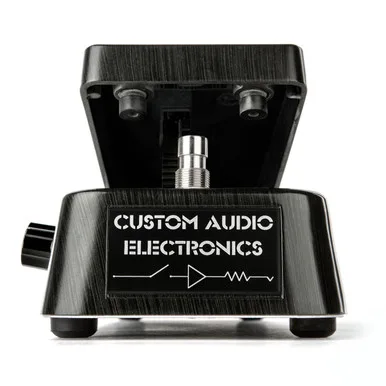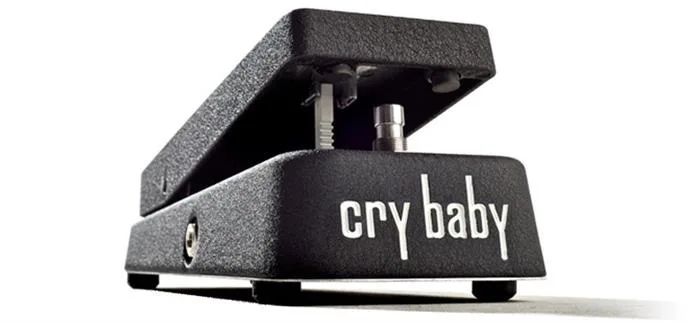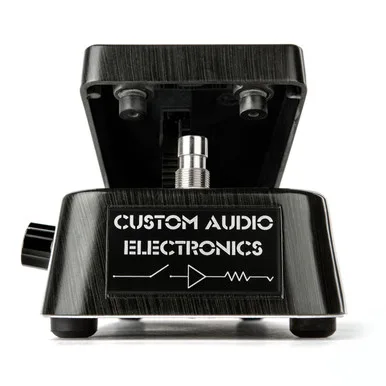


The Dunlop MC404 CAE Wah is a wah pedal developed by Bob Bradshaw of Custom Audio Electronics together with Dunlop's Cry Baby design team1. Its defining feature is a pair of switchable Fasel inductors, giving two distinct wah voices in one pedal: one voice emphasizes the high end, the other sits in the low to mid resonance range1. On top of the wah it carries a boost circuit borrowed from Custom Audio Electronics' CAE MC401 pedal, with up to 18dB of gain2.
Two Fasel inductors and a boost circuit
Fasel inductors are the vintage-style components at the heart of classic Cry Baby wahs, and the MC404 fits two of them, selected by a switch. Dunlop describes the two voices as high-end emphasis on one side and low to mid resonance on the other1. Dunlop's own Cry Baby buying guide characterizes the choice as a warm, vintage vibe or bright transparency4.
Premier Guitar's review names the two positions directly: the "Yellow Fasel" for a deep wah tone and the "Red Fasel" for a classic Cry Baby tone5. For a player, that means one pedal covers both the darker, throatier wah character and the brighter, more vocal sweep, without touching a soldering iron.
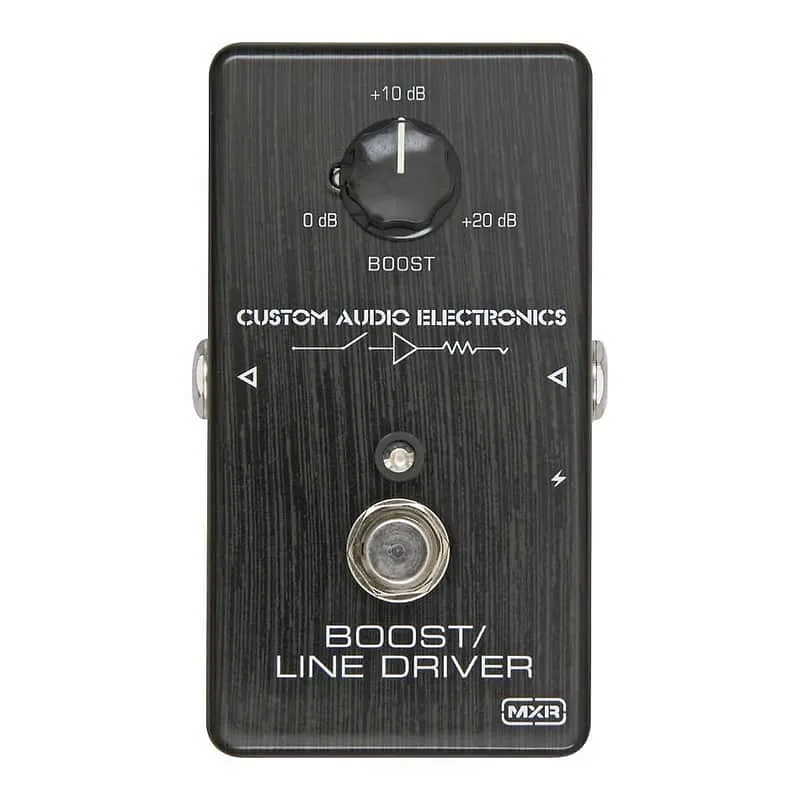
The boost circuit comes from the CAE MC401 pedal and delivers up to 18dB of gain2. A side-mounted kickswitch turns the boost on or off1, and a Boost volume control sets the level, which Premier Guitar notes is foot adjustable5.
The controls
Most of the MC404's adjustments live on the outside, with two trimmer-style controls inside15:
| Control | What it does |
|---|---|
| Inductor kickswitch | Chooses between the two Fasel inductors and their wah voices1 |
| Boost kickswitch | Side-mounted switch that turns the boost on or off1 |
| Boost volume control | Sets the boost level, foot adjustable5 |
| Internal Q pot | Shapes the effect response for each inductor4 |
| Internal gain pot | Adjusts gain1 |
The internal Q control is the one worth understanding. As Dunlop's buying guide puts it, the internal Q controls shape the effect response for each inductor4, meaning you can set how sharp and pronounced the wah peak is for each of the two voices independently. Premier Guitar also highlights the pedal's custom designed CTS extended life low noise potentiometer, the component the treadle sweeps across5.
Premier Guitar's reviewer found the ergonomics practical in use:
"your foot easily controls the small kickswitches on either side of the pedal, as well as the Boost volume control"
Designed with Custom Audio Electronics
Bob Bradshaw of Custom Audio Electronics is the designer behind the pedal, working with Dunlop's Cry Baby design team1. Custom Audio Electronics is the rack and switching gear company known for building complex rigs for professional players, and the MC404 brings that design input into a Cry Baby chassis. Custom Audio Electronics announced the pedal with a custom paint finish and CAE graphics2.
JHS Pedals adds detail on how the collaboration came together: the project was initiated by Jimmy Dunlop, with Sam McRae serving as lead engineer, and the pedal was released in 20096. Pedal of the Day's review likewise credits Bob Bradshaw of Custom Audio Electronics and the Cry Baby design team as the developers7.
How it compares and powers
Against the original Cry Baby GCB-95 and the 535, Premier Guitar's reviewer saw the MC404 as a step up in flexibility5:
"Dunlop takes another big step forward with the MC-404 CAE, with more features and added versatility."
The practical difference for a player is the dual inductors, the internal Q and gain trims, and the built-in boost, none of which the stock GCB-95 carries521.
Power is straightforward: a 9-volt battery, a Dunlop ECB003 9-volt adapter, or one of Dunlop's DC Brick, Iso-Brick, or Mini Iso-Brick supplies, none of which are included with the pedal1. Premier Guitar notes the battery compartment sits on the underside with a lift-off cover, so changing a battery does not mean unscrewing the four rubber feet to remove the back panel5.
Videos
ProGuitarShopDemos
Sweetwater
jimdunlopusa
Questions
Is the Dunlop MC404 CAE Wah true bypass?
Yes. Dunlop lists the MC404 as having true hardwire bypass, so when the wah is off your signal passes through without the pedal's circuitry loading it down. Premier Guitar's review also confirms true bypass among its top-grade components.
Does the MC404 take a 9-volt battery?
Yes. The MC404 runs on a 9-volt battery, a Dunlop ECB003 9-volt adapter, or Dunlop's DC Brick, Iso-Brick, and Mini Iso-Brick power supplies. The battery sits in a compartment on the underside with a lift-off cover, so you do not have to unscrew the rubber feet to swap it.
What does the internal Q pot do on the MC404?
The internal Q control shapes the effect response, in other words how sharp or pronounced the wah's peak is. Dunlop's buying guide notes that the internal Q controls shape the response for each inductor, so you can set the character of each of the two wah voices separately.
How much boost does the MC404 have?
Up to 18dB of boost, taken from the boost circuit in Custom Audio Electronics' CAE MC401 pedal. A side-mounted kickswitch turns the boost on or off, and a foot-adjustable Boost volume control sets the level.
Who designed the MC404 CAE wah?
The MC404 was developed by Bob Bradshaw of Custom Audio Electronics together with Dunlop's Cry Baby design team. According to JHS Pedals, the collaboration was initiated by Jimmy Dunlop, with Sam McRae as lead engineer, and the pedal was released in 2009.
What is the difference between the MC404 and the Cry Baby 535Q?
The MC404 carries two switchable Fasel inductors with distinct voices, an internal Q control, and a boost circuit with up to 18dB of gain. Premier Guitar's reviewer found it offered more features and added versatility over the 535 and the original GCB-95.
Sources (7)
- CAE WAH - Dunlop, Dunlop (jimdunlop.com)
- CAE News, Custom Audio Electronics, 2011-11-27
- MC404.pdf, Jim Dunlop, 2019
- RANGE OF EXPRESSION: FIND YOUR CRY BABY® WAH, Dunlop (lifestyle.jimdunlop.com), 2021-10-08
- Dunlop MC-404 CAE Wah Pedal Review, Premier Guitar, 2009-04-09
- ARE MASS PRODUCED PEDALS GOOD?, JHS Pedals, 2009
- MXR / Custom Audio Electronics MC404 Wah, Pedal of the Day, 2014-03-23
 Tim Mahoney