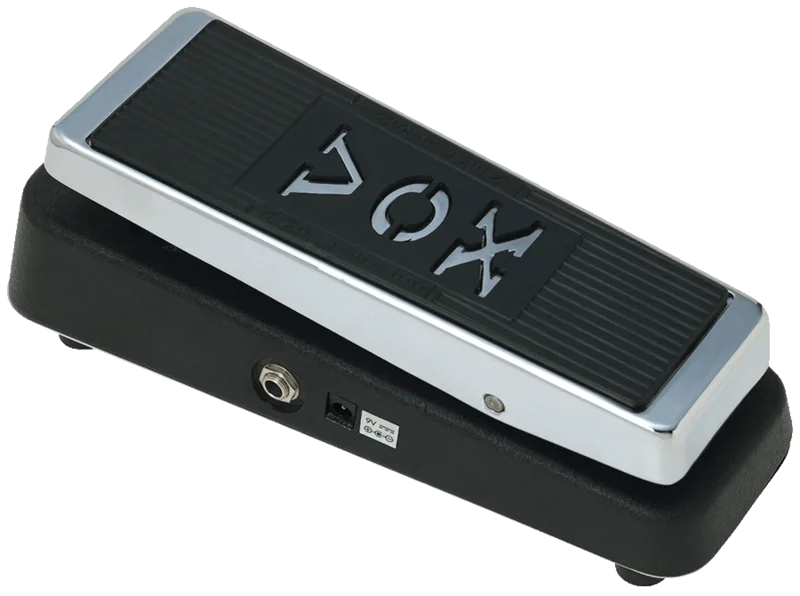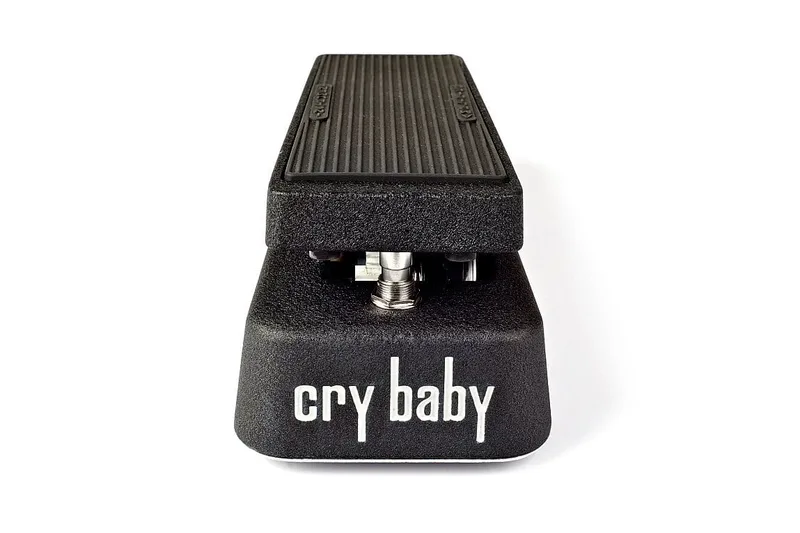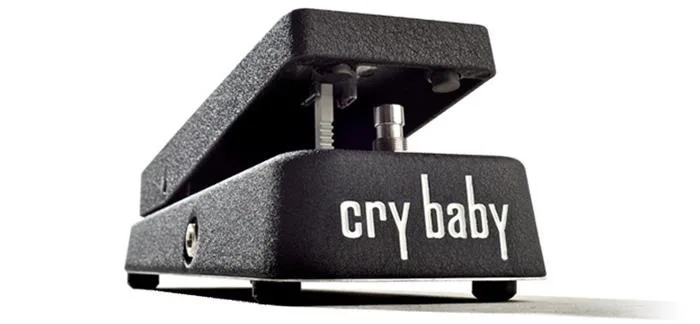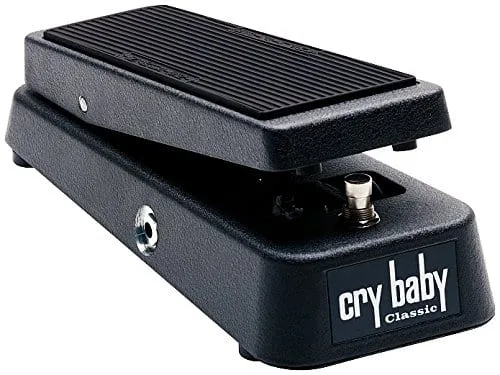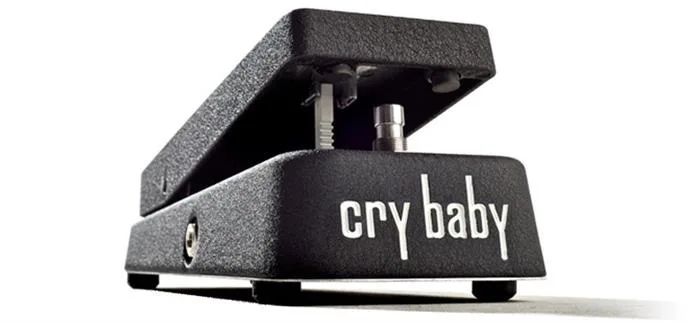


The Dunlop GCB95 Original Cry Baby is a wah pedal: a foot-controlled filter that sweeps a peak through your guitar's frequency range as you rock the pedal. Heel down, the tone is dark and muted; toe down, it is bright, peaky and vocal. Dunlop's manual calls it "The Original since 1967," and the company introduced the GCB95 as its first Cry Baby wah in 198212.
There are no knobs. The single control is the rocker pedal itself: by rocking your foot back and forth you change the effect on your tone instantaneously1. To switch the effect on and off, you push the toe of the pedal down until you feel a click1. Setup is two cables: one from your guitar into the GCB95's Instrument jack, and one from its Amplifier jack into your amp1.
What the GCB95 does to your sound
A wah is a band-pass filter whose center frequency follows your foot. In the GCB95 the sweep runs from a low-pass corner of 350 Hz to 450 Hz at one end of the travel to a high-pass region of 1.5 kHz to 2.5 kHz at the other1. The peak also adds gain: the manual lists a maximum gain of +19.5 dB heel down and +19 dB toe down1, which is why a wah can push an amp and make notes jump out.
Dunlop describes the GCB95 as having "a more up front and aggressive modern sound, with raised frequency range and more pronounced wah effect" compared with the vintage originals2. Reviewers broadly agree it is the familiar Cry Baby character. MusicRadar's review found it is "the same classic tone it's always been," while noting "it does get a little piercing at the top of its range"5. Gearnews' Julian Schmauch wrote that "this wah delivers a fast, expressive response that makes the wah effect sing"6.
"Tonally, the Cry Baby is the same classic tone it's always been. It does get a little piercing at the top of its range."
Not everything written about it is flattering. In MusicRadar's wah buying guide, Alex Lynham summed up the pedal's strengths and weaknesses in one line: classic wah sound and use by countless artists on the plus side, with "can cause 'tone suck'" and a sound that is "harsh in the treble overall" on the minus side7. The treble character is consistent with the circuit: a technical analysis of the GCB-95 notes it has slightly less bass content than the VOX V847 it is inspired by, because the input buffer filters part of the bass8.
Specifications: filter range, gain and impedance
The figures below come from Dunlop's GCB95 manual1.
| Specification | Value |
|---|---|
| Input level (max) | -8.0 dBV |
| Output level (max) | +10 dBV |
| Input impedance | 800 kΩ |
| Output impedance | 10 kΩ |
| Low-pass filter range | 350 Hz to 450 Hz |
| High-pass filter range | 1.5 kHz to 2.5 kHz |
| Maximum gain, heel down | +19.5 dB |
| Maximum gain, toe down | +19 dB |
| Signal-to-noise, heel down | 98 dBV |
| Signal-to-noise, toe down | 89 dBV |
| Current draw | 900µA |
The manual notes the signal-to-noise figures are A-weighted, referenced to 0dBV = 1VRMS1. The 900µA current draw is low enough that a single 9V battery lasts a long time and the pedal is trivially easy to power from a multi-output supply.
Power options, per the manual and Dunlop's product page13:
- One 9 volt battery, accessed via the bottom of the pedal
- Dunlop ECB003 AC adapter (ECB003E in Europe)
- Dunlop DCB10 DC Brick power supply
- Dunlop DC Brick, Iso-Brick and Mini Iso-Brick power supplies (not included)
Dunlop's product page lists the adapter and brick supplies as not included, so plan on a battery or your own supply when the pedal arrives3.
The original Cry Baby circuit and its versions
The Cry Baby circuit predates Dunlop's version by more than a decade. The pedal that would become the Cry Baby was first created in 1966 by engineers at the Thomas Organ Company9, and Dunlop's GCB-95 is a copy of the original VOX model made by VOX/Thomas Organ Co in 19708. Dunlop's own history page describes the GCB95 as "a modern interpretation of that sound," with engineers raising the frequency range and giving it a more pronounced wah effect23. Dunlop's product page likewise calls the GCB95 "a modern interpretation of the original 1966 Cry Baby Wah sound"3.
Inside, the circuit has three stages worth knowing about8:
- An input buffer: an emitter-follower (common collector) NPN amplifier with unity voltage gain, high input impedance and low output impedance. Its 0.01uF input capacitor isolates the guitar from the pedal's DC potential and removes hum. Dunlop added this buffer to the VOX-derived circuit, raising the input impedance from 69.5 kΩ to 1 MΩ to preserve the guitar's original tone.
- An active filter stage: a common-emitter amplifier with a voltage-shunt feedback network, built around feedback resistors R6 (470 kΩ) and R8 (82 kΩ to ground).
- The swept inductor-capacitor filter that the rocker pedal tunes across the range listed above.
The gain math is instructive: the analysis calculates the active filter's voltage gain as 56.4, about 35 dB, but the feedback network reduces it in practice to 19 dB8, which matches the manual's toe-down maximum gain figure1. Dunlop also changed resistor values from the VOX design, reducing R4 from 510Ω to 390Ω and R8 from 100 kΩ to 82 kΩ8. Over the years, the important changes to the GCB95 have been to reduce RF interference2.
Versions and relatives
The GCB95 sits at the base of a large Cry Baby family. The closest sibling is the GCB95F Cry Baby Classic, released in 20032. It takes the modern circuitry of the GCB95 and modifies it to emulate the warm vintage character of early Cry Baby wahs, with a lower frequency range for a darker vibe10. MusicRadar's review of the GCB-95F noted it "scores big-time by enabling either the use of batteries or Dunlop's ECB03 AC adaptor"11, and its manual lists the same bottom-plate 9-volt battery arrangement and a 1 MΩ input impedance12.
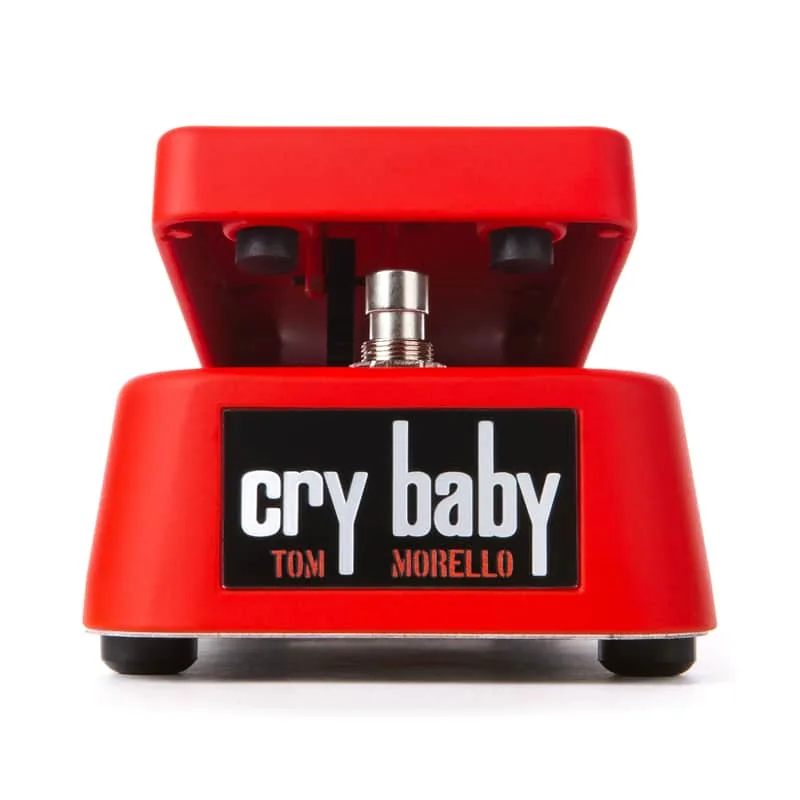
The GCB95 circuit has also been frozen in time for signature models. MusicRadar reported that the limited edition TBM95 Tom Morello Signature Cry Baby "houses an identical circuit to his early-'80s GCB95 Cry Baby"13, and Dunlop's page for that pedal lists the GCB95 at $99.99 alongside it4. MusicRadar has also noted the GCB95's price accessibility, observing you can pick one up for $9914.
For a broader look at the effect type and the rest of Dunlop's wah lineup, see the wah pedals page and the Dunlop brand page.
Videos
Sweetwater
Pedal Tone
Reverb
Questions
Does the Dunlop GCB95 take a 9V battery?
Yes. The GCB95 runs on one 9 volt battery accessed via the bottom of the pedal. The same battery compartment also means you can play it without any external supply at all, and Dunlop's manual lists the battery alongside the ECB003 AC adapter as a power option.
What power supply does the Cry Baby GCB95 use?
Dunlop specifies a Dunlop ECB003 9-volt adapter, or the ECB003E version in Europe. The pedal can also be powered from Dunlop's DC Brick, Iso-Brick and Mini Iso-Brick power supplies, or by a single 9 volt battery. None of these supplies are included with the pedal.
What is the difference between the GCB95 and GCB95F?
The GCB95F Cry Baby Classic takes the modern circuitry of the GCB95 and modifies it to emulate the warmer sound of early vintage Cry Baby wahs, with a lower frequency range for a darker vibe. It was released in 2003, while the GCB95 dates back to 1982. Both run on a 9 volt battery.
How much current does a Cry Baby wah draw?
The GCB95 manual lists a current draw of 900 microamps, which is very low by pedal standards. That means it places almost no demand on a power supply and is easy to run alongside other pedals from a multi-output brick.
How do you turn a Cry Baby wah on and off?
Push the toe of the pedal down until you feel a click. That switches the effect on and off. Rocking your foot back and forth on the pedal then changes the effect on your tone instantly, from dark at the heel to bright and peaky at the toe.
Sources (14)
- GCB95.pdf, Jim Dunlop, 2019
- Evolution of the Cry Baby Wah at Dunlop, Dunlop (lifestyle.jimdunlop.com), 2017-04-27
- CRY BABY® STANDARD WAH, Dunlop (jimdunlop.com)
- TOM MORELLO CRY BABY® WAH, Dunlop (jimdunlop.com)
- Jim Dunlop Cry Baby GCB-95 review, MusicRadar, 2016-12-20
- The Best Wah Wah Pedals for Iconic Guitar Tones: Cry Baby and Beyond, gearnews.com, 2025-08-18
- 5 great wah pedals guitarists need to try, MusicRadar, 2021-06-24
- Dunlop CryBaby GCB-95 Cicuit Analysis, GuitarPCB
- Guitar FX Layouts: Jim Dunlop CryBaby GCB-95, Guitar FX Layouts (tagboardeffects.blogspot.com), 2014-09-02
- RANGE OF EXPRESSION: FIND YOUR CRY BABY® WAH, Dunlop (lifestyle.jimdunlop.com), 2021-10-08
- Dunlop Cry Baby Classic GCB-95F review, MusicRadar, 2012-03-05
- GCB95F.pdf, Jim Dunlop, 2020
- Dunlop unveils the Tom Morello signature wah, MusicRadar, 2020-09-17
- “We are honoured that our company's relationship with the legendary guitar player continues to this day”: Dunlop salutes wah pedal pioneer Eric Clapton with a gold-plated signature Cry Baby, MusicRadar, 2024-11-19