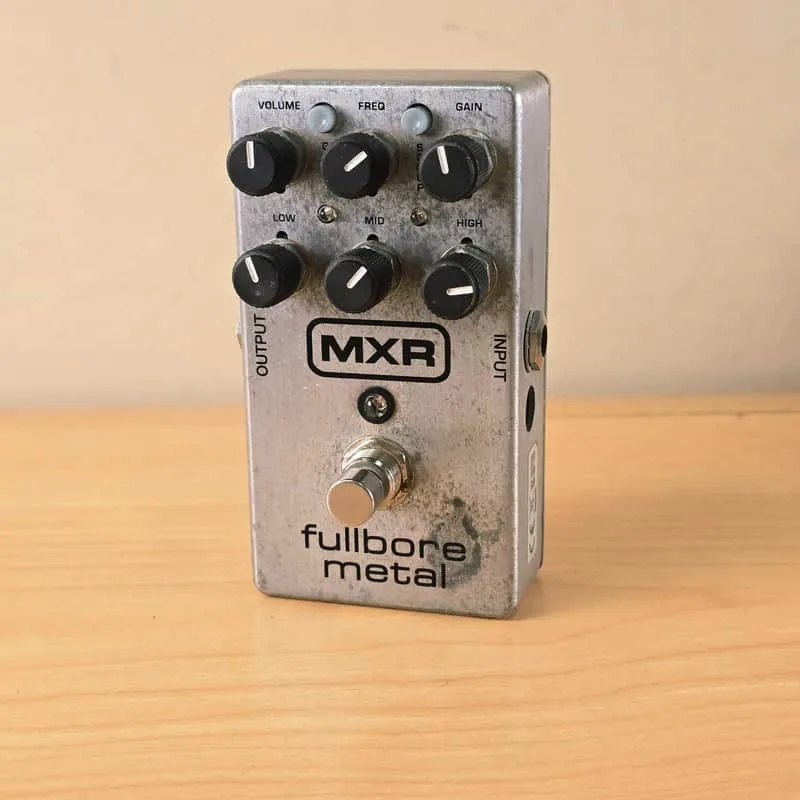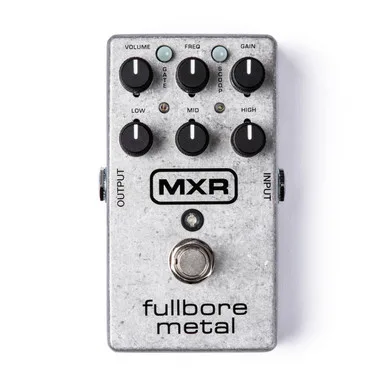


The MXR FullBore Metal (model M116) is a compact high-gain distortion pedal from MXR, the effects brand owned by Dunlop. It is aimed squarely at metal players: Dunlop says it "turbo-charges your guitar signal with lethal amounts of ultra high gain," and the pedal pairs that gain with a three-band EQ, a sweepable midrange control, a Scoop switch and a switchable noise gate12.
The noise gate is the feature that sets the FullBore apart from most distortion pedals. Extreme gain settings bring hiss and hum along with the distortion, and the built-in gate is there to knock that noise out while adding definition and tightness to syncopated riffs1. Dunlop unveiled the pedal in September 2009, describing it as a "compact but powerful device that provides guitarists all they'll need to unleash the most devastating contemporary metal guitar tones ever heard"3.
A metal distortion with a built-in noise gate
The FullBore Metal is built around one idea: a single compact box that covers what a metal guitarist needs from a distortion pedal. The manual calls it a "super high gain distortion" with a "three band EQ with sweepable mid frequencies"2. The gain on tap is deliberately extreme, and the gate exists because of it. Dunlop's product page describes the combination as a built-in Noise Gate "to knock out the noise associated with extreme gain levels while also adding" definition and tightness to syncopated metal riffs1.
The gate is switchable, so it can be taken out of the signal path entirely when it is not wanted, and an internal sensitivity control sets the threshold at which it engages1. In Premier Guitar's demo video, Chris Burgess explained that the "internal gate threshold control lets you set the noise gate's sensitivity"5.
MusicRadar's 2023 round-up of distortion pedals for metal, written by Alex Lynham, characterized the pedal's two signature features plainly:
"a scoop switch that instantly trims the fat from your tone, Metallica-style, and an optional noise gate that kills anything below a set volume"6
The Scoop switch is a one-touch midrange cut, the kind of scooped-mids voicing associated with classic metal rhythm tones, and it sits alongside the full EQ section rather than replacing it6.
The pedal is all-analog. Dunlop described it that way at launch3, and Premier Guitar's demo video noted it "includes an all-analog circuit path"5. It also uses true-bypass switching, so the clean signal passes through untouched when the pedal is off3.
The controls
The control set is straightforward for anyone who has used a distortion pedal, with the EQ section doing more work than most. MusicRadar lists the controls as Volume, freq, gain, low, mid, high, gate switch and scoop switch6.
| Control | What it does |
|---|---|
| Volume | Sets the pedal's output level6 |
| Gain | Sets the amount of distortion6 |
| Low | Bass EQ control for sculpting tone3 |
| Mid | Midrange EQ control6 |
| Freq | Sweeps the midrange frequencies the Mid knob acts on2 |
| High | Controls the amount of high end2 |
| Scoop switch | Instant midrange cut, "Metallica-style"6 |
| Gate switch | Turns the noise gate on and off6 |
The sweepable midrange is the detail that gives the EQ its range. Rather than a fixed mid band, the Freq knob moves the center frequency that the Mid knob boosts or cuts, which lets a player hunt down the specific midrange character they want, from honking presence to the flat, scooped rhythm sound the Scoop switch delivers in one step23.
Power and connections
The FullBore Metal runs on the standard MXR power arrangement. Dunlop's product page states it can be powered by a 9-volt battery, a Dunlop ECB003 9-volt adapter, or the DC Brick, Iso-Brick and Mini Iso-Brick power supplies1. MusicRadar's buying guide lists the same requirements: a 9V power supply or 9V battery6. The battery option means the pedal works on a board without a dedicated power feed, though a supply is the practical choice for a pedal designed to sit at high gain for long sets.
Where it came from and what it costs
Dunlop Manufacturing unveiled the FullBore Metal Distortion in September 2009 as its latest MXR offering3. At launch it carried a list price of $169.99 with a $99.99 street price in the US3. Dunlop's current product listing shows $125.994. In the UK, where the pedal was distributed by JHS7, MusicRadar's 2010 review listed it at £1498.
MusicRadar's 2010 round-up of distortion pedals called it "the compact FullBore Metal" from "effects guru [MXR]"8, and its 2023 metal distortion guide still included it among the pedals worth considering for the genre8. Dunlop also sells internal parts for the pedal under the M116-PARTS designation, which supports repairs for units already in use9.
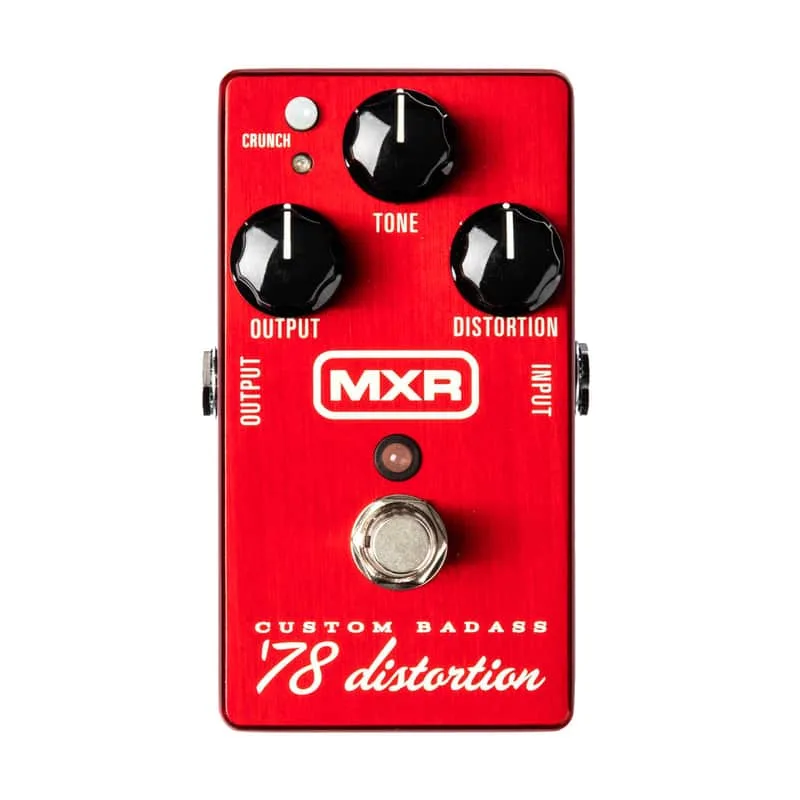
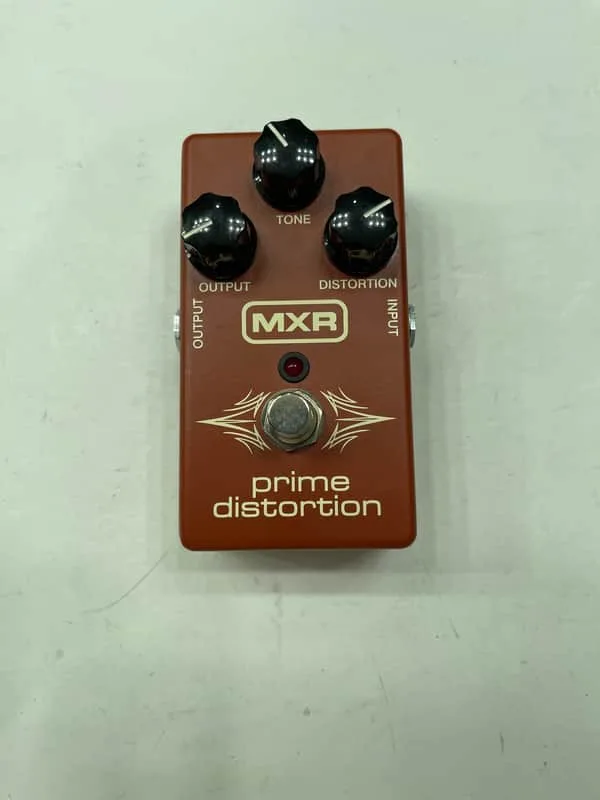
For players comparing MXR distortions, the FullBore Metal sits at the high-gain, metal-specific end of the range, where alternatives like the MXR M78 Custom Badass '78 Distortion and the MXR M69 Prime Distortion take more classic-leaning directions21.
Videos
ProGuitarShopDemos
Ola Englund
jimdunlopusa
Questions
Does the MXR FullBore Metal run on a battery?
Yes. Dunlop says the pedal can be powered by a 9-volt battery, a Dunlop ECB003 9-volt adapter, or Dunlop's DC Brick, Iso-Brick and Mini Iso-Brick power supplies. The battery makes it usable on a board without a dedicated power feed, though a supply is the usual choice for a pedal meant to sit at high gain.
Is the MXR FullBore Metal true bypass?
Yes. Premier Guitar's 2009 launch coverage listed true-bypass switching among the pedal's features, alongside 9V battery power with AC input available. With true bypass, the pedal passes your clean signal through untouched when it is switched off.
Is the FullBore Metal analog?
Yes. Dunlop described it at launch as an all-analog pedal, and Premier Guitar's demo video noted it includes an all-analog circuit path. The distortion, EQ and noise gate are all handled in the analog domain rather than by digital processing.
Can the FullBore Metal be powered with an AC adapter?
Yes. It accepts the Dunlop ECB003 9-volt adapter, and Dunlop also lists the DC Brick, Iso-Brick and Mini Iso-Brick supplies as compatible. MusicRadar's buying guide likewise lists its power requirements as a 9V power supply or 9V battery.
What does the noise gate on the FullBore Metal do?
The built-in, switchable noise gate mutes signal below a set volume, which knocks out the hiss and hum that comes with extreme gain settings. Dunlop says it also adds definition and tightness to syncopated metal riffs. An internal threshold control sets how sensitive the gate is.
How much does the MXR FullBore Metal cost?
At launch in September 2009 it carried a list price of $169.99 with a $99.99 street price in the US. Dunlop's current product listing shows $125.99. In the UK, MusicRadar's 2010 review listed it at £149.
Sources (9)
- MXR® FULLBORE® METAL DISTORTION, Dunlop (jimdunlop.com)
- M116.pdf, Dunlop Manufacturing, Inc., 2019
- Dunlop Unleashes MXR FullBore Metal Distortion Pedal, Premier Guitar, 2009-09-18
- MXR® DISTORTION III, Dunlop (www.jimdunlop.com)
- Dunlop Kirk Hammett Wah & MXR Fullbore Metal Demos, Premier Guitar, 2009-05-05
- Best distortion pedals for metal: High gain tones, MusicRadar, 2020-12-21
- MXR FullBore Metal pedal released, MusicRadar, 2009-10-13
- Round-up: 4 filthy guitar distortion pedals, MusicRadar, 2010-04-12
- MXR® DISTORTION+, Jim Dunlop (jimdunlop.com)