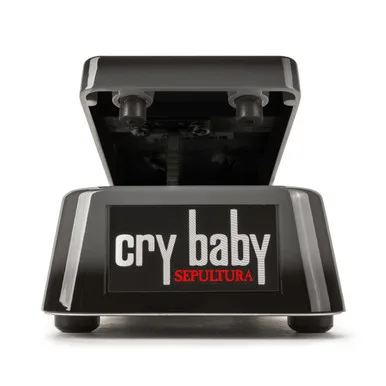
The Dunlop Sepultura 40th Anniversary Cry Baby Wah is a limited edition wah wah pedal developed in collaboration with Andreas Kisser, the Sepultura guitarist Dunlop describes as an "iconic wah-wah master." It commemorates Sepultura's 40th anniversary and farewell tour, and it carries the band's artwork alongside a feature set built around Kisser's playing: a boost switch, a Variable Q knob and auto-return switching1.
Why it exists
Dunlop lists this pedal as a legacy product that is no longer in production1. As a limited edition, it turns up on the used market rather than as a current catalog item.
Controls
| Control | What it does |
|---|---|
| Boost switch | Kicks in up to +15dB of gain, as set by the Volume knob1 |
| Volume knob | Sets the amount of boost gain, up to +15dB1 |
| Variable Q knob | Shapes the intensity of the wah effect, from a narrower bandpass emphasizing higher end harmonics to a wider bandpass emphasizing lower end harmonics1 |
The boost is the headline feature. With up to +15dB of gain available at the stomp of a switch, the pedal can push an amp or a drive pedal harder while the wah is engaged, which suits the high-energy style Kisser plays. The Variable Q knob covers the range of wah character: a narrower bandpass brings out higher end harmonics for a more vocal, pronounced sweep, while a wider bandpass leans on the lower end harmonics for a broader, fuller sweep1.
Auto-return switching
The pedal uses auto-return switching, which Dunlop says "allows him to stomp in and out of the effect at will"1. For a player like Kisser, that means the wah can be brought in for a specific riff or fill and switched out again without leaving it engaged for the whole song, which is how the pedal is used across Sepultura's catalog1.
Where it sits in the Cry Baby line
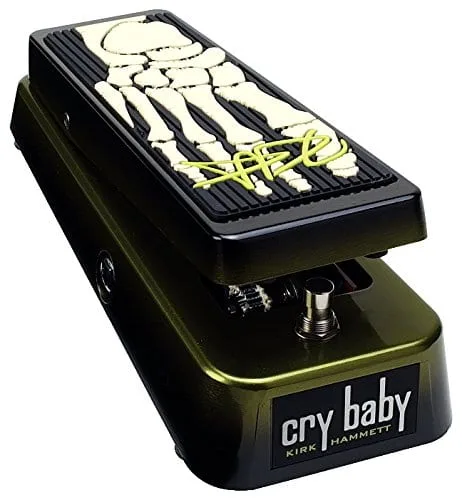
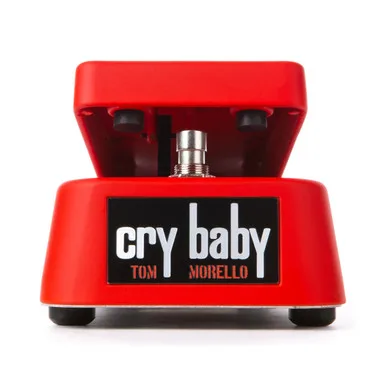
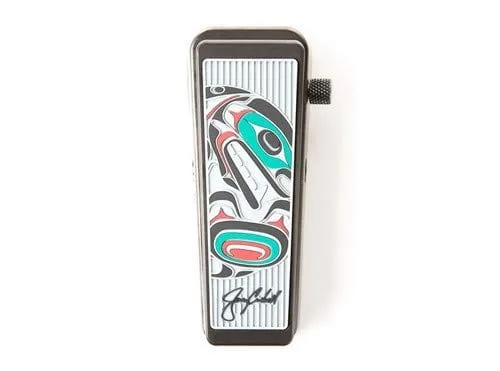
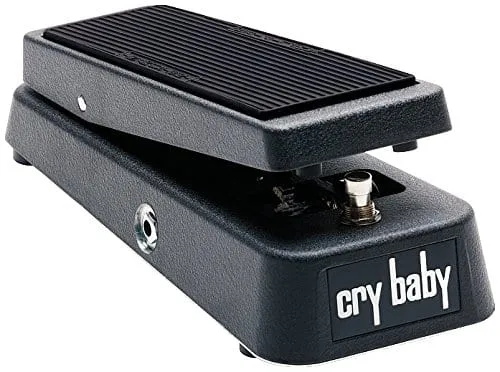
Dunlop's signature and limited edition Cry Baby range runs wide, from artist models like the Kirk Hammett Cry Baby, the Tom Morello Cry Baby Wah and the Jerry Cantrell Cry Baby to the Cry Baby Standard and the Cry Baby Multi-Wah. The Sepultura model stands apart in that company for its boost switch and Variable Q control, and because it was designed around one player's specific use of the effect1.
Questions
How much boost does the Sepultura wah add?
The Boost switch kicks in up to +15dB of gain, and the amount of boost is set by the Volume knob. That lets Kisser, or any player, push an amp or drive pedals harder while the wah is engaged, without needing a separate boost pedal on the board.
What does the Variable Q knob do?
The Variable Q knob shapes the intensity of the wah effect. At one end it gives a narrower bandpass that emphasizes higher end harmonics; at the other, a wider bandpass that emphasizes lower end harmonics. In practice it lets you tune how pronounced and how vocal the wah sweep sounds.
What does auto-return switching mean on a wah?
Auto-return switching means the effect switches on and off with a stomp, and the pedal returns to a set position when you lift your foot. On this pedal it allowed Andreas Kisser to stomp in and out of the effect at will during a song rather than leaving the wah on continuously.
Who designed the Sepultura Cry Baby wah?
It was a collaboration between Dunlop and Andreas Kisser, Sepultura's guitarist, whom Dunlop called an iconic wah-wah master. The pedal commemorates Sepultura's 40th anniversary and farewell tour, and gearnews.com reported it as the final pedal in a series of Dunlop collaborations announced in January 2025.
Which Sepultura songs feature Andreas Kisser's wah?
According to Dunlop, the Cry Baby has been an integral part of Kisser's sound and was used on some of the band's biggest hits, such as "Resist/Refuse" and "Roots Bloody Roots."
Sources (1)
- SEPULTURA 40TH ANNIVERSARY CRY BABY® WAH, Jim Dunlop (www.jimdunlop.com)