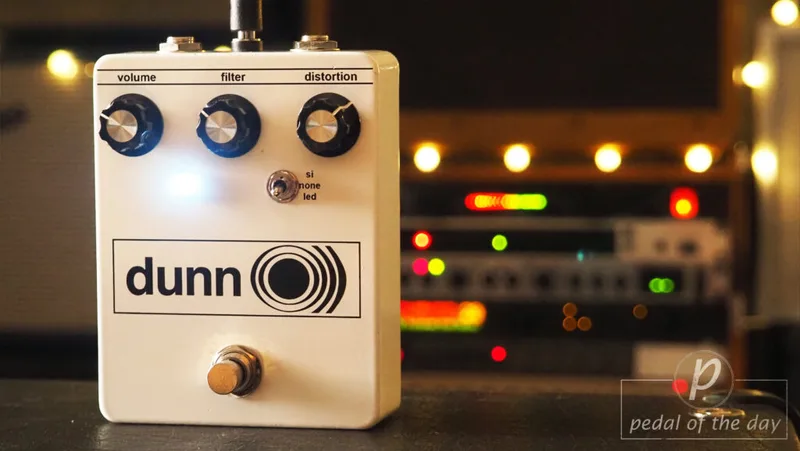


The Dunn Effects Deceiver Distortion is a grinding, brutal, in-your-face distortion pedal, in the words of Pedal of the Day's 2024 review. It is built on the classic white-faced RAT pedal specs, using the famed LM308N op-amp chip, and it adds a three-way clipping toggle that gives three distinct voicings from one circuit. The reviewer described it as bringing the classic RAT topology to the table, then cranking it up a couple notches for good measure.1
The Deceiver does not appear to be a current, widely available production pedal. Pedal of the Day's reviewer wrote that "it must be really rare, or a one-off, or discontinued or something," noting that little information is available online about it.1
The controls
The Deceiver keeps a familiar three-knob layout. According to Pedal of the Day, "the usual controls are Volume, Filter and Distortion," the same arrangement players know from RAT-style pedals.1
| Control | What it does |
|---|---|
| Volume | Sets the pedal's output level1 |
| Filter | Tones down or opens up the high end, in the manner of a RAT-style filter knob1 |
| Distortion | Sets the amount of drive and grit1 |
The In and Out jacks are top-mounted, which helps the pedal fit cleanly on a crowded board.1
The clipping toggle
The Deceiver's distinguishing feature is a 3-way toggle switch that allows you to choose from silicon clipping, LED clipping, or no clipping. Each position changes how the pedal distorts1:
- Silicon clipping: the firmer, more compressed hard-clipping character most players associate with a distortion pedal1
- LED clipping: a different clipping flavor, generally a looser, more open compression curve1
- No clipping: the op-amp stage runs without diodes in the feedback loop, for a louder, more overdriven character1
Because the toggle sits between these three options, the Deceiver covers territory from a standard distortion pedal through to a more open, overdrive-adjacent voice, all in one enclosure1.
Circuit and character
The circuit utilizes the famed LM308N op-amp chip, the chip long associated with the classic RAT. Pedal of the Day described the result as "bringing the classic Rat topology to the table, then cranking it up a couple notches for good measure," and summed up the pedal as "a grinding, brutal, in-your-face distortion pedal."1
"Based on the classic white-faced RAT pedal specs we all love"
Guitar and bass
The Deceiver is not a guitar-only design. The Pedal of the Day reviewer said it "sounds awesome on both guitar and bass," which puts it in the camp of drive pedals bass players can run as a gritty, aggressive boost or overdrive-style layer in front of their amp.1
Availability
Dunn Effects' Deceiver is a hard pedal to pin down. As of the October 2024 review, the reviewer characterized it as really rare, or a one-off, or discontinued or something, with little information available online. Players who come across one secondhand are looking at a pedal that does not appear in regular retail channels.1
Videos
MrExcane
MrExcane
Pedal of the Day
Questions
Is the Dunn Effects Deceiver a RAT clone?
Pedal of the Day describes the Deceiver as based on the classic white-faced RAT pedal specs, bringing the classic RAT topology to the table and then cranking it up a couple notches. So it is RAT-derived rather than a straight copy: the circuit uses the same famed LM308N op-amp chip associated with the RAT, but the reviewer characterizes it as a hotter, more aggressive take on that design rather than an identical circuit.
What does the clipping toggle on the Dunn Deceiver do?
A 3-way toggle switch lets you choose from silicon clipping, LED clipping, or no clipping at all. Silicon clipping is the firmer, more compressed style of distortion, LED clipping is a different flavor of hard clipping, and the no-clipping setting runs the circuit open for a looser, more overdriven character. It effectively gives the pedal three distinct distortion voicings in one box.
Which op-amp chip does the Dunn Deceiver use?
The circuit utilizes the famed LM308N op-amp chip, according to Pedal of the Day. That chip is closely associated with the classic RAT distortion pedal, which the Deceiver's circuit is based on, so it sits at the heart of the pedal's grinding, aggressive character.
Does the Dunn Deceiver work on bass?
Yes. The Pedal of the Day reviewer said it sounds awesome on both guitar and bass, so bass players can run it as a gritty, aggressive drive in front of their amp without it being a guitar-only design.
Is the Dunn Effects Deceiver still made?
Its status is unclear. The Pedal of the Day reviewer noted that it must be really rare, or a one-off, or discontinued or something, and that little information is available online. If you see one secondhand, it is worth a closer look, since it does not appear to be a current, widely distributed production pedal.
Sources (1)
- Dunn Effects Deceiver Distortion, Pedal of the Day, 2024-10-31