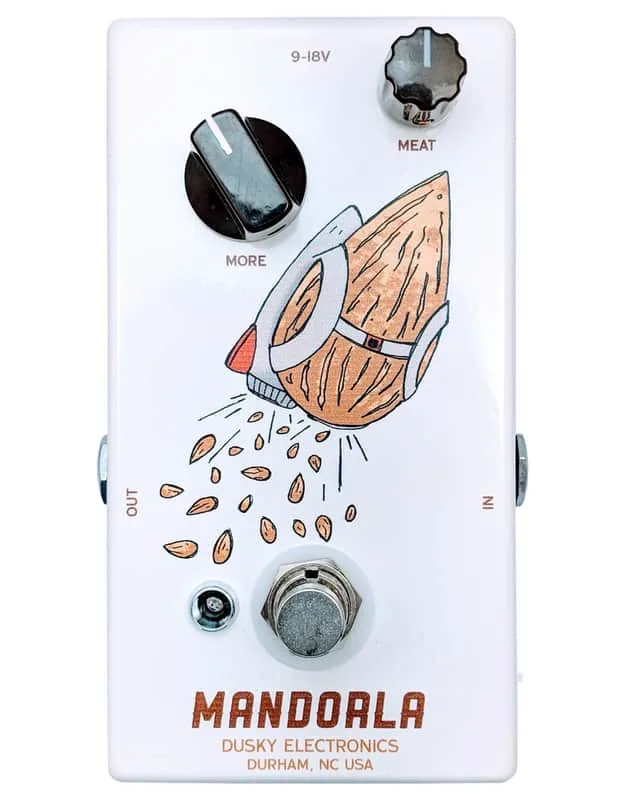


The Dusky Electronics Mandorla is a colored boost pedal: a boost that adds gain and harmonic color of its own rather than staying perfectly transparent. It is built around a MOSFET gain circuit inherited from vintage treble boost pedals of the '60s, and Delicious Audio's Paolo De Gregorio described the result as "a sound not unlike old tweed-era tube amps: clean, but colored"1. The pedal was announced with a street date of February 26, 2018 and a street price of $1602.
A colored boost that stays clean
The Mandorla sits between a transparent clean boost and a drive pedal. Premier Guitar's announcement put the mechanism plainly: "It produces gobs of even-order harmonic distortion without clipping"2. Even-order harmonics are the same flavor of richness associated with warm tube amps, so the pedal thickens and colors the signal without the hard flattening of the waveform that gives overdrive and fuzz their grit. For a player, that means it can push a clean tube amp into overdrive on its own: MusicRadar noted the analog boost has "enough gain to push a clean tube amp into overdrive"4.
The circuit's lineage matters to how it behaves. It is based around MOSFET transistors and inspired by '60s treble boosters4, and Delicious Audio described the "dirt" as coming from a MOSFET gain circuit inherited from those vintage designs1. Dusky's designer framed the intent this way:
"The concept for the Mandorla is to play to the inherent, delicious non-linearity of the MOSFET transistor to showcase a circuit that misbehaves in the most beautiful way possible."
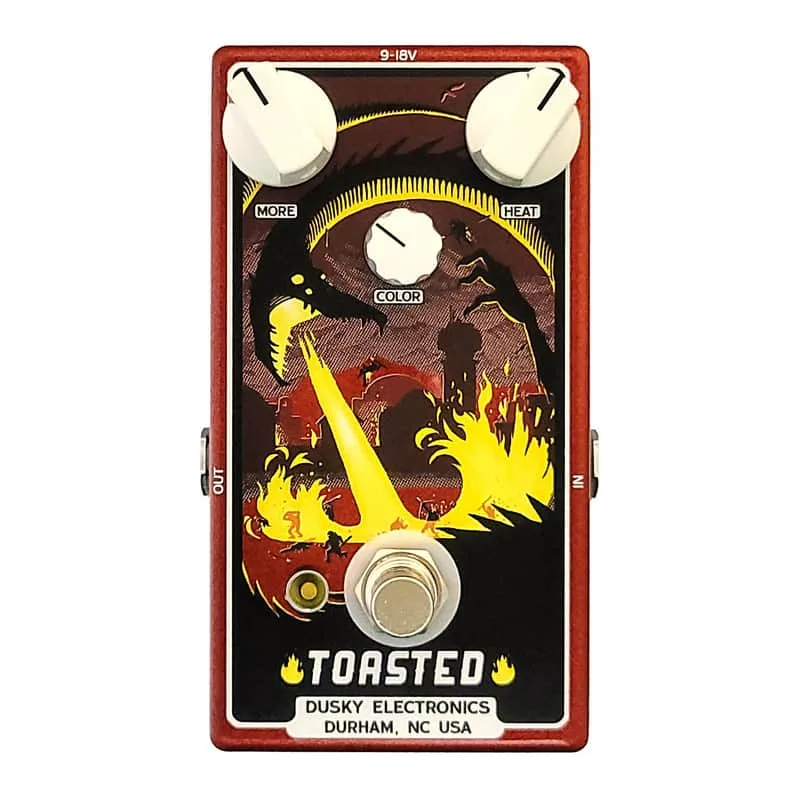
Premier Guitar's reviewer also noted the hand behind it: "It makes sense that Mandorla comes from the mind of an amp builder"3. If you want a comparison point on the same maker's bench, Dusky also makes the Toasted Drive, and the Mandorla belongs to the broader family of boost pedals rather than overdrive pedals, distortion pedals or fuzz pedals.
The controls
The Mandorla is a two-knob stompbox1:
The Meat knob is the voicing control, and it sweeps a wide range. All the way down, the voicing is very similar to vintage treble boosters; all the way up, it becomes a full range booster with tons of low end1. That flexibility is what separates the Mandorla from a fixed-voiced treble booster: at low Meat settings it can cut a band mix the way a '60s unit would, and at high settings it keeps the bottom intact.
Instruments and power
The Mandorla is not guitar-only. Dusky's product page says it "isn't just for guitar, it sounds great on bass, keyboard, or any electric instrument"1, and MusicRadar likewise described it as designed for use on guitar, bass and keyboard4. Bass players looking at colored boosts can read more in bass pedals.
The Mandorla hit the streets on Feb 26, 2018, with a street price of $160, and can be purchased directly from Dusky Electronics via their website, duskyamp.com, or at one of their dealers2.
What reviewers said
Premier Guitar's reviewer came away with a verdict that places the pedal above a simple volume push, describing "something better: a seamless interface between guitar and amp that retains the personality of both while expanding the tonal range of each overall sound"3. The same review listed the street price as $1603.
Videos
Dusky Electronics
Eric Haugen Guitar
Eirik Stordrange
Questions
Does the Mandorla work on bass?
Yes. Dusky's own product page says the Mandorla "isn't just for guitar" and sounds great on bass, keyboard, or any electric instrument. MusicRadar likewise described it as designed for use on guitar, bass and keyboard, so bass players can treat it as a full-range colored boost rather than a guitar-only effect.
What power supply does the Dusky Mandorla need?
Premier Guitar's announcement lists operation from 9 to 18V power supplies, so a standard 9V DC pedal supply works, and the circuit also tolerates higher-voltage supplies within that range. As with any pedal, use an isolated supply rated for the pedal rather than assuming a daisy chain will behave the same.
Is the Mandorla a fuzz or an overdrive?
Neither, exactly. It is a colored boost: a pedal that adds gain and harmonic color while staying on the clean side. Premier Guitar's announcement says it produces even-order harmonic distortion without clipping, and Delicious Audio compares its sound to old tweed-era tube amps, clean but colored.
Is the Mandorla analog?
Yes. MusicRadar described the Mandorla as an analogue boost built around MOSFET transistors, inspired by '60s treble boosters. There is no digital processing in the circuit; the color comes from the way the MOSFET gain stage reacts to the signal.
Sources (5)
- Dusky Electronics Mandorla Boost, Delicious Audio, 2019-06-18
- Dusky Electronics Announces the Mandorla, Premier Guitar, 2018-02-16
- Quick Hit: Dusky Mandorla Review, Premier Guitar, 2018-05-22
- Dusky Electronics unveils Mandorla boost pedal, MusicRadar, 2018-02-16
- Dusky Electronics launches new boost pedal, Guitar.com, 2018-02-19