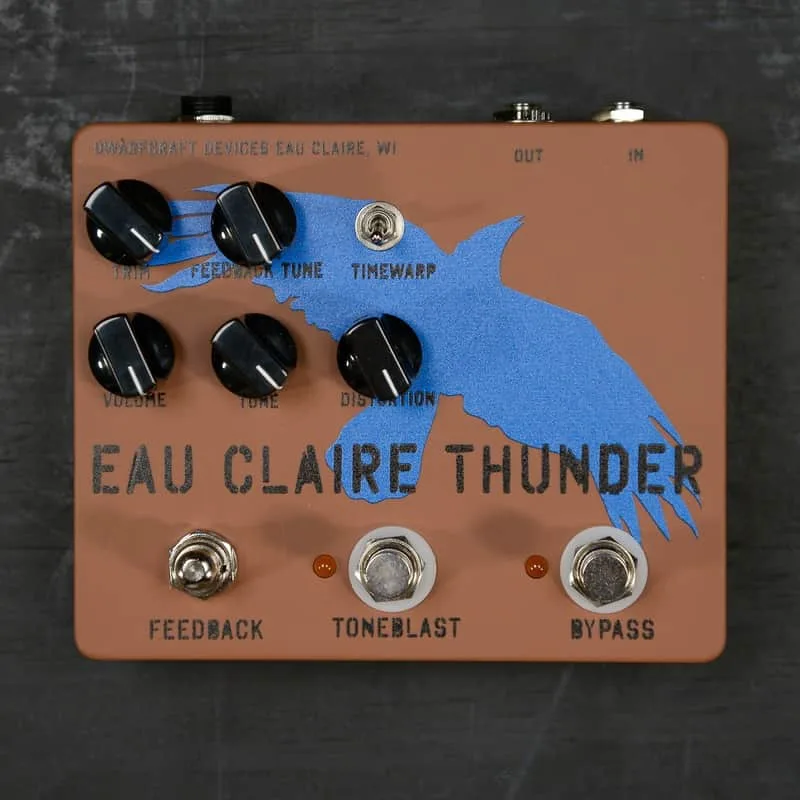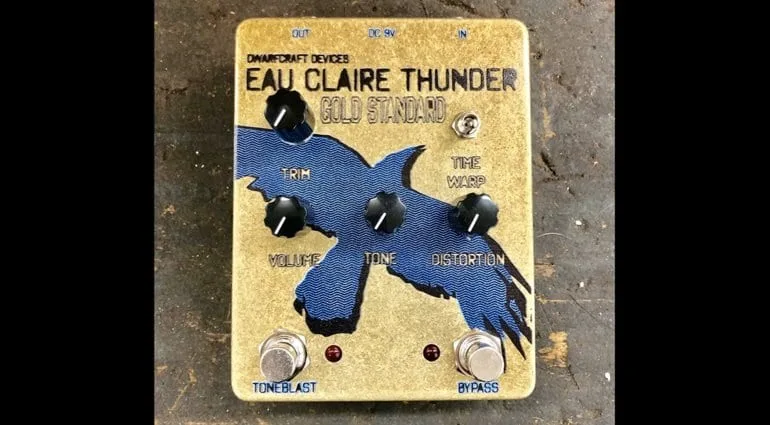


The Eau Claire Thunder Gold Standard is a limited-edition version of the Eau Claire Thunder, the flagship distortion pedal from Wisconsin builder Dwarfcraft Devices. Announced in May 2019, it reworks the original circuit with germanium clipping diodes and NOS (new-old-stock) Fairchild 2n5133 transistors, packs it into a smaller enclosure with top-mounted jacks, and drops the feedback loop section that made the original Thunder famous among experimental players12.
The component swap changes the character. According to the builder's own description, the NOS transistors decrease the gain, making this version of the circuit warmer, a little more "wooly," and somewhat more versatile than the original13. Delicious Audio summed it up as not as extreme as the original, but more detailed4.
A warmer, woolly take on the Eau Claire Thunder
The original Eau Claire Thunder was, in Delicious Audio's words, "the pedal that put Wisconsin's pedal builder Dwarfcraft Devices on the map in the early aughts"4. Its name comes from the bad weather of the company's hometown, Eau Claire, Wisconsin5. At its core is a standard volume, tone, gain arrangement, and Delicious Audio's 2012 review described the result as "a distortion that is much less tubby and bouncy than a Muff derivative"6.
The Gold Standard keeps that lineage but shifts the voicing. The gain is lower than on the standard version, and Gearnews described the result as a warmer circuit that is a touch more woolly2. Guitar World's announcement framed it the same way, reporting that the use of NOS transistors decreased the gain, making the circuit warmer, a little more "wooly," and somewhat more versatile than what it called the balls-out original1.
"The gain is lower than on the standard version, and the result is a 'warmer' circuit that's a touch more 'woolly.'"
For a player, that means the Gold Standard leans less on sheer aggression and more on texture. Gearnews' reviewer, listening to the available demos, called it "a warm-sounding boutique dirt/fuzz box that could be perfect for down-tuned riffs and sludgey guitar chords," while admitting it is an acquired taste2.
Controls and layout
The Gold Standard carries four knobs, a toggle, and two footswitches, a simpler panel than the original Thunder's2.
| Control | What it does |
|---|---|
| Volume | Output level2 |
| Tone | Shapes the frequency balance2 |
| Trim | Fine adjustment within the circuit2 |
| Distortion | Gain amount2 |
| Time Warp switch | Controls a clipping diode13 |
| Bypass footswitch | Standard on/off2 |
| Tone Blast footswitch | Bypasses the Tone control for more volume and a fuller frequency response23 |
The Toneblast switch is the one to know about: kicking it takes the tone control out of the signal path, which the announcement described as giving more volume and a fuller frequency response3. The Timewarp toggle switches a clipping diode, changing the clipping character13.
The enclosure is a smaller, streamlined box with top-mounted jacks, which Gearnews noted makes it "a bit friendlier with your average pedal board" than the original2. The original Thunder was housed in a die-cast enclosure with sturdy metal construction and heavy-duty footswitches6.
Germanium diodes and NOS transistors
The Gold Standard's name refers to its component choices: germanium clipping diodes and NOS Fairchild 2n5133 transistors, selected for what the announcement called a vintage Muff vibe123. Germanium diodes clip at a lower threshold than the silicon diodes in most distortion pedals, which is part of why the builder describes the result as warmer and woollier rather than harder-edged.
The NOS transistors are also the reason the run was limited. The press release stated that because of the choice of transistors, only a small number could be built, since the Fairchild 2n5133 is a vintage part available only in leftover stock3.
Does the Gold Standard have the feedback loop?
No. This is the biggest functional difference from the original. Delicious Audio reported that the Gold Standard is "more compact and streamlined," stripped of the feedback loop section, meaning the Feedback footswitch and Feedback Tune knob are gone4.
On the original Thunder, that feedback loop was a signature feature: the Feedback Tune knob tunes an internal feedback loop's oscillation frequency, letting the pedal self-oscillate into squeals and other noises6. Players who want that behavior need the original, not the Gold Standard.
Limited edition and versions
The Gold Standard was a one-time limited run, and the press disagreed on exactly how many were built124:
- Premier Guitar's press release: 65 units3
- Guitar World: 73 pedals1
- Gearnews: 73 units worldwide2
- Delicious Audio: a limited run of 70 units4
The run was constrained by the supply of NOS Fairchild 2n5133 transistors3. Whatever the exact count, all of these figures describe a small batch, and the pedal is long sold out.
Where it sits in the fuzz and distortion overlap
The press split on what to call it. Guitar World called it an update of the company's flagship distortion pedal1; Gearnews called it a boutique dirt/fuzz box2; Delicious Audio called it a Muff-style fuzz box4. All three fit, because the underlying Eau Claire Thunder circuit is Big Muff-derived. Coda Effects' technical analysis of the Big Muff circuit notes that the Thunder takes a Muff-style circuit and removes the tone stack, giving what it calls an "in your face" sound with a lot of mids7. That mid-forward, tone-stack-less design is why the Thunder reads as more aggressive and less scooped than a typical fuzz pedal, and why the Gold Standard's lower-gain, germanium-clipped take on it lands closer to warm sludge than buzzsaw.
Videos
Pedals and Effects
Eirik Stordrange
theonetrueaen
Questions
How many Eau Claire Thunder Gold Standard pedals were made?
Reports disagree on the exact number. Guitar World and Gearnews both said the run was limited to 73 units worldwide, while Delicious Audio later reported a limited run of 70. The original press release at Premier Guitar gave a figure of 65, tied to the choice of NOS Fairchild 2n5133 transistors, which were only available in finite quantities.
How is the Gold Standard different from the original Eau Claire Thunder?
The Gold Standard uses germanium diodes and NOS Fairchild 2n5133 transistors instead of the original's component choices, which lowers the gain and makes the circuit warmer and woollier. It also comes in a smaller, streamlined enclosure with top-mounted jacks, and it drops the original's feedback loop section, the Feedback footswitch and Feedback Tune knob.
Does the Gold Standard have the feedback loop?
No. Delicious Audio reported that the Gold Standard is more compact and streamlined than the original Eau Claire Thunder, stripped of the feedback loop section, meaning the Feedback footswitch and Feedback Tune knob are gone. Instead it carries a Time Warp switch plus Bypass and Tone Blast footswitches.
Is the Eau Claire Thunder Gold Standard a fuzz or a distortion?
Both descriptions appear in the press. Guitar World called it an update of Dwarfcraft's flagship distortion pedal, while Gearnews described it as a warm-sounding boutique dirt and fuzz box, and Delicious Audio called it a Muff-style fuzz box. The underlying Eau Claire Thunder circuit is Big Muff-derived, so it sits in the fuzz and distortion overlap.
What did the Eau Claire Thunder Gold Standard cost?
It retailed at $229 when it was announced in 2019, a figure given by Premier Guitar, Guitar World and Gearnews. A later Boris-themed Eau Claire Thunder run in 2020 carried a higher USD 279 recommended retail price.
Sources (7)
- Dwarfcraft Unveils New Eau Claire Thunder Gold Standard Distortion, Guitar World, 2019-05-30
- Dwarfcraft Gold Standard Eau Claire Thunder: A limited run of only 73 units, gearnews.com, 2019-06-03
- Limited-Edition Eau Claire Thunder by Dwarfcraft, Premier Guitar, 2019-05-29
- Dwarfcraft Devices Eau Claire Thunder Gold Standard, Delicious Audio, 2020-04-27
- Dwarfcraft Devices closes down, issues special Eau Claire Thunder fuzz pedals, gearnews.com, 2020-04-20
- Pedal Review: Dwarfcraft Devices Eau Claire Thunder, Delicious Audio, 2012-01-12
- Coda Effects, Coda Effects, 2026