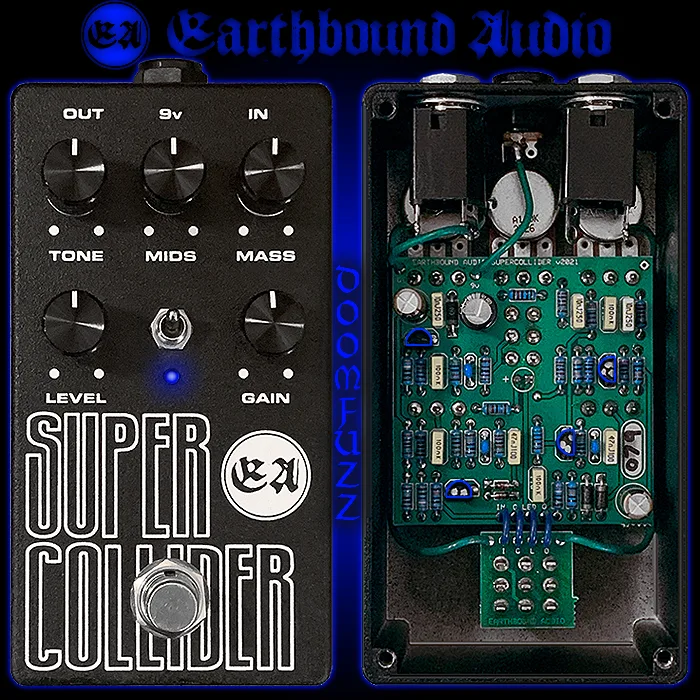


The Earthbound Audio SuperCollider is a fuzz pedal from Earthbound Audio, pitched at heavy players: Guitar Pedal X describes its sound as plenty of gain and saturation underpinned by hefty low-end Mass, and labels it a Doom Fuzz1. Under the hood it is a four-transistor Big Muff derivative, but with Earthbound Audio's own Depth and Mids controls added, and a toggle switch that selects between LED and silicon clipping12.
Production has ended. Guitar Pedal X reported in June 2024 that the last 22 SuperColliders were made in February and March of that year, and that it is somewhat unlikely there will ever be more1. New units were $179; the GPX reviewer paid about £140 for his second-hand on Ebay1.
The controls and switches
Guitar Pedal X lists the control set as Tone, Mids, Mass, Level, a Gain Structure toggle (more gain up, less gain down) and Gain1. Pedal of the Day adds that the toggle lets you choose between LED or silicon clipping options2.
| Control | What it does |
|---|---|
| Gain | Sets the amount of drive and saturation1 |
| Gain Structure toggle | Two gain settings; the lower one clarifies the signal a touch1 |
| Clipping toggle | Selects LED or silicon clipping2 |
| Tone | Tone shaping1 |
| Mids | Midrange control, added on top of the Big Muff-style circuit4 |
| Mass | Low-end control, described by GPX as hefty earth-shattering low-end Mass1 |
| Level | Output volume1 |
The clipping toggle is the pedal's most distinctive feature. Per the Guitar FX Layouts technical analysis, the LED option uses two green LEDs, which are louder, less distorted and have more mids than the silicon diodes, and newer production SuperColliders had that switch built in as standard4.
A couple of builder observations from the Guitar FX Layouts comments are worth knowing if you use the pedal's range fully: one builder found the Mass knob seemed to work only in the last quarter of its travel, and another suggested a linear pot for volume might give better control4.
Where it came from
The SuperCollider is a small-batch pedal from Earthbound Audio, a Jersey-based company25. Guitar FX Layouts published a stripboard layout for it in September 2012, greeting it as yet another Muff-style circuit, but this time with added Depth and Mids controls4. Pedal of the Day featured it in August 2016 as a distortion/fuzz pedal23.
What reviewers said
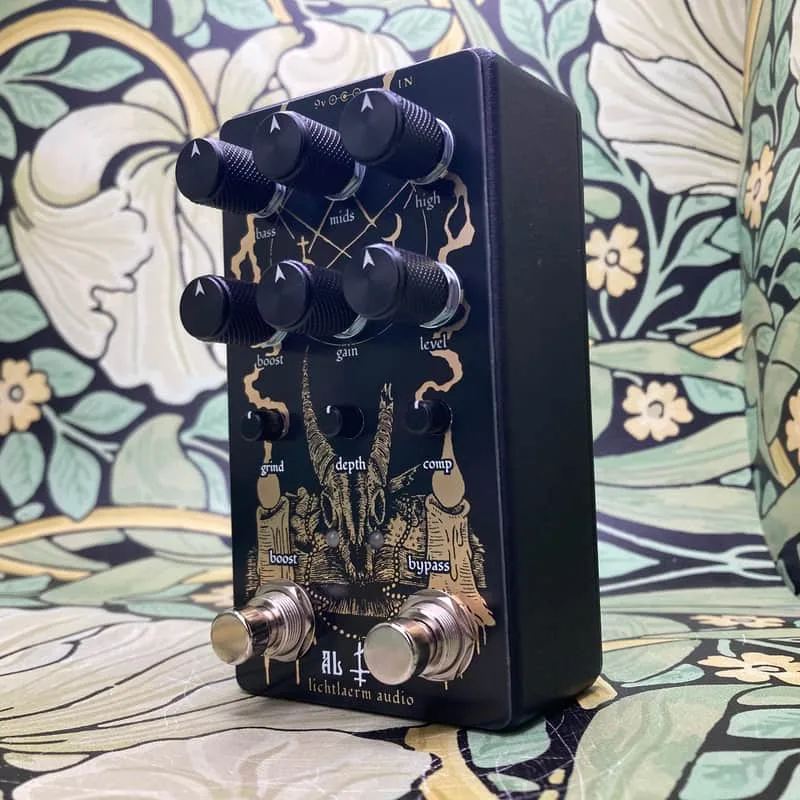
Guitar Pedal X's Stefan Karlsson, reviewing the pedal in June 2024, called it a most magnificent low-end saturation beast, while noting it was not quite at the level of his two standing favorites, the Blackhawk Balrog and the Lichtlaerm Altar1. He also shared a setting for doom and sludge playing: everything near maximum except the Mids and Gain controls, which he runs at around 3 o'clock for what he calls optimal Doom Sludge Tones1.
The Guitar FX Layouts builder verdict was similarly positive on the circuit itself: "It's a higher gain green Muff with effective tone controls. The depth pot works very well for guitar. It's also the quietest BMP variant I've built."4
Pedal of the Day's 2016 review positions the Supercollider for down-tuned guitar and heavy bass, which fits the Mass control's low-end emphasis1.
Players
Marissa Paternoster is documented as using the SuperCollider. In a Stompbox Book interview with Paternoster and Cynthia Ann Schemmer, it is described as one of Paternoster's favorite pedals, manufactured by Earthbound Audio5.
Videos
Prymaxe
Dennis Kayzer
Prymaxe
Questions
What circuit is the Earthbound Audio SuperCollider based on?
It is a four-transistor Big Muff derivative. Guitar Pedal X's Stefan Karlsson, writing in June 2024, described it as a small-batch, four-transistor Big Muff derivative, and the Guitar FX Layouts technical analysis called it a higher gain green Muff with effective tone controls. It is not a straight copy: Earthbound Audio added Depth and Mids controls of its own on top of the Big Muff-style topology.
Is the Earthbound Audio SuperCollider still in production?
No. According to Guitar Pedal X in June 2024, the last 22 SuperColliders were made in February and March 2024, and it is somewhat unlikely there will ever be more. New units were listed at $179; the reviewer paid about £140 for his second-hand on Ebay. Used examples are the practical route for players looking for one now.
What is the difference between the silicon and LED clipping on the SuperCollider?
The toggle switch selects between LED or silicon clipping. Per the Guitar FX Layouts analysis, the LED option uses two green LEDs, which are louder, less distorted and have more mids than the silicon diodes. Newer production SuperColliders had that switch built in as standard.
Which players are documented using the SuperCollider?
Marissa Paternoster is documented as using the SuperCollider. In a Stompbox Book interview with Paternoster and Cynthia Ann Schemmer, it is described as one of Paternoster's favorite pedals, manufactured by the Jersey-based company Earthbound Audio.
Is the SuperCollider a Big Muff clone?
Not exactly. It is built on a four-transistor Big Muff-style topology, but Earthbound Audio added its own Depth and Mids controls, and a toggle for LED or silicon clipping. Guitar FX Layouts summed it up as another Muff-style circuit, but this time with added Depth and Mids controls, and described it as a higher gain green Muff with effective tone controls.
Sources (5)
- Guitar Pedal X, Guitar Pedal X, 2024-06-12
- Earthbound Audio Supercollider Distortion/Fuzz, Pedal of the Day, 2016-08-23
- Earthbound Audio Supercollider Distortion Fuzz, Pedal of the Day, 2016-08-18
- Guitar FX Layouts: Earthbound Audio Supercollider, Guitar FX Layouts (tagboardeffects.blogspot.com), 2012-09-28
- Visiting Marissa Paternoster, Stompbox Book (stompboxbook.com), 2020-02-08