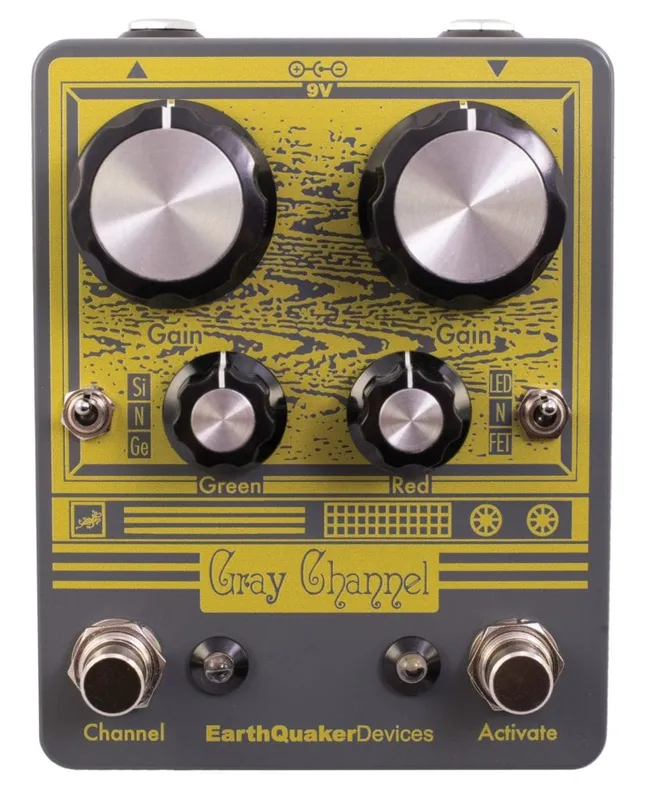


The EarthQuaker Devices Gray Channel is a dual-channel overdrive pedal: two independent hard-clipping overdrive circuits in one box, each with its own Gain and Level knobs and its own three-position clipping toggle. EarthQuaker Devices describes it as "two channels of a simple hard clipping overdrive that leaves the character of the guitar and amp intact"1.
The circuit is a tribute with a wink. EarthQuaker Devices says it is "based around a classic hard-clipping gray box overdrive (subtle hint, huh), one of my all-time favorites," and adds that this same classic circuit is the pedal that got the maker started building pedals and launched the company1. Delicious Audio's reviewer called the result "a real 'twofer' of an overdrive"2.
The Gray Channel is no longer in production. EarthQuaker Devices lists it on its legacy page of discontinued pedals3, so it is found on the used market today.
Two channels of the gray box
Each channel is a take on that classic gray box overdrive, but the two are not identical. The Green channel offers Silicon, Germanium or no clipping diodes, while the Red channel offers LED, Mosfet or no clipping diodes1. EarthQuaker Devices says the pedal "retains the classic warm overdrive sound and expands upon it with several clipping options and bigger bass response"1.
The two channels are selected by the Channel footswitch, so one runs at a time. That makes the pedal less a stacking machine and more a two-voice overdrive: a rhythm setting on one channel, a lead setting on the other, each with its own gain structure and clipping character152.
The controls
The control set is deliberately minimal. Each channel has a Gain knob and an Output Level knob, plus a three-position clipping toggle, and the Channel footswitch selects between Red and Green15.
| Control | Channel | What it does |
|---|---|---|
| Gain | Green and Red | Adjusts the drive; dirtier clockwise, cleaner counterclockwise1 |
| Output Level | Green and Red | Sets the channel's output volume5 |
| Clipping toggle | Green | Si (Silicon), Ge (Germanium) or N (no diodes)1 |
| Clipping toggle | Red | LED, FET (Mosfet) or N (no diodes)1 |
| Channel footswitch | Both | Selects between Red and Green channels1 |
Pedal of the Day noted one practical detail: the Gain knobs are oversized, "so much so that, with a little practice, you can adjust them on the fly with your foot, right in the middle of a performance"5.
What each clipping mode does
The clipping diodes are where the six voices live, and both the maker and reviewers described how each behaves15.
| Mode | Channel | Character |
|---|---|---|
| Si | Green | Bright, loud and fuzzy with a natural tube-type break up1 |
| Ge | Green | A little looser, with more lows and warmth and less output2 |
| N | Green | Clean boost until roughly 1 o'clock on the Gain, then op amp saturation into a biting, loud distortion2 |
| LED | Red | The loudest, cleanest and most touch sensitive, least compressed1 |
| FET | Red | Mosfet clipping diodes1 |
| N | Red | The same clean-to-crazy-loud op amp distortion setup as the Green channel2 |
The N modes deserve a note of their own. With no clipping diodes in the circuit, the overdrive character comes from the op amp itself, which is why the Green channel's N mode behaves as a clean boost at low Gain settings before the op amp saturates2. Pedal of the Day summed up the range: "there are an insane amount of tonal options lurking within these modes, and when combined with the Gain knobs, you can really dial in any type of overdrive sound"5.
Power, switching and connections
The Gray Channel runs on a standard 9V DC supply with a 2.1mm negative center barrel and draws 45 mA1.
The pedal is true bypass with electronic relay-based switching, and EarthQuaker Devices states that audio will not pass without power1. A dead supply means silence, not a dry passthrough.
Delicious Audio described the switching as relay-based "soft touch" switching, and noted that each Gray Channel was built one at a time at a former automotive paint factory in Akron, Ohio2.
Where it came from and where it went
EarthQuaker Devices listed the Gray Channel as the "Dynamic Dirt Doubler" at USD 195.004. The circuit it honors, that gray box hard-clipping overdrive, is also the pedal EarthQuaker Devices credits with getting the company started building pedals in the first place1.
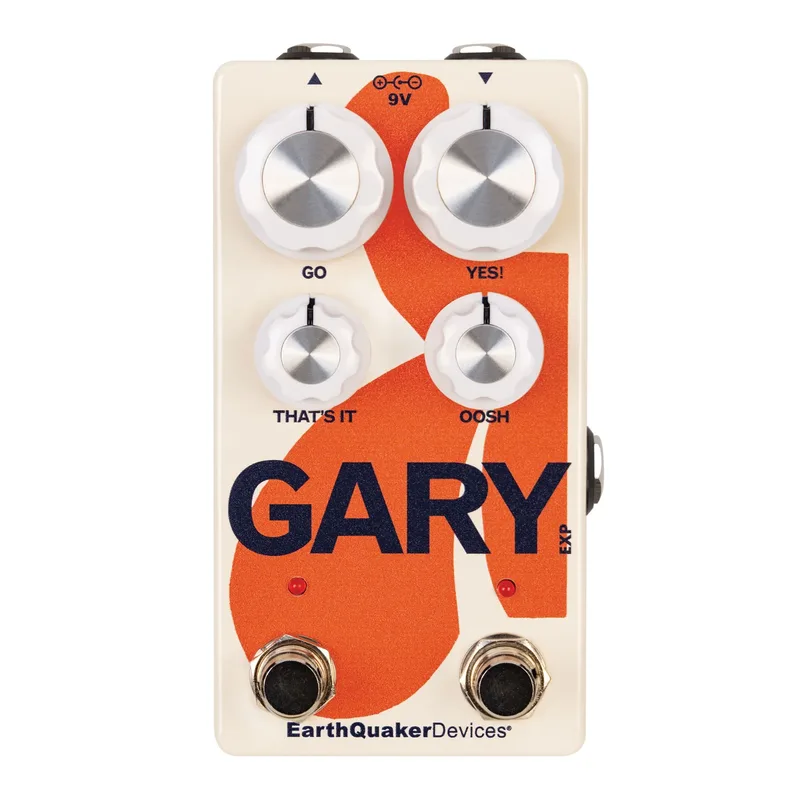
The pedal is now discontinued13, but its Green channel survived. In November 2024, EarthQuaker Devices and IDLES guitarist Lee Kiernan released the Gary, a dual overdrive/fuzz pedal whose overdrive side is based on the Gray Channel's Green channel, featuring just that one channel6.
What reviewers said
Delicious Audio's Paolo De Gregorio reviewed the Gray Channel in March 2018 and came away positive, calling it "a real 'twofer' of an overdrive" built around one of his all-time favorite pedals, and confirming that it "retains the classic warm overdrive sound and expands upon it with several clipping options and bigger bass response"2.
"there are an insane amount of tonal options lurking within these modes, and when combined with the Gain knobs, you can really make any type of overdrive sound you desire come to life."
Both reviews point the same way: the Gray Channel's appeal is not one sound but the spread of sounds, from warm low-gain overdrive to op amp distortion, inside a two-knob-per-channel layout125.
Videos
ProGuitarShopDemos
ProGuitarShopDemos
EarthQuakerDevices
Questions
Is the Gray Channel still in production?
No. EarthQuaker Devices lists the Gray Channel as no longer in production, and it appears on the maker's legacy page alongside other discontinued pedals. Used units are the way players find one today. Its Green channel circuit was carried forward into the Gary collaboration pedal with IDLES' Lee Kiernan, released in late 2024.
Does the Gray Channel pass signal without power?
No. The pedal is true bypass with electronic relay-based switching, and EarthQuaker Devices states plainly that audio will not pass without power. If your power supply fails mid-gig, the Gray Channel goes silent rather than passing a dry signal, so a reliable 9V supply matters.
Can you use both channels of the Gray Channel at once?
No. The Channel footswitch selects between the Red and Green channels, so one channel is active at a time. What the two channels give you is two fully independent overdrive voices, each with its own Gain and Level settings and its own three clipping modes, ready to swap between.
What does the N mode on the Gray Channel do?
N stands for no clipping diodes. On the Green channel, Delicious Audio found it acts as a clean boost until roughly 1 o'clock on the Gain knob, then saturates the op amp into a biting, loud distortion. The Red channel's N mode is the same clean-to-loud op amp distortion setup.
Sources (6)
- Gray Channel Dynamic Dirt Doubler, EarthQuaker Devices
- EarthQuaker Devices Gray Channel Overdrive, Delicious Audio, 2018-03-19
- Legacy Products, EarthQuaker Devices
- Earthquaker Devices launch eight new pedals at NAMM, gearnews.com, 2016-01-17
- EarthQuaker Devices Gray Channel Overdrive, Pedal of the Day, 2017-03-01
- Earthquaker Devices Gary Modulated Fuzz + Overdrive, Delicious Audio, 2024-11-14
 Lee Kiernan