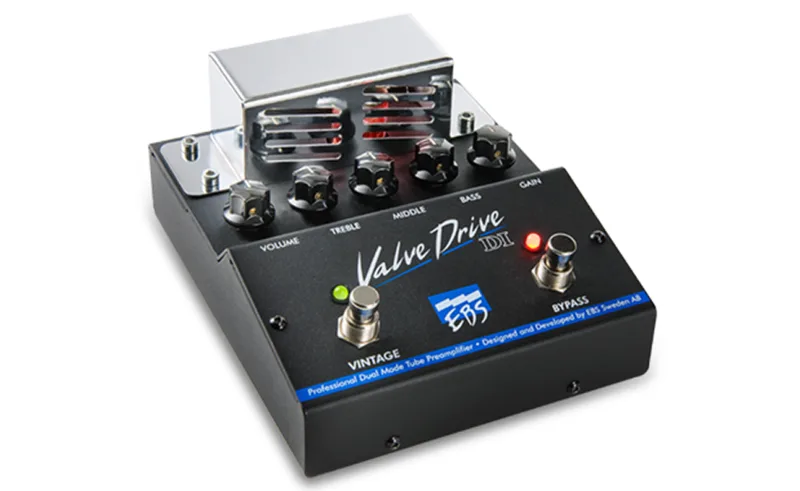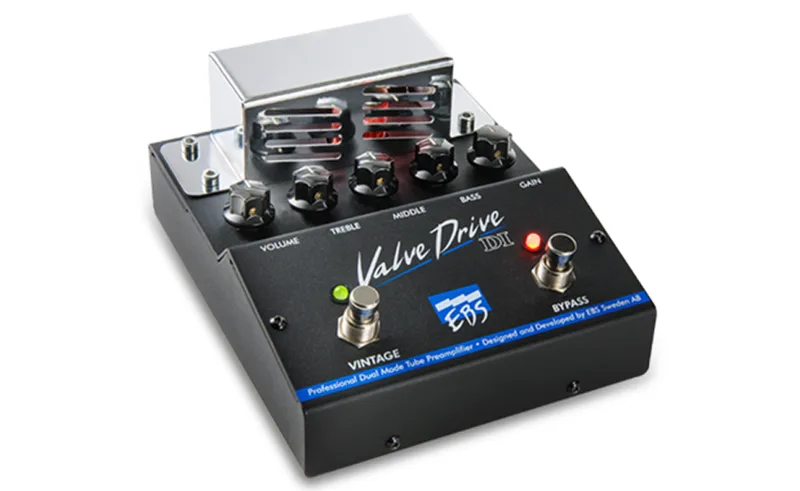


The EBS ValveDrive DI is a tube preamp and overdrive pedal for bass, built around a high-quality ECC83 (12AX7) tube that EBS says delivers an authentic tube feel1. It is an all-analog, high-grade tube design aimed at bass players, and it can be used as a preamp, as an overdrive pedal, or both1. MusicRadar's review team described it as a valve-driven preamp with DI box functions, "ideal for adding some tonal boost, colour and drive to your sound at the kick of a switch"2.
What sets the DI version apart from a plain overdrive pedal is its output section: a balanced floating XLR output alongside a low-impedance 1/4-inch output, which lets it sit at the end of a pedalboard and feed a mixing desk directly1. EBS describes it as suitable for live and studio use1.
Controls and EQ
Classic-style passive filters control Volume, Treble, Middle, Bass and Gain1. The three EQ bands each work in a fixed frequency range:
| Control | Range | Character |
|---|---|---|
| Bass | 0 to 15 dB below 80 Hz | Bell1 |
| Middle | 0 to 12 dB at 400 Hz | Notch1 |
| Treble | 0 to 6 dB at 5 kHz | Shelving1 |
| Gain | -∞ to +26 dB, up to 60 dB ultra high gain distortion | 1 |
Because these are passive filters, the knobs do not behave like a flat-at-noon active EQ. EBS gives a specific starting point for a flat sound1:
A good starting point for a relatively flat response is Bass and Treble at minimum, with Mid at maximum1.
The pedal also offers Vintage or Normal modes, which EBS says give two different overall tube-drive characters, a vintage or a modern tube sound1. A -10 dB pad switch attenuates the output by 10 dB, useful when hitting the XLR output hard1.
Power and connections
The ValveDrive DI runs on 9V DC at 700mA, and an EBS 9V DC power supply is included in the box1. That current draw is the main practical consideration for pedalboard builders: EBS notes that the ValveDrive DI, like its MicroBass 3 and Stanley Clarke Signature Acoustic preamp, needs at least 700mA to operate correctly3.
If you do not use the included supply, EBS says to make sure your supply delivers 9V DC with at least 700mA. Two isolated outputs can be connected in parallel using the EBS DC1-48 90/0 PAR adaptor, which is available through the EBS webshop except in the US, where it is available from regular dealers only1.
On the output side, the balanced floating XLR output and the low-impedance 1/4-inch output are both marked as new features of the DI version1. Output impedance is 100 ohms, nominal input level is -10 dBv, and nominal output level is -10 dBv unbalanced and -20 dBv balanced1. Input impedance is 1 Mohm1.
Using it as a preamp and DI
The low-impedance 1/4-inch output replaced the former standard passive output, so the ValveDrive DI can be used as a stand-alone preamp with an external power amp4. MusicRadar framed the choice as yours: "whether you use it as a DI box or as an effects pedal"2. The pedal uses true bypass for the main effect path, so when it is off your dry signal passes through untouched1.
History: from the ValveDrive to the DI
The ValveDrive DI is a variant of the original EBS ValveDrive, an overdrive/preamp pedal released in 20064. The original was powered by a 12V AC supply, converted to high voltage inside the pedal to give the tube the push it needed to deliver real tube distortion4.
The DI version shipped in February 2014, priced at £269 RRP inc VAT in the UK4. It changed the power arrangement to 9V DC with the supply included, and added the balanced XLR output14.
Do not confuse the ValveDrive DI with the original legacy ValveDrive, which used a completely different 12V AC supply1.
What reviewers said
MusicRadar reviewed the ValveDrive DI and found it far more versatile than its description suggests, concluding it is "far more useful than you can imagine - well worth the cost," though the review noted it is a little pricey overall2.
Videos
Prymaxe
Gilles Tantot
IvanBassist
Questions
Does the EBS ValveDrive DI work with a regular pedal power supply?
It runs on 9V DC and needs at least 700mA, which is more than most single isolated outputs on a typical pedalboard supply deliver. A 9V DC power supply is included with the pedal. If you use your own supply, EBS says it must deliver 9V DC with at least 700mA, or you can combine two isolated outputs in parallel with the EBS DC1-48 90/0 PAR adaptor.
What is the difference between Vintage and Normal mode on the ValveDrive DI?
The two modes give two different overall tube-drive characters, which EBS describes as a vintage or a modern tube sound. Both are available on the same pedal, so you can switch between the two characters without changing the rest of your settings.
Can the EBS ValveDrive DI be used as a standalone preamp?
Yes. The former standard passive output was replaced with a low-impedance output, so you can run the ValveDrive DI straight into an external power amp and use it as a stand-alone preamp. EBS also describes it as suitable for live and studio use.
Is the EBS ValveDrive DI true bypass?
Yes, the pedal uses true bypass for the main effect path. If you plan to use it in a DI setup, it is worth testing how the bypass behaves in your signal chain before a show.
How do you set the ValveDrive DI EQ flat?
EBS says a good starting point for a relatively flat response is Bass and Treble at minimum, with Mid at maximum. From there you can push the Bass control for lows under 80 Hz, the Mid control around 400 Hz, and Treble around 5 kHz.
Sources (4)
- Valve Drive, EBS Professional Bass Equipment (ebssweden.com)
- EBS Valve Drive DI review, MusicRadar, 2015-01-04
- Dive Deeper into the EBS RUNSTEN®, EBS Professional Bass Equipment, 2025-09-25
- EBS Announces the EBS ValveDrive DI, Guitar Interactive Magazine, 2014-01-30