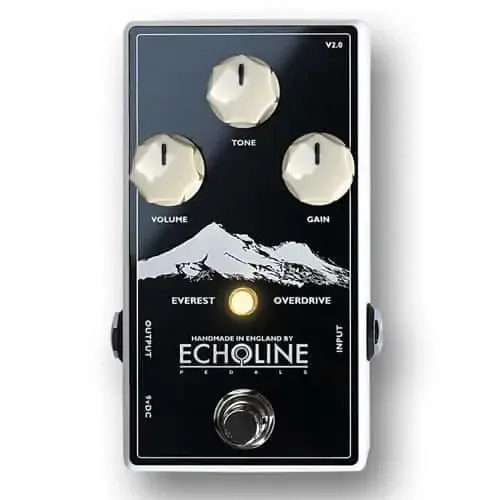


The Everest Overdrive is a medium-gain overdrive pedal from Echoline Pedals, hand-built in the UK. Its stated aim is to emulate the driven tone of valve amps, using an original circuit built around two NOS germanium diodes and Texas Instruments op-amps. Delicious Audio's Paolo De Gregorio described it as "a super responsive and articulate sounding medium gain overdrive pedal"1.
What it does to your sound
Echoline's design pairs the germanium diode clipping with a Class A line driver built into the pedal. The maker's stated intent is that the circuit "emulates the driven tone of valve amps"1. As a medium-gain drive, it sits in the same general territory as the pedals covered in the Boss SD-1 vs Ibanez TS9 Tube Screamer comparison: enough gain to push an amp or stand in for amp breakup, without crossing into distortion territory.
Delicious Audio's verdict was warm: "Responsive, rich and articulate, this simple three-knob drive might be what the doctor ordered to revive a stale tone!"1.
Controls and power
The Everest keeps its front panel to three knobs, the classic gain, tone and level arrangement, with no extra switches or menus documented1. That simplicity is part of how the pedal is presented: the character comes from the circuit rather than from tweaking.
Power is a standard 9vDC input with center negative polarity, the common arrangement for pedalboard supplies1.
The germanium diodes are described as NOS (new old stock) 1970s military spec parts1. NOS components are finite, so builds of pedals like this depend on the maker's stock of period parts.
Where it came from
Echoline Pedals builds the Everest by hand in the UK1. The pedal was covered by Delicious Audio in September 2020, in a write-up by Paolo De Gregorio1. Beyond that coverage, the Everest is a small-batch, hand-built pedal rather than a mass-produced product line.
Videos
AndyDemos
Niklas Guitar
shnobel
Questions
Does the Echoline Everest Overdrive use germanium diodes?
Yes. The Everest uses two NOS germanium diodes from the 1970s, described as military spec, as its clipping elements. They work alongside Texas Instruments op-amps in an original design that Echoline says emulates the driven tone of valve amps. Germanium clipping is a deliberate component choice rather than a generic part, and the diodes are a defining feature of the pedal's circuit.
What power supply does the Echoline Everest Overdrive need?
The Everest takes a standard 9vDC power input with centre negative polarity, the same arrangement used by most common pedal power supplies and daisy chains. No battery option or current draw figure is documented, so a standard 9V centre-negative supply is what to plan for when fitting it to a board.
What is the Class A line driver in the Everest Overdrive?
The Everest has a Class A line driver built in. A line driver is a stage that conditions the signal leaving the pedal, and Class A refers to a circuit design in which the amplifying stage is active across the whole signal cycle. Echoline presents it as a built-in feature of the pedal rather than an optional mode.
How many knobs does the Everest Overdrive have?
Three. Delicious Audio describes it as a simple three-knob drive, which is the standard gain, tone and level arrangement most overdrive players already know. The control layout is deliberately minimal, with the character of the pedal coming from the germanium diode clipping and the Class A line driver rather than from extra switches or menus.
Where is the Echoline Everest Overdrive made?
The Everest Overdrive is hand-built in the UK by Echoline Pedals. Hand-built construction is part of how the pedal is presented, alongside its use of NOS 1970s military spec germanium diodes, which are the kind of components typically sourced in limited quantities for small-batch builds.
Sources (1)
- Echoline Pedals Everest Overdrive, Delicious Audio, 2020-09-02