

The Ravish Sitar is a sitar emulator pedal made by Electro-Harmonix, launched at Summer NAMM in 20111. Its stated purpose is to "transform your electric guitar into a sitar"2, and it does this by splitting your signal into two synthesized voices: a lead sitar voice that follows what you play, and a sympathetic string voice that generates the resonant drone a real sitar produces from its undamped strings. Electro-Harmonix describes it as "a truly new design with the flexibility to be a crossover tonal wonder"2.
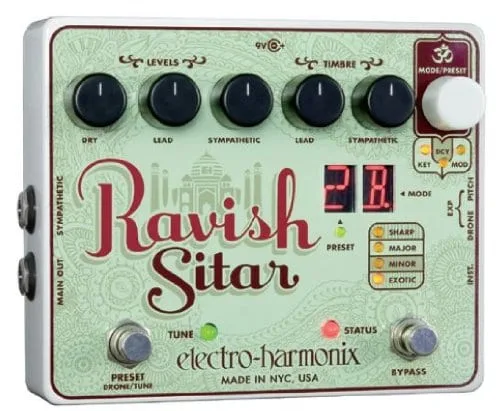
The pedal sits in a compact mint-green enclosure measuring 5 7/16" x 4 7/16", decorated with subtle paisley and Taj Mahal graphics3. It carries a list price of $277.40 on the maker's product page as of October 20262.
What it does to your sound
The Ravish does not simply filter your guitar tone toward a sitar. It generates two separate voices from your playing. The lead voice tracks your notes with a sitar-like character, and you can shape its "buzz" or "zing" with a dedicated timbre control2. The sympathetic voice produces the resonant, droning strings underneath, with its own timbre control and level2. A third level knob sets the amount of dry guitar signal, so the three elements can be balanced against each other4.
The lead voice also has a selectable decay speed, letting the note die away quickly like a plucked sitar string or ring longer2. Delicious Audio's review notes the decay time of the lead tone is adjustable as a parameter value from 0 to 94.
The controls: six knobs, two footswitches and an LCD
The front panel carries six knobs, two footswitches, nine LEDs, and an LCD readout3. The knob set breaks down into level controls for the dry, lead and sympathetic tones, timbre controls for the lead and sympathetic tones, and a Mode/Preset knob that switches between the various modes and the presets4.
| Control | What it does |
|---|---|
| LEAD LEVEL | Controls the amount of lead sitar signal at the main output2 |
| LEAD TIMBRE | Controls the "buzz" or "zing" of the lead tone2 |
| SYMPATHETIC TIMBRE | Controls the "buzz" or "zing" of the sympathetic strings tone2 |
| Level knobs (dry, lead, sympathetic) | Set the balance of the three voices4 |
| Mode/Preset knob | Switches between modes and presets4 |
The two footswitches do different jobs. The Bypass footswitch toggles between effect mode and bypass mode2. The Preset footswitch is more versatile: press and release it to load a selected preset; in Key mode, press and hold it to engage the custom tuning feature; in any mode other than Key mode, press and hold it to freeze the sympathetic strings2. Premier Guitar describes this as a footswitch that lets you select presets or hold the sympathetic strings in a drone "over which you can solo or play melodies"3.
The LCD readout displays the root note, and four LEDs just below it show whether you have dialed up a sharp of the raised root, or a major, minor, or exotic scale. The exotic scale is based on the Hindustani Bhairava scale, which Premier Guitar describes as a major scale with a flat second and flat sixth3.
Key mode and Mod mode
Key mode tailors the sympathetic tone for a given key by letting you select the scale that makes up the sympathetic voice3. You reach it by pressing the Mode/Preset knob until the Key LED is lit, then twisting the knob to run through the list of keys and scales, which include Sharp, Major, Minor and Exotic4.
One more press of the Mode/Preset button puts you in Mod mode, which adds a variable rate of modulation to the sympathetic strings to emulate a tanpura, the long-necked drone instrument that accompanies Indian classical music4.
Presets can be customized and stored, and key transpositions can be handled with the Preset switch when a root note is programmed via the presets3.
Inputs, outputs and expression
The pedal has an instrument input and two outputs4. The main output jack carries the dry, lead sitar and sympathetic string signals together2. The separate Sympathetic output lets you treat the drone as its own signal path: Premier Guitar notes that "by adding a second amp and routing your Sympathetic output through a phaser, things can still get weirder and more interesting"3, which opens up stereo-style setups.
There are two expression pedal inputs. One bends the pitch of the lead voice, by as much as an octave according to Delicious Audio's review4, while the other, labeled Drone Exp, takes an optional expression pedal for manual control of the Ravish's sympathetic strings2. The maker sums up the pair as allowing you to bend the pitch of the lead voice and control the volume of the sympathetic strings simultaneously2.
The Ravish Sitar runs on a 9.6VDC-200mA power adapter, which is included2. That voltage is higher than the 9V center-negative standard most pedalboards use, so plan power accordingly rather than assuming a standard daisy chain will work.
Where it came from
Electro-Harmonix launched the Ravish Sitar at Summer NAMM 20111, and the maker's product page lists 2011 as the year released2. Guitar World later included it in a roundup of modern pedals that conjure sixties sounds, noting that "Electro-Harmonix has streamlined the essence of the sitar into a compact enclosure"5.
What reviewers said
Premier Guitar's review is candid about authenticity: the Ravish "may not transform your guitar into a totally authentic-sounding sitar"3.
"And while it's not going to fool anyone familiar with the sound of a real sitar, like an electric sitar, it has a cool voice all its own."
With the manual's quick-start settings, which call for Dry at 2 o'clock, Lead at noon, Sympathetic at noon, Lead timbre at 3 o'clock, and Sympathetic timbre at 11 o'clock3, the reviewer found the Ravish "sounded much more like an electric sitar accompanied by a keyboard synth in the Sympathetic section"3. In other words, it is its own instrument rather than a replica, which is how the review frames its appeal.
Videos
ProGuitarShopDemos
Premier Guitar
EHX
Questions
Does the Ravish Sitar sound like a real sitar?
Not exactly. Premier Guitar's reviewer found it will not fool anyone familiar with a real sitar, but that it has a cool voice of its own, comparing it to an electric sitar. With the manual's quick-start settings, the reviewer heard something more like an electric sitar accompanied by a keyboard synth in the sympathetic section.
How do you hold a drone on the Ravish Sitar?
Press and hold the Preset footswitch. In any mode other than Key mode, holding that footswitch freezes the drone of the sympathetic strings, so you can solo or play melodies over a sustained drone. An expression pedal in the Drone Exp jack can also control the sympathetic strings' volume manually.
Can the Ravish Sitar run in stereo?
Yes, in effect. It has a separate Sympathetic output alongside the main output, and Premier Guitar suggests routing the Sympathetic output through a phaser into a second amp for stereo effects.
When did Electro-Harmonix release the Ravish Sitar?
Electro-Harmonix launched the Ravish Sitar at Summer NAMM in 2011, and the maker's product page lists 2011 as the year released.
Sources (5)
- Summer NAMM 2011: Electro-Harmonix launches the Ravish Sitar, MusicRadar, 2011-07-25
- Ravish | Sitar Emulator - Electro-Harmonix, Electro-Harmonix (www.ehx.com)
- Electro-Harmonix Ravish Sitar Pedal Review, Premier Guitar, 2011-11-15
- Pedal Review: Electro Harmonix Ravish Sitar, Delicious Audio, 2012-11-10
- Zero to Sixties in Five Pedals: Five Modern Effects that Conjure Far-Out, Vintage Tones, Guitar World, 2015-06-29