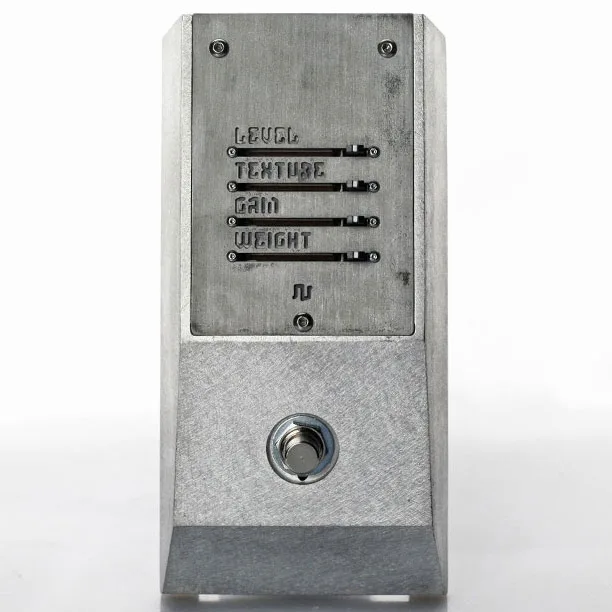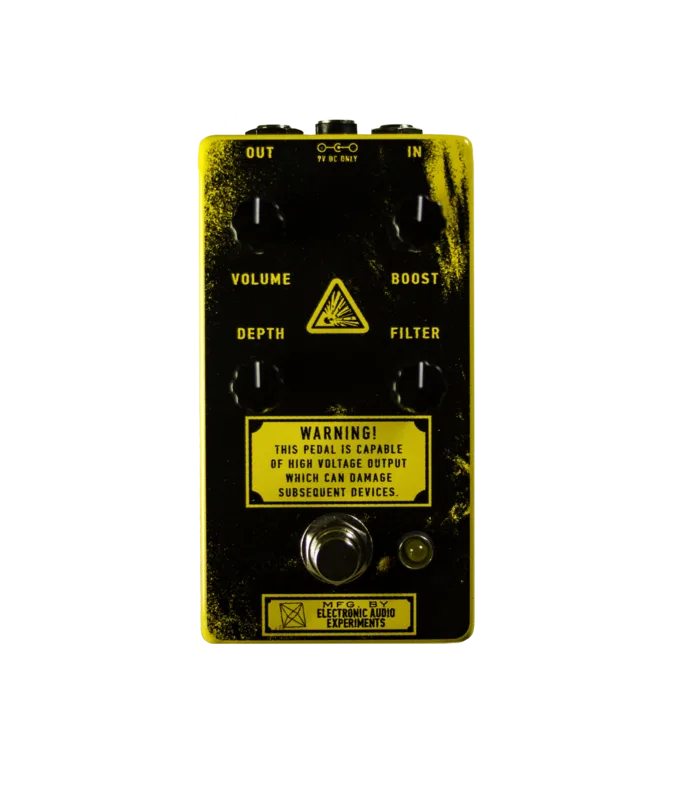
The Electronic Audio Experiments µ Blaster is a boost/overdrive pedal, named for its cascading stages of FET mu amps. Its defining trick is internal voltage conversion: by converting an incoming 9V power supply to about 27V, the pedal offers far more headroom than other comparable pedals, according to the maker. That means more clean space before the circuit compresses or distorts, which is why it works as both a boost and a light overdrive1.
Controls
The µ Blaster has four knobs, each with a distinct job:
| Control | What it does |
|---|---|
| Boost | Adds additional saturation and presence. Counterclockwise is clean and relatively dark, clockwise is brighter and moderately driven1 |
| Depth | Active bass control. Lower settings produce rangemaster-like tones with lots of chime, higher settings allow a huge amount of bass through; at max depth and boost there is an additional frequency boost in the 50 to 100Hz range1 |
| Filter | Simple low-pass filter at the output, useful for taming harmonic content from high Boost settings1 |
| Volume | Self explanatory, can deliver a massive output1 |
The Volume knob carries a warning from the maker: "Use judiciously, as high levels can damage certain input stages"1. In practice, that means rolling Volume back before feeding the front end of an amp or pedal with a sensitive input stage.
Power
The pedal runs from a standard 9V DC center negative power jack, the same supply type as most pedalboard pedals1. Inside, the circuit converts that incoming 9V to about 27V, which is where the extra headroom comes from1.
Version 1 and Version 2
The µ Blaster went through two versions in 2016:
| Version | Release | Notes |
|---|---|---|
| Version 1 | Spring and Summer 2016 | Original release with etched enclosures1 |
| Version 2 | November 2016 (current) | Increased usability of filter control1 |
The µ Blaster was produced in extremely low quantities during Electronic Audio Experiments' early DIY days, and the maker's page for it is retained for archival purposes1. Version 2, from November 2016, is the most recent version1.
Videos
Coastal Tone
Questions
Is the Electronic Audio Experiments µ Blaster true bypass?
Yes. Electronic Audio Experiments lists true bypass switching among the µ Blaster's additional features, alongside top-mounted jacks and a standard 9V DC center negative power jack.
What power supply does the µ Blaster need?
A standard 9V DC center negative power supply, the same type used by most pedals. The pedal then converts that incoming 9V to about 27V internally, which is what gives it more headroom than comparable boost and overdrive pedals.
What does the Depth knob do on the µ Blaster?
Depth is an active bass control. Lower settings produce rangemaster-like tones with lots of chime, while higher settings let a huge amount of bass through. At maximum Depth and Boost, the circuit adds an extra frequency boost in the 50 to 100Hz range.
Is the µ Blaster still in production?
No, not in any regular sense. Electronic Audio Experiments produced it in extremely low quantities during the company's early DIY days, and the product page is retained for archival purposes only.
Can the µ Blaster's Volume knob damage an amp?
It can. The Volume control can deliver a massive output, and Electronic Audio Experiments warns players to use it judiciously, because high levels can damage certain input stages.
Sources (1)
- µ Blaster, Electronic Audio Experiments, 2016