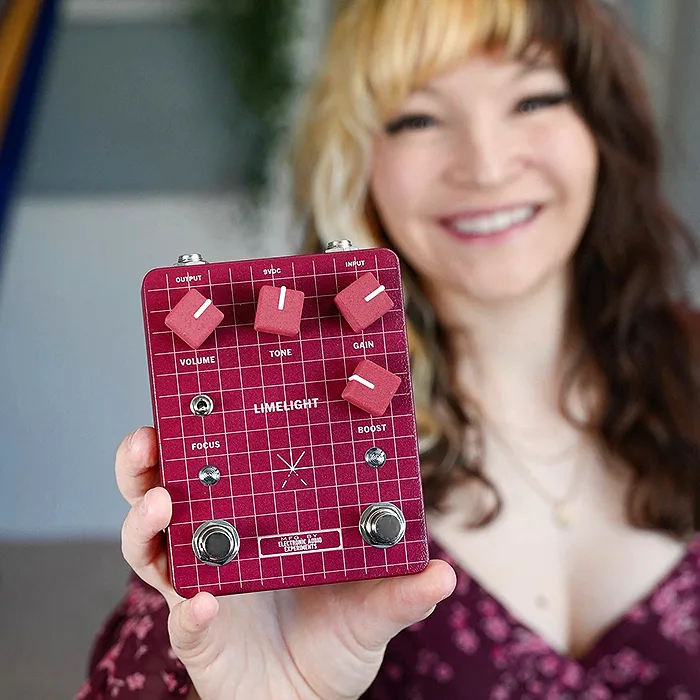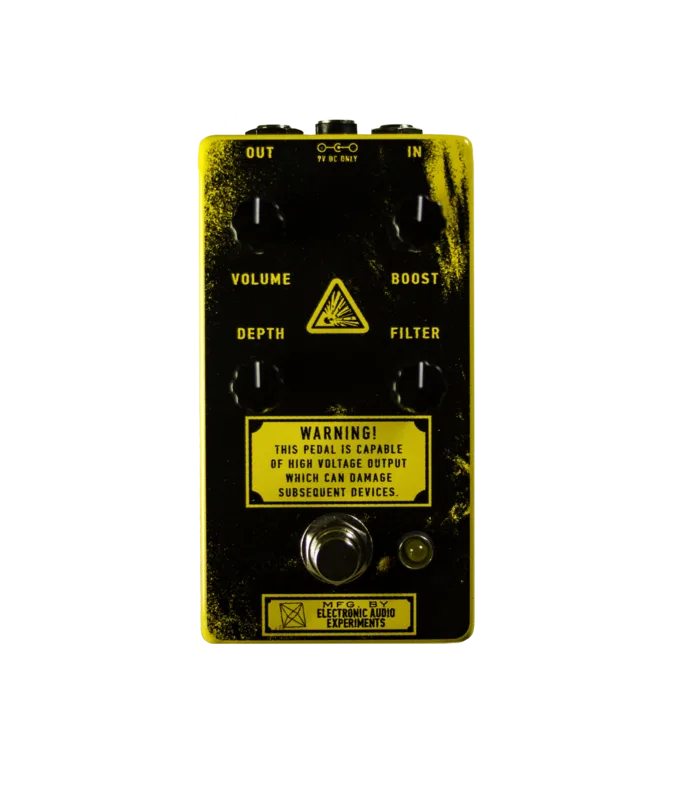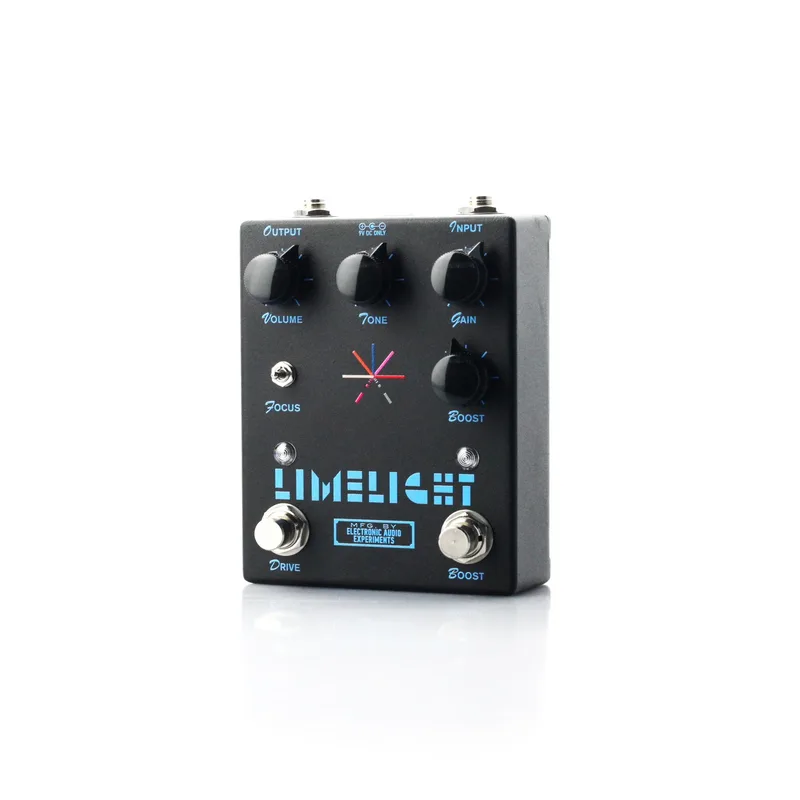


The EAE x Touche Amore Limelight is a dual channel overdrive pedal with an independent front-end boost, developed by Electronic Audio Experiments in collaboration with the Los Angeles punk band Touché Amoré. The drive side is an op amp overdrive that the maker describes as having "equal parts aggression and chime," while the boost side delivers up to +21dB of clean gain ahead of the drive circuit, enough to push the pedal from overdrive into heavy distortion territory1.
The pedal came out of work with the band's Nick Steinhardt and Clayton Stevens. Electronic Audio Experiments says the original version was built to commemorate the release of Touché Amoré's 2020 LP, Lament, and that it has since earned a permanent place in the lineup1. The current Version 2 keeps the same basic concept in a new mechanical form factor, rotated to portrait orientation, and is listed at $249.001.
What it is and what it does
The Limelight is two pedals in one box. The drive channel is an op amp overdrive: a circuit built around an operational amplifier that clips the signal for its gain. Electronic Audio Experiments says the design is loosely based in the "breaker" lineage of overdrives, but with significant changes to the circuit for what the maker calls "superior articulation and a much wider range of gain"1. Delicious Audio, covering the Version 2, likewise described it as a dual channel overdrive with equal parts aggression and chime and a wider gain range than before2.
The boost channel sits in front of the drive. It is a clean boost, meaning it raises the signal level without adding its own clipping, and it has its own footswitch so it works independently. Used alone it is a straightforward volume lift for solos or pushing your amp; used with the drive engaged, it hits the overdrive circuit harder. As Delicious Audio put it when the V2 launched, "The front-end 0-21dB clean boost, in this optic, can push the circuit beyond overdriven tones, putting heavy distortion" within reach2.
"The front-end 0-21dB clean boost, in this optic, can push the circuit beyond overdriven tones, putting heavy distortion"
The controls
Version 2 has five knobs: Volume, Gain, Tone, Focus and Boost. Each drive and boost stage has its own footswitch1.
| Control | What it does |
|---|---|
| Volume | Output level control; turn clockwise for more volume1 |
| Gain | Controls two gain stages at once, with a natural midrange boost as you turn it clockwise; approximately 50dB at the maximum setting1 |
| Tone | Adjustable low pass filter; clockwise for more treble, counterclockwise for less1 |
| Focus | Variable low cut in the drive section; adjusts the amount of chime and midrange presence1 |
| Boost | Sets the boost channel from 0dB to +21dB of clean gain, clockwise for more1 |
Two details are worth noting for players comparing circuits. The Gain knob working two gain stages at once is unusual: rather than a single clipping stage, the drive has two that track the same control, which is part of how the pedal reaches its wide gain range. Focus, meanwhile, is a low cut before the drive rather than a tone control after it, so it shapes what the clipping stage receives rather than filtering the output. Less low end going into an overdrive generally means a tighter, more articulate result, which is what the maker means by "chime and midrange presence"1.
The footswitches are arranged left and right:
Because the two circuits are independent, you can run the boost into the drive, the drive alone, or the boost alone as a straight clean boost12.
Bypass and power
The Limelight uses relay-based true bypass switching for both circuits, and the switching defaults to bypass if the pedal loses power, so your signal path survives a dead supply1.
Power requirements are standard for a modern pedal but rule out a battery1:
The Limelight does not accept a battery. It needs a 9V DC supply with a 2.1mm center negative barrel plug, and Electronic Audio Experiments recommends a regulated, isolated supply rated for 100mA. The input is protected from reverse polarity, but the maker warns that an incorrect power supply may still cause permanent damage1.
Current draw is 80mA with both channels engaged1, which is modest by digital standards but more than some analog drives, and the reason for the 100mA recommendation. At 80mA it will run happily on most isolated pedalboard supplies; a single 100mA output covers it.
Collaboration, versions and the Tour Edition
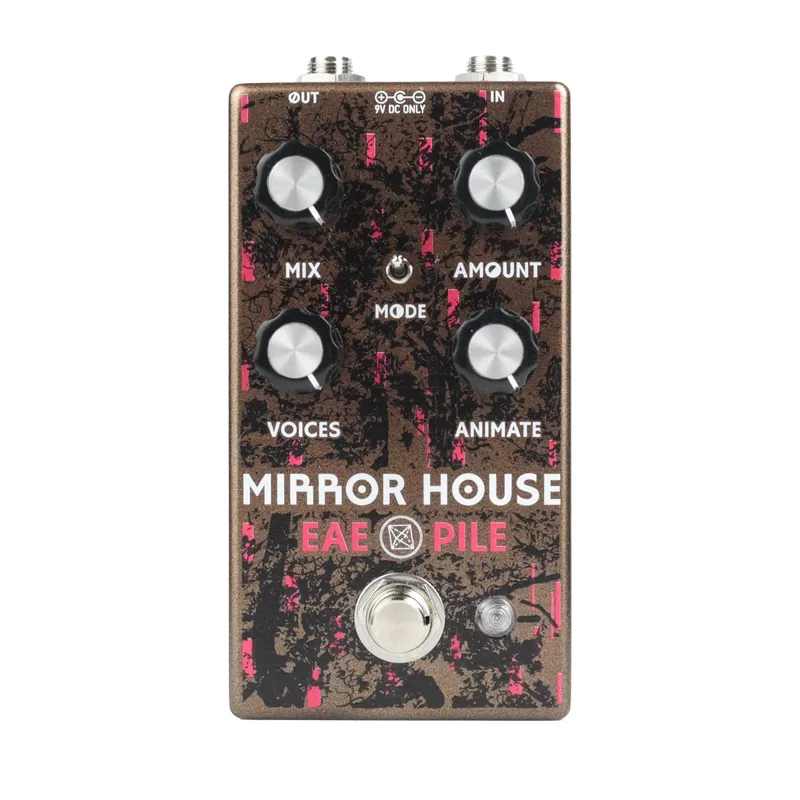
Electronic Audio Experiments has a history of artist collaborations. The company's Mirror House pitch shifter was originally developed with the Boston band Pile3, and the Limelight follows the same pattern: a pedal built with working players rather than adapted from an existing design. For the Limelight, EAE worked with Touché Amoré's Nick Steinhardt and Clayton Stevens ahead of recording Lament1.
The pedal's timeline, as the maker presents it:
- 2020: Version 1 released to commemorate Lament1
- 2022: Version 2 announced, with circuit changes for a wider gain range and superior articulation2
- Current: Version 2, offered in Black Stage 4, Black and Stage 4 variants, housed in a portrait enclosure1
A 2026 Limited Tour Edition of the pedal also exists as a separate release.
Videos
ambienttrash
Mark Johnston
Touché Amoré
Questions
Does the EAE Limelight take a battery?
No. Electronic Audio Experiments states plainly that the Limelight does not accept a battery, and none of the company's pedals take one. It needs a 9V DC power supply with a 2.1mm center negative barrel plug, and the maker recommends a regulated, isolated supply rated for 100mA.
Is the Limelight true bypass?
Yes. Both the drive and boost circuits use relay-based true bypass switching, and the pedal defaults to bypass if power is lost, so your signal keeps passing through in a power failure. The drive and boost each have their own footswitch and can be engaged independently.
How much boost does the Limelight's boost channel give?
The Boost knob sweeps the boost channel from 0dB to +21dB of clean gain. Because the boost sits at the front end of the circuit, turning it up drives the overdrive harder, and Electronic Audio Experiments says a fully boosted signal can push the circuit beyond overdriven tones into heavy distortion.
What does the Focus knob do?
Focus is a variable low cut in the drive section. Turning it changes how much low frequency reaches the clipping stage, which adjusts the amount of chime and midrange presence in the driven sound. Less low end into the drive generally means a tighter, more present tone.
Can I run both channels at the same time?
Yes. The drive and boost circuits are independent, each with its own footswitch, so you can run the boost alone, the drive alone, or both together. With both channels engaged the pedal draws 80mA, which is why the maker recommends a supply rated for 100mA.
Sources (3)
- EAE x Touche Amore Limelight, Electronic Audio Experiments, 2020
- Electronic Audio Experiments Limelight V2 Overdrive, Delicious Audio, 2022-07-13
- EAE x Pile Mirror House, Electronic Audio Experiments, 2025