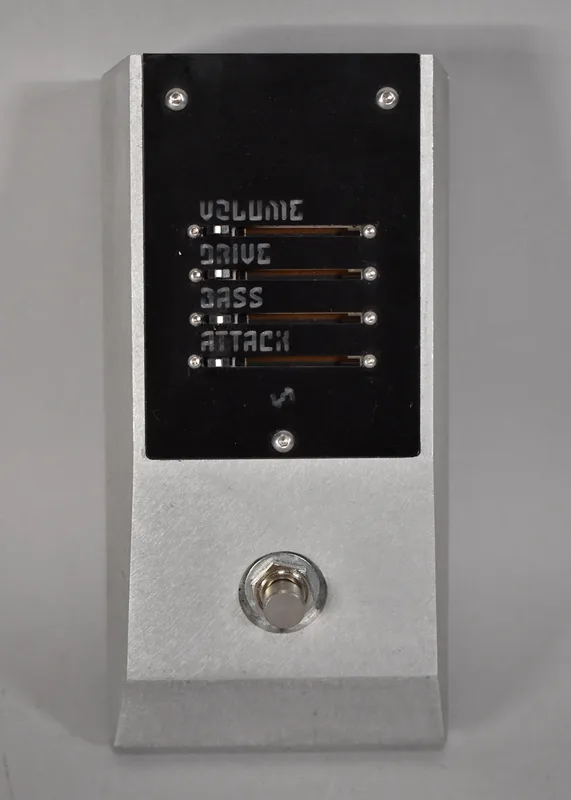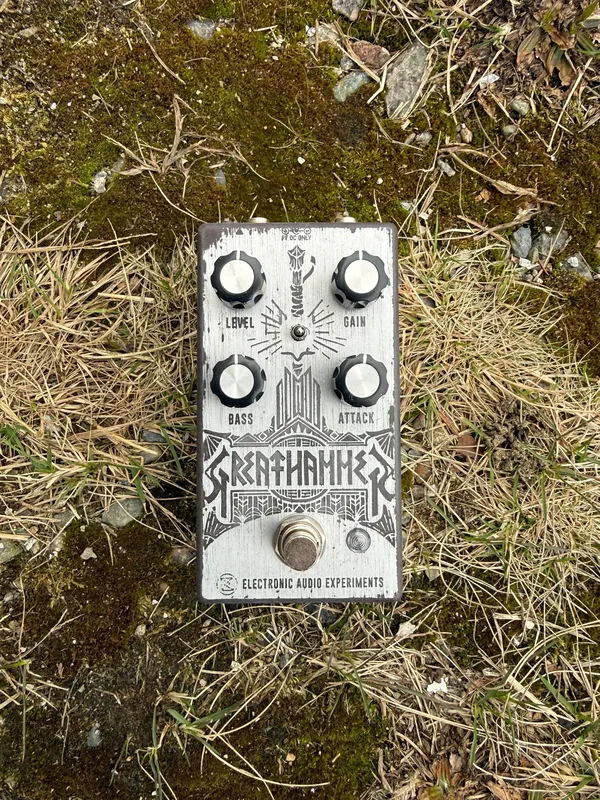


The Electronic Audio Experiments Greathammer is a bass-focused overdrive that, in the maker's words, brings "a distinct flavor of solid state thump" to a bass rig. It is a solid state bass driver and preamp pedal, built around circuit ideas taken from a 1970s Canadian bass amplifier and redesigned from the ground up. Version 1, the original release, arrived in January 20261.
What sets the Greathammer apart from many bass overdrives is how it keeps its low end. Rather than mixing a clean signal back in, the circuit itself is designed to reach far deeper low frequency extension than the designs it descends from, without a traditional clean blend1. The maker also points to a "classic piano-like attack that defined 90s noise rock," with the tonal range expanded to suit more players1.
Where the circuit comes from
Electronic Audio Experiments says it "took cues from a beloved 1970s Canadian bass amplifier, but we did not shy away from redesigning entire circuit blocks" from scratch1. Press coverage of the earlier version of the pedal identifies that amplifier as a Traynor bass amp, and describes the original Greathammer Overdrive as delivering 50 decibels of low-end tone2. The current Greathammer is the evolved form of that earlier Traynor-derived overdrive2.
The pedal is an entirely SMT (surface mount) construction, which Guitar Pedal X's reviewer noted "shows just how great the results can be for that format when well-engineered"2.
The controls
The Greathammer carries five knobs, one toggle and one footswitch. The maker describes each control as follows1:
| Control | What it does |
|---|---|
| Level | Overall volume level, capable of extremely high output |
| Gain | Signal gain from clean to moderate to extreme, approximately 50dB maximum passband gain |
| Attack | Pre-gain tone control; adjusts frequencies above 1kHz to tailor the drive response and the sharpness of pick attack |
| Bass | Post-clipping low frequency shelf boost, up to +14dB at 100Hz and below |
| Notch (toggle) | 3-position mid cut: center is a full mid cut, down is a moderate mid cut, up is flat mids |
| Footswitch | Activates the effect with intelligent momentary/latching behavior |
The Attack control is worth a closer look for players new to the design: because it shapes the signal before the gain stage, it changes how the drive itself responds, not just the treble of the finished sound. The Bass control works after the clipping stage, boosting lows up to +14dB at 100Hz and below, which is where a bassist's fundamental lives1.
Guitar Pedal X's review summarizes the control set as Level, Gain (50dB), Mids (Flat Mids, Full Mid Cut or Slight Mid Cut), Bass and Attack, describing Attack as a pre-gain tone, sharpness and bite control2.
Power and switching
The Greathammer runs on 9V DC through a 2.1mm center negative barrel plug and draws 70mA1.
No battery option exists. Electronic Audio Experiments states plainly: "Our pedals do not accept batteries."1
Bypass is not true bypass. The pedal uses silent electronic switching with a high-headroom op amp buffer, so the signal passes through a buffer when the effect is off1. The footswitch has intelligent momentary/latching behavior, meaning it can be held for momentary bursts of effect rather than only toggling on and off1.
No clean blend, deep low end
Many bass overdrives solve the problem of losing low end under clipping by adding a parallel clean blend. The Greathammer takes the opposite approach: the maker states the circuit "can achieve far deeper low frequency extension than its progenitors," all without a traditional clean blend1. For a bassist, that means the low end comes from the drive circuit itself rather than from a mixed-in dry signal.
On guitar
Although it is a bass pedal, the Greathammer has drawn attention from guitar players. Guitar Pedal X's reviewer, Stefan Karlsson, called it "a solid state bass driver/preamp that works especially well on guitar"2. At his settings, 3 o'clock on Level, Gain and Bass, 2 o'clock on Attack, with the mids fully cut, he found it delivered a loud, full, balanced, low-end-heavy sound with the range still intact, and judged it a good match for Stoner, Sludge and Doom styles2.
"At 3 o'clock on Level, Gain and Bass, 2 o'clock Attack and Full Cut Mids, it delivered loud, full, balanced, low-end-heavy sound"
He later described it as "essentially a solid state bass preamp with crushing low-end" that performs brilliantly on guitar3.
Availability and price
The Greathammer lists at $249.00 USD on the Electronic Audio Experiments product page1. In the UK, Joe's Pedals priced it at £249, and Guitar Pedal X reported that Joe's Pedals sold out of the Greathammer almost instantly after the announcement, with the EAE site awaiting its next batch at $2492. Earlier coverage, from February 2026, gave the same figures: typically $249 on the Electronic Audio Experiments Webstore, and £249 at Joe's Pedals when available4. All Greathammer pedals come with the maker's standard warranty1.
Videos
Electronic Audio Experiments
ambienttrash
Mark Johnston
Questions
Does the Greathammer take a battery?
No. Electronic Audio Experiments states that its pedals do not accept batteries, so the Greathammer runs only on external power. It needs a 9V DC supply with a 2.1mm center negative barrel plug, and draws 70mA.
Is the Greathammer true bypass?
No, it is not described as true bypass. The maker specifies silent electronic switching with a high-headroom op amp buffer, so the bypassed signal passes through an internal buffer rather than being hard-wired around the circuit.
Does the Greathammer have a clean blend?
No. The maker says the circuit achieves far deeper low frequency extension than its progenitors without a traditional clean blend, avoiding the approach many bass overdrives use to keep low end intact by mixing in an untouched signal.
Which amp is the Greathammer based on?
Electronic Audio Experiments says it took cues from a beloved 1970s Canadian bass amplifier but redesigned entire circuit blocks from scratch. Press coverage of the earlier version identifies that amplifier as a Traynor bass amp.
Can you use the Greathammer on guitar?
Yes. Guitar Pedal X's reviewer found it works especially well on guitar, calling its sound thunderous and bone-crushing yet poised and balanced, and noting it suits Stoner, Sludge and Doom styles.
Sources (4)
- Greathammer Bass Driver, Electronic Audio Experiments, 2026-01
- Guitar Pedal X, Guitar Pedal X, 2026-04-16
- Guitar Pedal X, Guitar Pedal X, 2026-05-05
- Guitar Pedal X, Guitar Pedal X, 2026-02-02