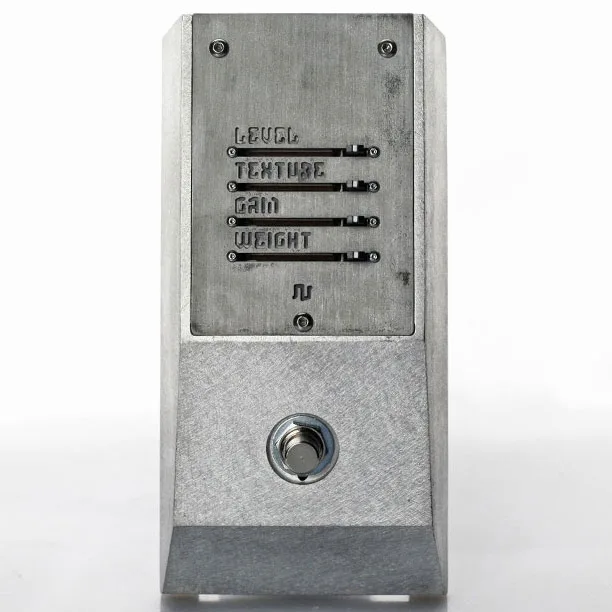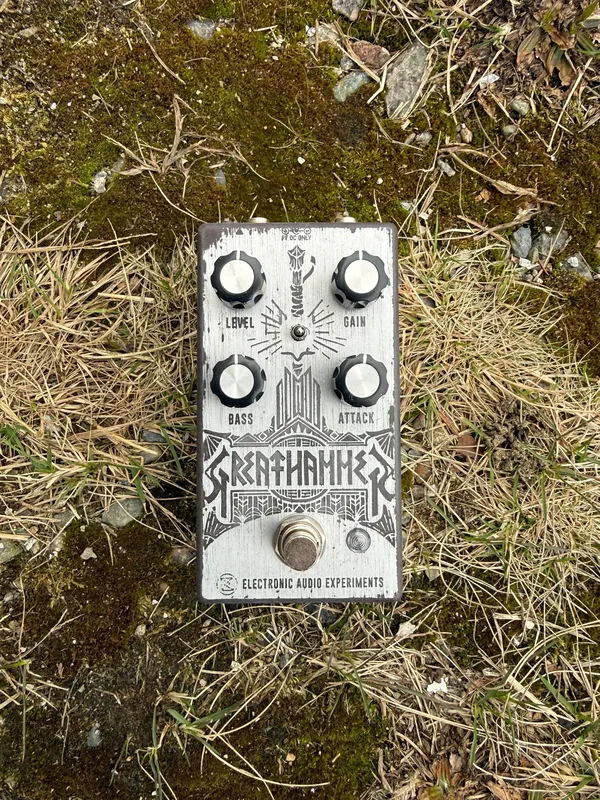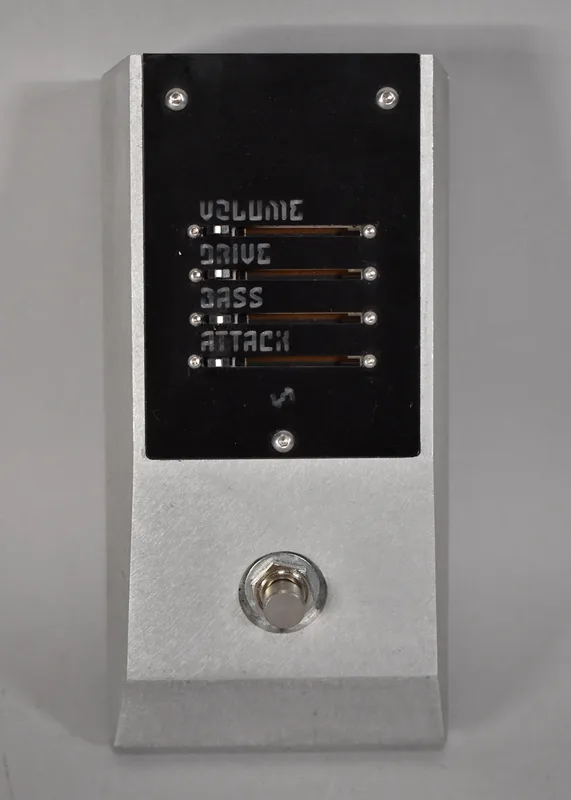


The Electronic Audio Experiments 0xEAE Bass Driver is a bass gain device and preamp pedal from Boston's Electronic Audio Experiments, built in collaboration with the design collective Obstructures. The maker describes the circuit as an homage to a beloved vintage Canadian bass amplifier, and positions it as delivering "solid state noise rock thunder with key augmentations for the modern bassist"1. It is the third and final installment of the collaborative 0xEAE form factor, a line of neo-brutalist gain devices that began with the 0xEAE Boost in 202112.
With a gain control spanning a 50dB range, the Bass Driver covers everything from a clean push to full-on distortion, with a post-clipping bass shelf to keep the low end intact and an internal notch filter for direct or ampless rigs1.
A bass gain pedal modeled on a vintage Canadian amp
The Bass Driver completes what the maker calls a trifecta of neo-brutalist gain devices executed with the Obstructures collective1. The series began with the 0xEAE Boost, which Delicious Audio reported in April 2021 as the first entry in the new line, with a pilot batch going live for sale through the webstore on Friday, April 30, at 2PM EST2. The Boost is a versatile signal boost/overdrive built around a discrete op amp gain stage pushed by a second gain stage with an aggressive high frequency emphasis32.
The collaboration itself was unusually deep. As John of Electronic Audio Experiments told Delicious Audio2:
"We exchanged hundreds of emails with design notes, mechanical drawings, and aesthetic goals while frequently exchanging"
The exterior physical design and a shared affinity for noise rock informed the intent of the circuitry, with the line's stated goal of marrying cutting edge visual and engineering design with stage-proof sturdiness32. The 0xEAE Fuzz followed as the second installment before the Bass Driver closed the series1.
The controls
The Bass Driver carries four knobs and one internal switch. Here is what each does, per the maker1:
| Control | What it does |
|---|---|
| Drive | Signal gain, from clean to moderate to extreme. Approximately 50dB maximum passband gain. |
| Bass | Post-clipping low frequency shelf boost, up to +14dB at 100Hz and below. |
| Attack | Adjusts frequencies above 1kHz, tailoring the overall clipping response and sharpness of pick attack. |
| Volume | Overall volume level, capable of extremely high output. |
| Notch (internal switch) | Activates a notch filter centered at 750Hz. Disabled by default. |
The single footswitch is an effect activator1.
The Drive knob is the heart of the pedal. Its approximately 50dB of maximum passband gain means it can sit as a clean preamp at low settings and reach extreme saturation turned up, which is what the maker means by saying the Bass Driver "can be restrained or rowdy"1. The Bass knob works after the clipping stage rather than before it, so boosting the low end does not simply drive the circuit harder; it restores weight to the distorted signal, up to +14dB at 100Hz and below1. Attack shapes the treble content going into the clipping, letting you dial in how sharp the pick attack reads1.
The Notch switch
The Notch control is an internal switch, not a front panel knob. It activates a notch filter centered at 750Hz, and it ships disabled1. The maker notes it can be useful for ampless setups or running direct into a power amp1. In a direct rig with no speaker cabinet coloring the sound, cutting that 750Hz band can keep the midrange from honking, so players using the Bass Driver as a straight bass preamp into a PA or power amp may want to flip it on.
Power and bypass
The Bass Driver runs on 9V DC, center negative, drawing under 65mA at idle. Electronic Audio Experiments recommends a regulated, isolated power supply rated for 200mA minimum, and the PSU input is protected against reverse polarity and over-voltage1.
The Bass Driver does not accept batteries, per the maker, so it needs a spot on a powered pedalboard from day one1.
Bypass is soft-touch relay switching with an op amp buffered bypass1. That is not true bypass: when the pedal is off, your signal still passes through the pedal's op amp buffer. Players with long cable runs or many true bypass pedals ahead of it may find that buffer helps keep the high end intact; players who want a pure wire-through when bypassed should know it is not that.
Where it sits in the EAE lineup
Videos
Electronic Audio Experiments
Noise Generator
Joe Dinsdale
Questions
What does the Notch switch on the 0xEAE Bass Driver do?
The Notch control is an internal switch that activates a notch filter centered at 750Hz. It ships disabled, and the maker suggests it can be useful for ampless setups or running direct into a power amp, where cutting that midrange band helps the tone sit better.
Can the 0xEAE Bass Driver run on a battery?
No. Electronic Audio Experiments states plainly that its pedals do not accept batteries, so the Bass Driver needs an external 9V DC power supply on your pedalboard.
What power supply does the 0xEAE Bass Driver need?
It runs on 9V DC, center negative, drawing under 65mA at idle. The maker recommends a regulated, isolated supply rated for 200mA minimum. The power input is protected against reverse polarity and over-voltage.
Is the 0xEAE Bass Driver still in production?
This iteration was produced in a finite quantity, and Electronic Audio Experiments says it intends to manufacture the circuit in a new form at a later date. The V1 initial release arrived in April 2025.
How much gain does the Drive knob provide?
The Drive knob sets signal gain from clean to moderate to extreme, with approximately 50dB of maximum passband gain. The maker describes the Bass Driver as able to be restrained or rowdy across that range.
Is the 0xEAE Bass Driver true bypass?
No. It uses soft-touch relay switching with an op amp buffered bypass. When the effect is off, the signal passes through a buffer rather than a straight wire, which keeps long cable runs from dulling your tone.
Sources (3)
- 0xEAE Bass Driver Archive, Electronic Audio Experiments, 2025
- Electronic Audio Experiments 0xEAE Boost, Delicious Audio, 2021-04-29
- 0xEAE Boost Archive, Electronic Audio Experiments, 2025