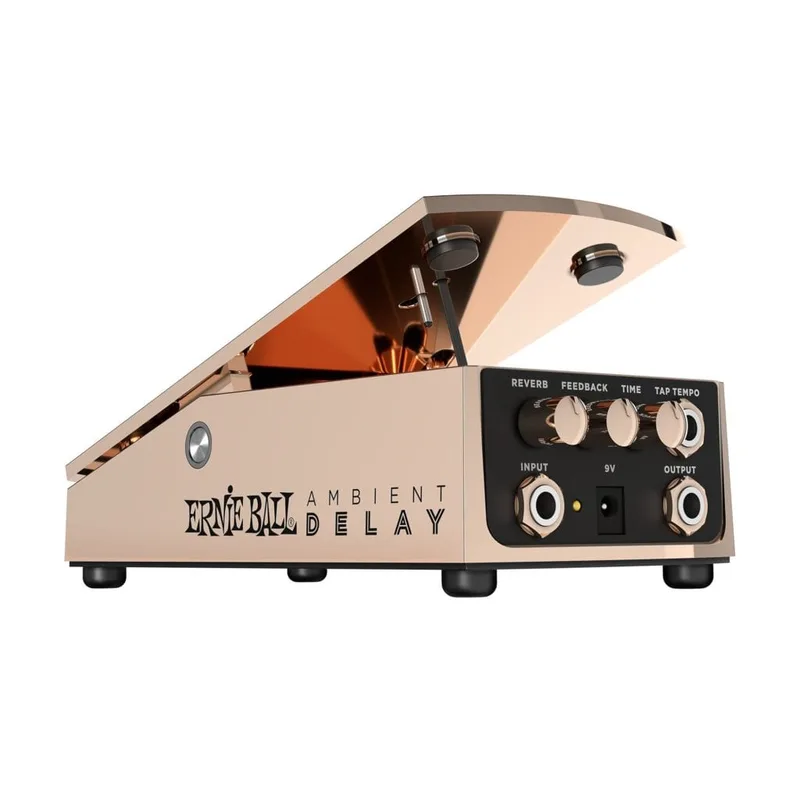


The Ernie Ball Ambient Delay is a delay pedal with a plate-style reverb built into the chassis of an Ernie Ball volume pedal. Instead of stomping a switch and leaving the effect at one setting, you rock the treadle with your foot to throttle how much of the ambient delay-and-reverb texture sits in your sound, without taking your hands off the guitar12. Premier Guitar called it "This re-imagining of Ernie Ball's time-tested volume pedal design combines digital delay and plate-style reverb with the expressive potential of a wah."1
The effect itself is a hybrid: a digital delay layered with an all-purpose plate reverb, in a single combined mode rather than separate delay and reverb engines you can program independently34. Ernie Ball pitched it at players who want ambience they can push and pull in real time, from a quiet slap-back behind a clean part to a full wash of repeats2.
How the treadle works
The core idea is the foot sweep. The knobs set the character of the ambience, and the treadle sets how much of it you hear: toe-up action reduces the effect mix, and toe-down action increases effect intensity1. Delicious Audio described the sweep as "a throttle control for the amount of 'mix' of ambient texture in the overall sound."4
Because the pedal is always on, courtesy of a transparent buffer circuit, you can dial the ambience in and out on the fly rather than switching it3. That makes it behave more like a volume pedal or wah in your signal chain than a conventional stompbox: it is a performance control, not an on/off effect.
The mechanics are based on Ernie Ball's existing range of foot controllers, which gearnews judged "should be pretty solid"5. The pedal uses Ernie Ball's PVC-coated Kevlar cord and spring linkage, introduced in 2016 to replace the traditional Vectran string in the VP and VP Jr volume pedals, which the company described as built "for dependable performance under the most punishing conditions of professional use"2.
Controls
| Control | What it does |
|---|---|
| Delay Time | Sets the delay time, from 50ms to 1s4 |
| Feedback | Sets the number of repeats4 |
| Reverb Level | Sets the level of the plate reverb4 |
| Treadle (foot sweep) | Controls the effect level, the mix of ambient texture in the overall sound41 |
| Tap tempo input | Connection for an external tap tempo controller4 |
MusicRadar's review breaks it down the same way: time and feedback knobs for the digital delay, plus a reverb knob that adjusts the level of the plate reverb, with the option of an external tap tempo footswitch3.
Delay times and tap tempo
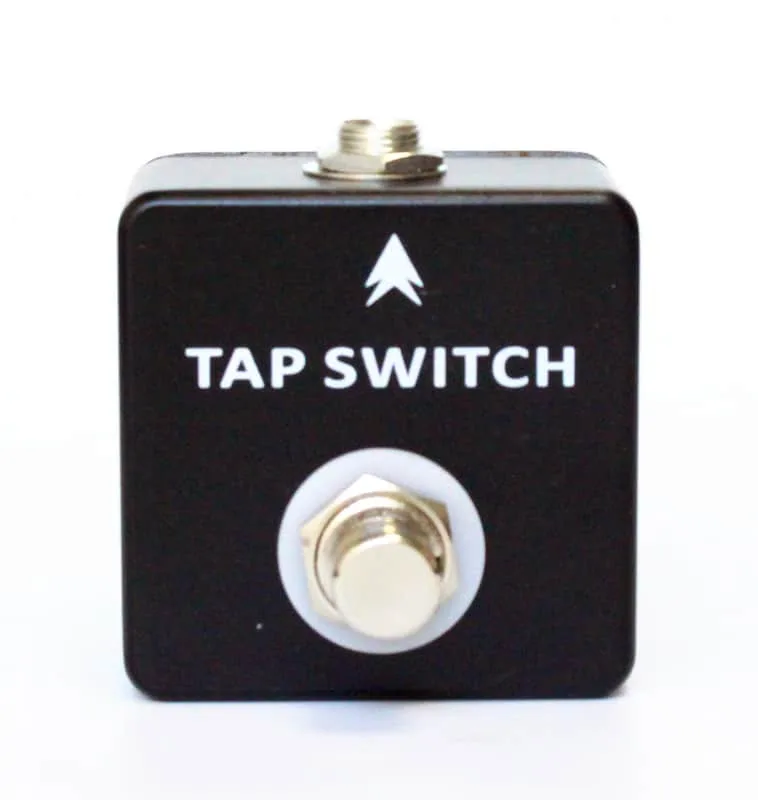
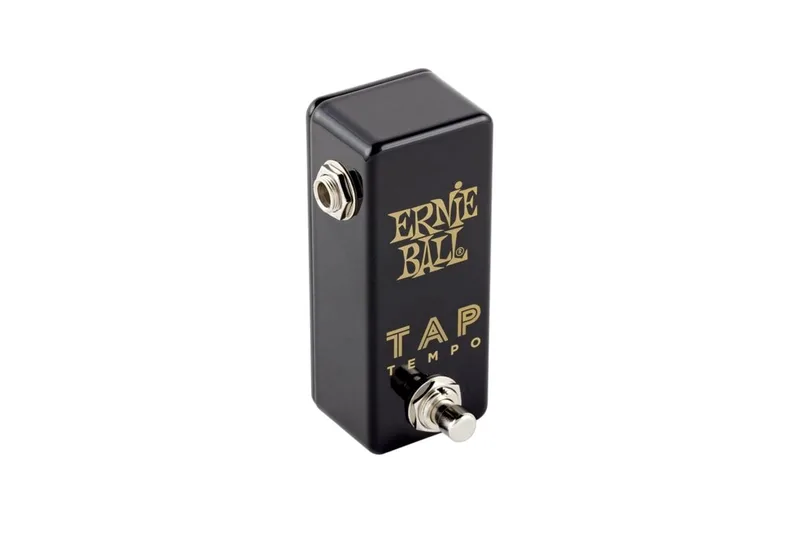
The delay time range is 50 milliseconds to one second42. Ernie Ball's press release framed that range as "for everything from slap-back to extended repeats" and "anything from subtle textures to ambient soundscapes"2. There is no built-in tap switch, but the pedal has a dedicated connection for an external tap tempo controller, so you can set repeat times with your foot while the treadle handles the mix49.
Power and connections
The Ambient Delay has no battery option, so it needs a power supply on your board1. Guitar World's 2016 review described it as powered by a nine-volt adapter (not included), or any standard center-negative barrel plug power source8. Premier Guitar's 2021 review, though, found a wall adaptor with interchangeable plugs for both EU and US territories included in the box1.
The pedal is mono: one input, one output, plus the tap tempo input and the PSU input9. Physically, Premier Guitar found it about as wide as the VP Jr but about two inches shorter, with a height slightly taller than a volume pedal, presumably to fit the delay and reverb circuitry1. The sealed aircraft aluminum chassis is designed to protect the internal components from outside elements4, and the finish is a rose gold aluminum casing2.
Where it came from
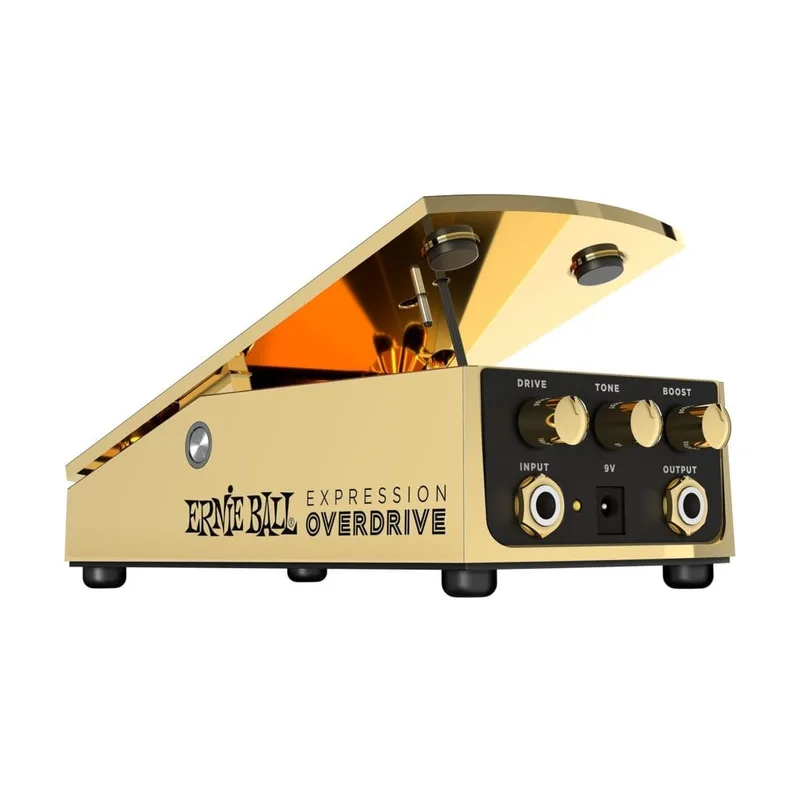
The Expression Overdrive and Ambient Delay were announced at the Winter NAMM Show earlier in 20165. At announcement, the Expression Ambient Delay was set for Q2 2016 availability at $199.99 SRP/MAP7; it was later reported as available Q4 2016 for $199.996. In the UK, the Ambient Delay 6184 carried an RRP of £209.95, due in August 20165. By the time pre-orders opened, the pedals were only just starting to appear5, with Ernie Ball taking pre-orders for both the Expression Overdrive and Ambient Delay10.
The Ambient Delay was built on the mechanics of Ernie Ball's existing range of foot controllers, its volume pedals, a design lineage reviewers expected to be pretty solid51. The company positioned the hybrid pedals for guitar and bass as offering "more sonic expression than traditional stomp pedals in a road-worthy metal construction"2. Ernie Ball also promoted the pedal with demo material: Ilan Rubin of Nine Inch Nails, Angels & Airwaves and New Regime played and discussed it in the launch video10.
What reviewers said
Reviewers focused on the pedal's voicing, with one verdict reading simply: "Excellent voicing."3 The same review noted the single-mode approach as a different tack for the company, "offering just a single delay and reverb mode with full-sized expression control modelled on EB's famous volume pedal design"3.
For a player, the trade-off is clear from the reviews: you get one well-voiced delay-and-reverb combination with real-time foot control over its level, rather than the multiple modes, presets and stereo routing of a conventional delay or reverb stompbox. If a treadle fits how you play, that is the point of the design; if you want switchable modes, it is not that pedal.
Videos
ProGuitarShopDemos
Premier Guitar
Sweetwater
Questions
Does the Ernie Ball Ambient Delay take a battery?
No. Premier Guitar's review states there is no battery option, so the pedal needs external power. Guitar World's review describes it as powered by a nine-volt adapter, or any standard center-negative barrel plug power source. Premier Guitar's later review found a wall adaptor with interchangeable plugs included in the box.
Is the Ernie Ball Ambient Delay true bypass?
No. MusicRadar describes the pedal as always on, courtesy of a transparent buffer circuit, which lets you dial in the ambience on the fly. There is no true bypass switching, because the treadle controls the effect mix rather than switching the effect in and out.
What is the maximum delay time on the Ambient Delay?
One second. The delay time control ranges from 50 milliseconds to one second, which Ernie Ball positioned as covering everything from slap-back echo to extended repeats. An external tap tempo footswitch can also be connected to set the time.
Can you use tap tempo with the Ernie Ball Ambient Delay?
Yes. The pedal has a connection for an external tap tempo controller, and MusicRadar notes the option of an external tap tempo footswitch for the delay section. There is no built-in tap switch on the pedal itself.
Is the Ambient Delay stereo?
No. Guitar.com's review lists the pedal's connections as a mono input and output, plus a tap tempo input and a PSU input. There are no stereo outputs.
What delay times does the Ernie Ball Expression Ambient Delay cover?
The delay time control runs from 50 milliseconds to one second of delay layered with reverb. Ernie Ball described this range as covering everything from slap-back to extended repeats, and from subtle textures to ambient soundscapes.
Sources (10)
- Ernie Ball Ambient Delay Review, Premier Guitar, 2017-01-17
- Ernie Ball Launches New Overdrive & Ambient Delay, Premier Guitar, 2016-08-08
- Ernie Ball Ambient Delay review, MusicRadar, 2017-07-04
- New Pedals: Ernie Ball Ambient Delay, Delicious Audio, 2020-09-25
- Ernie Ball Expression Overdrive and Ambient Delay, gearnews.com, 2016-07-08
- Summer NAMM 2016: Ernie Ball offers on-the-fly control of overdrive and delay with new Expression Series guitar effects pedals, MusicRadar, 2016-06-30
- NAMM 2016: Ernie Ball debut Overdrive and Ambient Delay Expression effects pedals, Guitar.com, 2016-01-28
- Review: Ernie Ball Expression Overdrive and Ambient Delay, Guitar World, 2016-12-23
- Review: Ernie Ball Expression Overdrive, Expression Tremolo & Ambient Delay, guitar.com, 2019-01-14
- Ernie Ball Launches Expression Overdrive and Ambient Delay Pedals, Guitar World, 2016-09-13
 Tim Mahoney