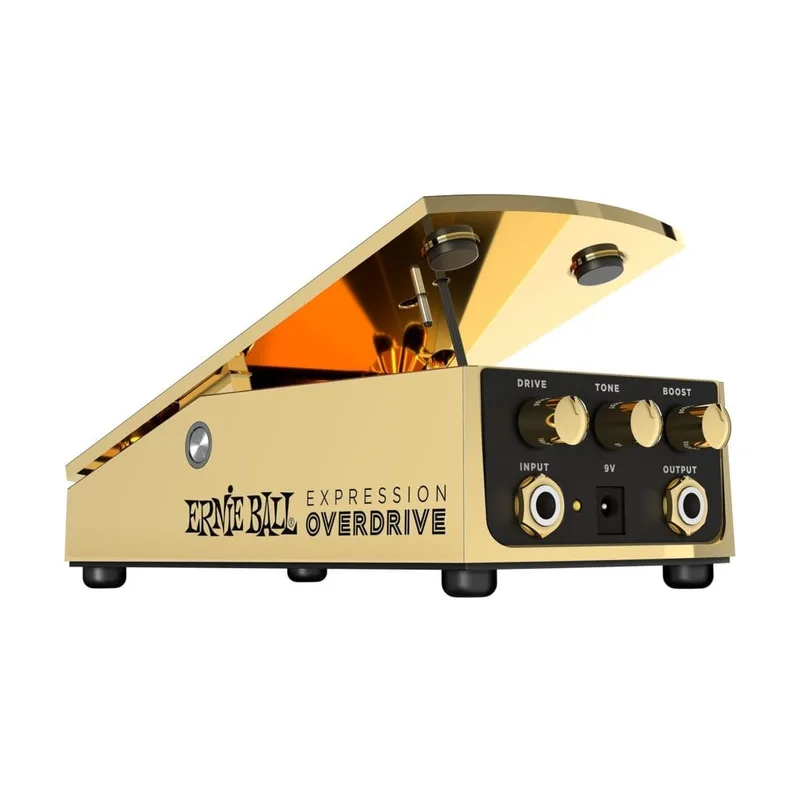


The Ernie Ball Expression Overdrive is an overdrive pedal with a difference: instead of clicking a footswitch and settling on one gain setting, you control the amount of drive with your foot, through a treadle built into the pedal's body. Ernie Ball announced it at Summer NAMM 2016 alongside the Ambient Delay, as the first two products of its Expression Pedal series, which takes the familiar wah and volume pedal chassis and applies it to overdrive and delay effects.12
Its core function is to deliver increasing amounts of overdrive via foot control, moving from clean to all-out growl and everything in between without taking your hands off the guitar.32 Ernie Ball's own description promises everything from a hint of natural tube-amp-like overdrive and rhythm crunch to searing lead tones, and the company positions it as a hybrid pedal for both guitar and bass.2 The mechanics build on the idea of the MVP volume/boost pedal and on Ernie Ball's existing range of foot controllers, so the treadle hardware has a volume-pedal pedigree behind it.45
A treadle-controlled overdrive
The concept is straightforward: the pedal sits in your signal chain like any other overdrive, but the amount of drive is swept by foot rather than locked to a knob. At heel-down there is zero effect, and at toe-down you get the maximum effect, so the treadle works like a volume pedal for gain.3 With the pedal dialed all the way back, toe up, the pedal is bypassed rather than muted, so your clean tone keeps passing through.1
There is no footswitching involved at all. The pedal is always on in the signal chain, and you bring in the effect by pressing down on the treadle. Because your full signal is always passing through the buffered pedal, which MusicRadar's reviewer found is not tonally transparent, this is not a true-bypass design.3
The treadle itself is not adjustable for resistance, but MusicRadar's reviewer Trevor Curwen found it "seems to offer just the right amount of resistance while maintaining position wherever you 'park' it," which matters if you want to set a partial drive level and leave it there mid-song.3 The build carries over Ernie Ball's foot-controller hardware, including a newly engineered ultra-durable PVC-coated Kevlar cord and spring linkage, aimed at dependable performance under professional use.25 The enclosure is a polished gold aluminum casing, and the whole unit measures 88 x 52 x 192mm.210
The controls: Drive, Boost, Tone and treadle
The pedal keeps its panel simple, with three knobs working alongside the treadle. Delicious Audio described the setup as the standard overdrive dials for drive, tone and a 20dB gain boost, with the pedal sweep controlling the level of overdrive.1
| Control | What it does |
|---|---|
| Drive | Sets the drive level; keep it at minimum to use the pedal as a boost3 |
| Boost | Up to 20dB of gain boost; with Drive at minimum it pushes the amp harder, perhaps with some tonal shift13 |
| Tone | Shapes top-end; it comes into play as the treadle is depressed, and turning it clockwise adds treble for higher-gain settings3 |
| Treadle | Sweeps the amount of overdrive: heel-down is zero effect, toe-down is maximum effect3 |
The Drive and Boost knobs interact in a useful way. As Curwen put it in MusicRadar, "by keeping the Drive knob at minimum but turning the Boost up, you can use it as a useful boost, perhaps with tonal shift, to drive your amp a little further."3 That gives the pedal a second job as a boost pedal for solos, with the treadle still available to bring in drive on top. The Tone knob matters most once the treadle is down: depressing the treadle to add overdrive brings the Tone control into play, and turning it clockwise should give adequate top-end at higher drive settings.3
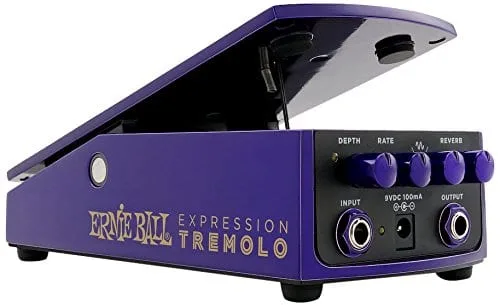
Because the drive level lives under your foot, the pedal is aimed at players who want on-the-fly, dynamic control, giving more sonic expression than traditional stomp pedals, in a road-worthy metal construction.2 That is the same hands-free idea behind the wider expression pedal category, and it sits alongside the Ernie Ball Expression Tremolo that joined the series later.
Power and connections
The pedal runs on a nine-volt adapter, which is not included, or any standard center-negative barrel plug power source.9 There is no battery option, just an input for a nine-volt DC supply.10 Current draw is 18mA at 9V DC, center negative.6 Guitar.com's reviewer Simon Bradley noted that guidance on current requirements was hard to find, and used a supply producing a maximum of 300mA without problems, advising players to have a suitable PSU on hand before buying.10 Connections are mono input and mono output, plus the PSU input.10
No battery compartment and no included power supply: budget for a 9V DC center-negative supply when planning a board around this pedal.109
Where it came from
What reviewers said
Reviews were positive on the concept and the build, with some reservations on price and tone.
- MusicRadar (Trevor Curwen): "A great pedal, but it comes at a price," noting the UK street price of £210, "it is not cheap, but some will feel that it's a fair price to pay for a new hands-free layer of performance."3
- Guitar World (Chris Gill): Awarded the Expression Overdrive and Ambient Delay a Platinum Award, with a list price of $203.99 each, praising the built-in expression pedals that do away with the standard click switch and let users blend effect levels from dry to fully processed.9
- Guitar.com (Simon Bradley): Called it "an excellent concept, but the tone may be a little gritty for some players," at £199, while finding "no doubt that all three units are well made and have an alluring look."10
"A great pedal, but it comes at a price."
Guitar.com also flagged a practical point for live use: the layout makes on-the-fly adjustments of the pots tricky, with the crowded control panels of the Tremolo and Delay leaving little room for questing fingers.10 At launch, Gearnews noted that Ernie Ball's marketing leaned on the usual tube-like sound claims while offering little information on the drive's specs, a gap independent listings later filled with the analog circuit type and power figures.56
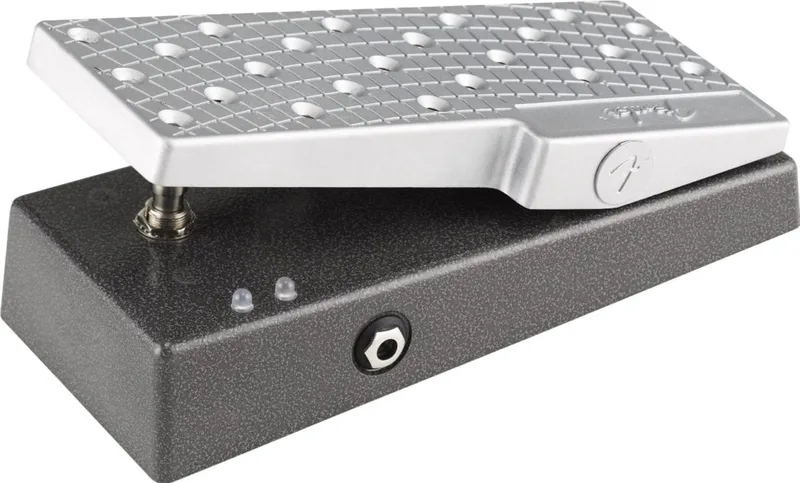
For players comparing treadle-controlled options, the Expression Overdrive stands apart from digital expression controllers like the Fender EXP-1, which adjusts volume or amp parameters on Fender Mustang amplifiers rather than generating its own overdrive.11 The Ernie Ball unit is a self-contained analog overdrive pedal whose treadle sweeps its own gain, which makes it a different tool from both switch-based drives and pure expression controllers.
Videos
ProGuitarShopDemos
Ernie Ball
Ernie Ball
Questions
Does the Ernie Ball Expression Overdrive have a footswitch?
No. There is no footswitching at all. The pedal is always on in your signal chain, and you bring the overdrive in by pressing down on the treadle. With the treadle dialed all the way back, toe up, the pedal is bypassed rather than muted, so your clean signal keeps flowing.
Is the Ernie Ball Expression Overdrive true bypass?
No. It is an always-on buffered pedal, so your full signal is always passing through the buffer, which MusicRadar's reviewer noted is not tonally transparent. Players who want a fully clean signal path when the effect is off should factor that in before adding it to a board.
Does the Ernie Ball Expression Overdrive take a battery?
No. There is no battery option, only an input for a nine-volt DC supply. It runs on 9V DC with a standard center-negative barrel plug, drawing 18mA, and a power supply is not included, so you need a suitable PSU on hand.
Can the Ernie Ball Expression Overdrive be used as a clean boost?
Yes, in a practical sense. Keeping the Drive knob at minimum and turning the Boost up gives you a useful boost, though MusicRadar's reviewer noted it may come with some tonal shift, pushing your amp a little harder rather than acting as a perfectly transparent volume lift.
Does it work on bass?
Yes. Ernie Ball introduced the Expression Overdrive as a hybrid effects pedal for both guitar and bass, with the same foot-sweepable overdrive control, so bass players can use the treadle to move from clean to driven tones on the fly.
Is the Ernie Ball Expression Overdrive analog or digital?
It is an analog design. The 6183 Expression Overdrive is listed with an analog circuit type, running on 9V DC at 18mA, and Ernie Ball's marketing describes its sound as natural, tube-like overdrive with a wide range.
Sources (11)
- Ernie Ball Debuts Expression Overdrive And Ambient Delay At The Brooklyn Stompbox Exhibit, Delicious Audio, 2016-08-25
- Ernie Ball Launches New Overdrive & Ambient Delay, Premier Guitar, 2016-08-08
- Ernie Ball Expression Overdrive review, MusicRadar, 2017-05-05
- Summer NAMM 2016: Ernie Ball offers on-the-fly control of overdrive and delay with new Expression Series guitar effects pedals, MusicRadar, 2016-06-30
- Ernie Ball Expression Overdrive and Ambient Delay, gearnews.com, 2016-07-08
- 6183 Expressionspedal, Overdrive by Ernie Ball, RockBoard PedalPedia, 2026
- Watch Dhani Harrison and Pete Thorn Demo Ernie Ball's New Expression Series Pedals, Guitar World, 2016-11-22
- Ernie Ball Launches Expression Overdrive and Ambient Delay Pedals, Guitar World, 2016-09-13
- Review: Ernie Ball Expression Overdrive and Ambient Delay, Guitar World, 2016-12-23
- Review: Ernie Ball Expression Overdrive, Expression Tremolo & Ambient Delay, guitar.com, 2019-01-14
- Exp-1 by Fender, RockBoard PedalPedia, 2026