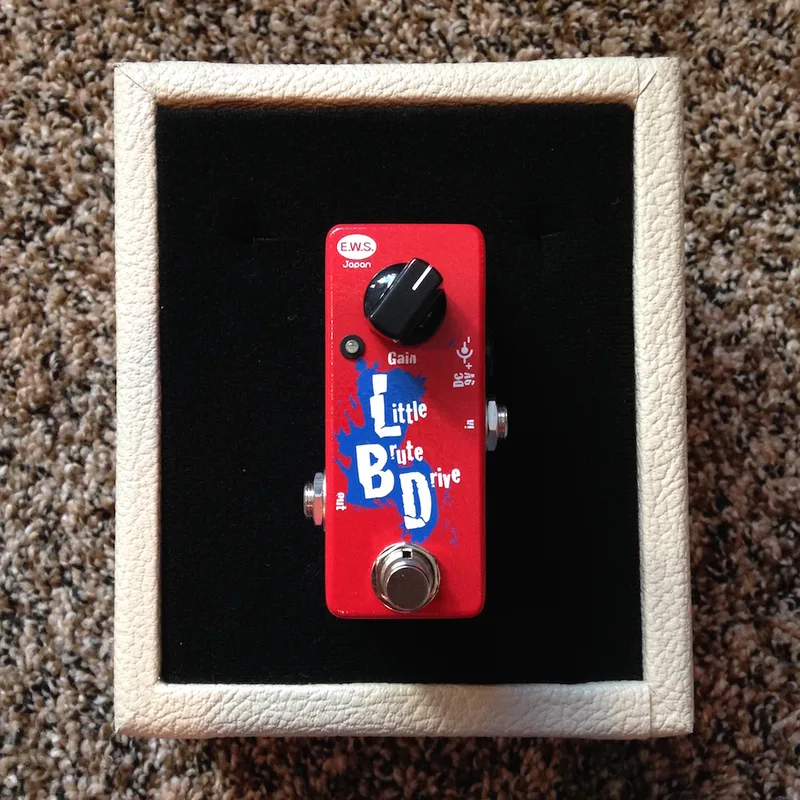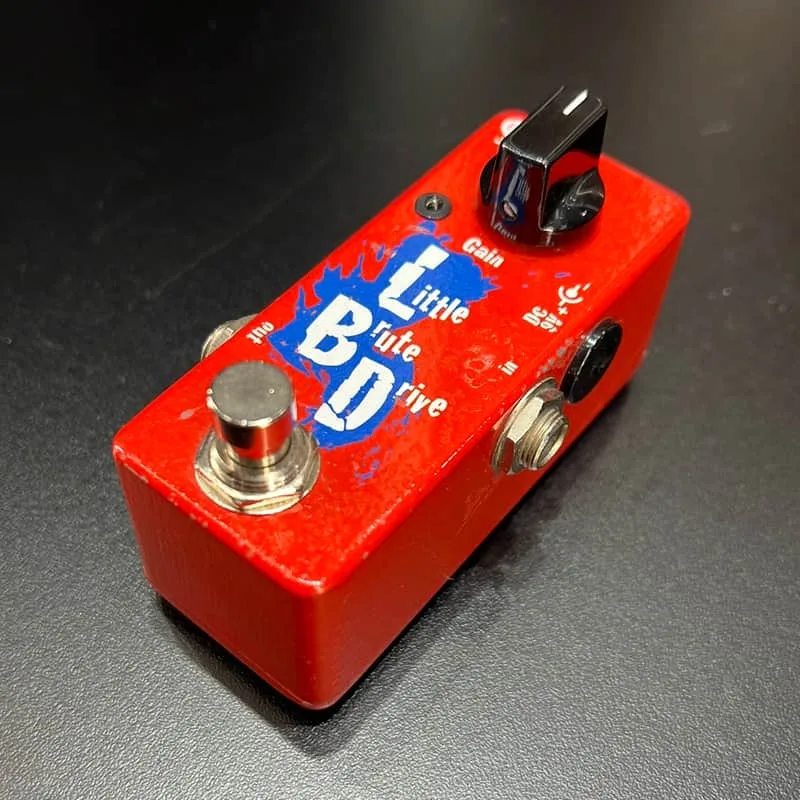


The EWS Little Brute Drive is a mini overdrive and distortion pedal from Japanese maker EWS, a smaller follow-up to the company's larger Brute Drive1. It follows the tone design of British stack amps, and its compact body takes up very little real estate on a pedalboard2. In use it is aimed at two jobs: taking a clean amp into overdriven territory, or pushing an already driven amp that extra mile1.
The pedal was later updated as the Little Brute Drive II, which keeps the same British stack voicing but moves its tone shaping to the outside of the enclosure3.
A mini overdrive voiced like British stack amps
The original Little Brute Drive is a single-knob overdrive and distortion pedal in a mini enclosure1. Its compact design fits anywhere on a pedalboard, which is the main practical argument for it over a full-size box2. Circuit-wise, it is built around a 4558 opamp, with the two gain stages split across the two opamp sections: gain A affects the first opamp while gain B affects the second2.
Reviewers found it more versatile than its one-knob face suggests. MusicRadar's Trevor Curwen called it flexible, working both as a booster and as a distortion1:
"Flexible - works as a booster and a distortion. Overdrive is up there with the best1."
Pedal of the Day's Mike B found it beefier than expected for its size, with a multitude of drive sounds available from boost to overdrive, and judged its compact size and tonal range enough to make it "a worthy opponent of bigger, fatter overdrive pedals that are also on the market"4.
The controls: volume, tone and mid switch
The two versions handle controls differently. The original puts one gain knob on top and hides the rest inside; the II brings volume and tone out as mini-knobs and adds a mid switch314.
| Control | Little Brute Drive | Little Brute Drive II |
|---|---|---|
| Gain/drive | Single gain knob, low-level crunch to full-on overdrive/distortion1 | Gain control with low and high gain settings3 |
| Volume | Internal trimmer for output level1 | External mini-knob3 |
| Tone | Internal trimmer for treble content1 | External mini-knob, acts as a high cut filter3 |
| Midrange | Not on the original | Three-stage mid switch at the top of the pedal3 |
On the original, the gain knob is the whole show on top of the pedal. Turn it up and it moves from a low-level crunch through to a rich, full-on overdrive/distortion1. Pedal of the Day described the sweep as running "from a sweet, chime-y boost to a growling overdrive bordering on distortion" when maxed out4. The rest of the shaping is done by a pair of set-and-forget internal trimmers, accessible through the back panel, that set the output level and the amount of treble content1.
The II's mid switch controls the strength of the midrange. It sits at the top of the pedal and pushes the midrange in three stages from the foot switch side to the DC jack side, so each of its positions is a distinct tone setting rather than a subtle nudge3. Delicious Audio's description of the two gain ranges gives a picture of the pedal's range: in the low gain setting it is crunchy sounding, full of bite and midrange, while the high gain setting becomes crisper with a more focused drive3.
From the Brute Drive to the Little Brute Drive II
The Little Brute Drive follows on from EWS's larger Brute Drive, shrinking the concept into a mini pedal1. Pedal of the Day called it the younger brother of that earlier pedal, the Brute Drive Eric Gales model4.
The Little Brute Drive II is an updated version of the well-received mini overdrive, and it follows the tone design of British stack amps like the previous LBD3. The visible change is the control set: volume and tone are mini-knobs on the II, where they were under-the-hood trim pots on the Mark I3. The II also runs on a built-in 9V battery or an external power supply3.
The 9V/16V voltage switch on the Little Brute Drive II is internal, installed on the board behind the back panel, so changing it means opening the pedal up rather than flipping a switch on the outside3.
The 16V option is the II's other addition. With the internal slide switch, the effect drive voltage can be set to 9V or 16V3. Compared to 9V, the headroom expands with 16V drive, resulting in a wide dynamic range, and the compression feeling also decreases3. For a player who wants the pedal to stay cleaner and more dynamic at higher playing levels, that is the setting's practical appeal.
What builders and reviewers made of it
The Little Brute Drive has also drawn attention from the DIY community. Tagboard Effects published a vero layout of the circuit in two versions, a modified one with external pots and a stock one with trimmers, on a 17x16 board2. A build report on the layout concluded:
"Sounds great! more a distortion then a drive."
The same builder found it sounded better than the Caline CP16 mark4 used for comparison2. That impression, more distortion than drive, lines up with the original's gain range reaching full-on overdrive/distortion at the top of the knob1.
Videos
Pete Thorn
Mike Hermans
Xotic Video
Questions
What does the 16V setting change on the Little Brute Drive II?
An internal slide switch sets the effect drive voltage to 9V or 16V. At 16V the headroom expands, giving a wide dynamic range, and the compression feeling decreases compared with running the pedal at 9V. The switch sits on the board behind the back panel, so you have to open the pedal to change it.
Where is the 9V/16V switch on the EWS Little Brute Drive II?
The slide switch is an internal one, installed on the board behind the back panel. It is not reachable from the outside of the enclosure, so changing between 9V and 16V drive voltage means opening the pedal up.
Can the Little Brute Drive II run on a battery?
Yes. The Little Brute Drive II can be used with a built-in 9V battery as well as with an external power supply, so it works on a board or on its own without a power brick.
What does the mid switch do on the Little Brute Drive II?
The mid switch controls the strength of the midrange. It is positioned at the top of the pedal and pushes the midrange in three stages, moving from the foot switch side toward the DC jack side, so each position gives a different level of mid emphasis.
How is the Little Brute Drive II different from the Little Brute Drive I?
The II keeps the British stack tone design of the original but moves controls to the outside. Volume and tone are mini-knobs on the II, where they were under-the-hood trim pots on the Mark I, and it adds a mid switch and an internal 9V/16V voltage switch.
Is the EWS Little Brute Drive true bypass?
Yes, the Little Brute Drive is a true bypass pedal, so with the effect switched off the signal passes through without the circuit coloring it.
Sources (4)
- EWS Little Brute Drive review, MusicRadar, 2014-08-28
- Guitar FX Layouts: EWS Little Brute Drive, tagboardeffects.blogspot.com, 2017-10-06
- EWS Little Brute Drive II, Delicious Audio, 2018-08-27
- E.W.S. Little Brute Drive, Pedal of the Day (www.pedal-of-the-day.com), 2015-06-07