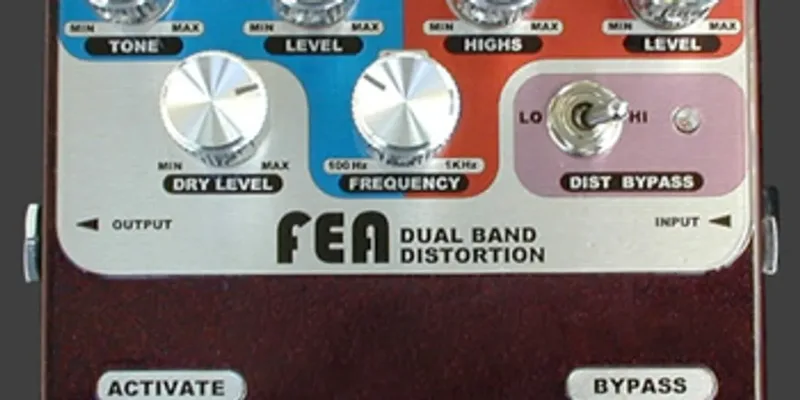


The FEA Labs Dual Band Distortion is a distortion pedal that takes a different approach from a one-circuit dirt box: the incoming guitar or bass signal is divided into two bands of frequencies, each with its own distortion type. The low band delivers a hard clipping distortion built on germanium diodes, while the high band delivers an overdrive built on two FET amplifiers. The pedal also covers octave distortion, using a full wave rectifier, alongside the two band circuits1.
FEA Labs announced the Dual Band Distortion as the latest pedal in its lineup in September 2010, and No Treble reported days later that it was available from the FEA website for $245 plus shipping and handling, matching the special introductory price of $245.00 USD plus S&H given in the announcement (plus tax if shipped within New York State)12.
How the two-band design works
Splitting the signal before distorting it means the low end and the high end can be treated on their own terms. The high band uses two audiophile quality FET (field effect transistor) amplifiers, and the press release describes the result as "a smooth (tube-like) overdrive distortion tone that reacts to the style of the player and the way they attack the strings"1. The low band offers "a classic hard clipping distortion tone using germanium diodes in a unique asymmetrical configuration which adds even order harmonics to the tone"1.
Because each band has its own distortion, the pedal also lets you mix clean and distorted signal by frequency rather than by blending the whole signal. Either the high or low band distortion can be bypassed, which mixes the clean, undistorted signal in the selected frequency band while the other band continues to provide distortion1. For a bassist, that means the fundamentals can stay clean and full while the upper harmonics break up, or the reverse.
The controls
The pedal's feature set centers on three things, per the announcement: an adjustable crossover frequency, a dry signal blend, and a distortion band bypass feature, along with a complement of tone controls1.
- Crossover frequency control: sets the user selectable frequency at which the low band ends and the high band begins1
- Band bypass: removes the distortion from either the high or low band, leaving that band clean while the other keeps distorting1
- Dry signal blend: mixes undistorted signal with the effected signal1
- Tone controls: the announcement mentions a complement of tone controls without detailing them1
- Activation footswitch: a stomp switch with direct bypass when the pedal is not active1
Power and circuit
The pedal runs 18 volt circuitry, but it is powered by a 9 volt battery or a standard 9 volt DC adapter1. That internal step-up approach shows up elsewhere in the FEA Labs range: the FEA Labs DB-CL Dual Band Compressor Limiter, a related dual band design, uses an onboard internal charge pump to operate at 18V from a 9V power supply, which Pedal of the Day noted gives headroom useful for active pickups and aggressive playing styles3.
The 18 volt internal supply comes from a 9 volt source, so the pedal is not asking for an 18 volt supply on your board. A standard 9 volt DC adapter or a 9 volt battery powers it1.
Size and mounting on a board
The press release describes a small footprint design of 4.5" by 3.5"1, compact enough to sit alongside standard pedals on a board. A single activation footswitch handles bypass1.
Videos
Brett Kingman
Brett Kingman
Brett Kingman
Questions
What does dual band mean on the FEA Labs Dual Band Distortion?
The pedal divides the incoming guitar or bass signal into two bands of frequencies, each with its own distortion type. The low band gets a hard clipping distortion using germanium diodes, while the high band gets a FET-based overdrive. The frequency where the low band ends and the high band begins is set by the user with the crossover frequency control.
Does the FEA Labs Dual Band Distortion work with bass?
Yes. The maker's press release describes the incoming signal as a guitar or bass signal, and the pedal's two-band design suits bass because the low and high strings can be treated differently. Either band's distortion can be bypassed to leave that frequency band clean while the other band keeps distorting.
Does it run on a battery?
Yes. The pedal's 18 volt circuitry is powered by a 9 volt battery or a standard 9 volt DC adapter, according to the press release announcing it.
What kind of clipping diodes does it use?
The low band uses germanium diodes in an asymmetrical configuration, which the press release says adds even order harmonics to the tone and gives a classic hard clipping distortion sound. The high band does not use diode clipping; it uses two FET amplifiers for its overdrive.
How big is the FEA Labs Dual Band Distortion?
The press release describes a small footprint design measuring 4.5 inches by 3.5 inches.
Sources (3)
- FEA Labs Releases Dual Band Distortion, Premier Guitar, 2010-09-22
- Gear Watch: FEA Labs Dual Distortion Pedal, No Treble, 2010-09-25
- FEA Labs DB-CL Dual Band Compressor Limiter, Pedal of the Day, 2018-04-18