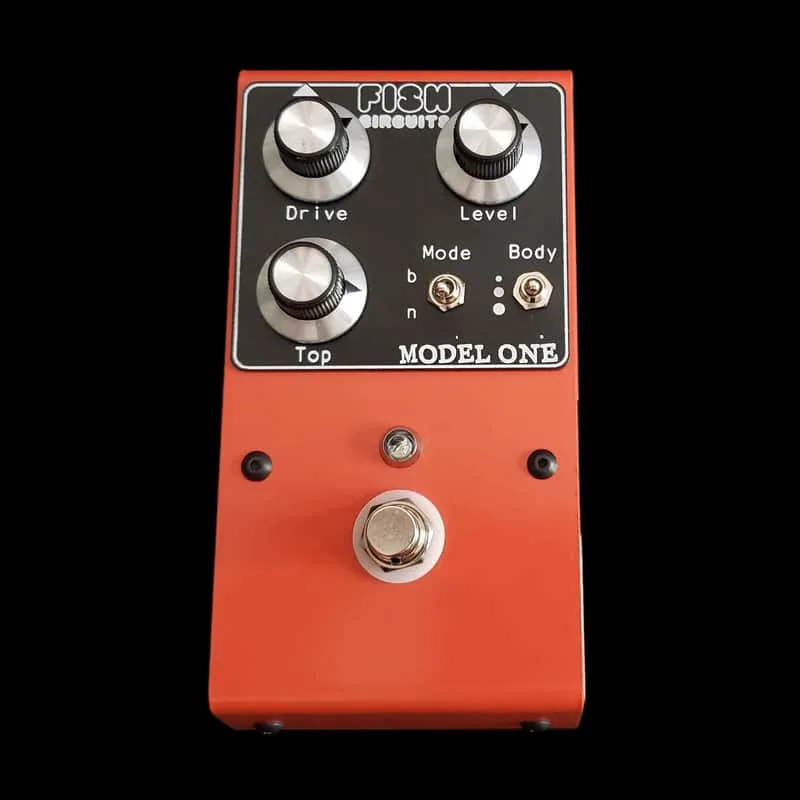


The Fish Circuits Model One is an overdrive pedal built around an original circuit, not a copy of a classic design. It is the first pedal from Fish Circuits, a company launched by Mike Poisson, and it arrived in May 20251. Delicious Audio's Paolo De Gregorio described it as "an overdrive featuring an original circuit"1.
The controls
The Model One keeps a familiar three-knob layout and adds two switches that shape the gain structure1:
- Drive is the gain control1
- Top acts as tone1
- Level sets output volume1
- Mode is a two-way toggle that selects between two different gain structures1
- Body is a three-position switch that sets three low-frequency levels at the input stage1
The Body switch and the two gain modes
The Body switch works at the input of the circuit, before the gain stages. Because the bass cut happens there, De Gregorio notes you will still get a rich full sound when distorted, but with less mud1. The three positions do distinct jobs:
- Top position: cuts most of the bass out1
- Middle position: comes in handy, tidying things up1
- Lowest setting: the fattest, for the biggest and meanest sound, though De Gregorio adds it might even be too much1
The Mode toggle is where the pedal splits in two. Mode n has a lot more volume than b but less gain, delivering a classic low-gain sound. Mode b, with a lot more gain but less volume, offers a saggier and more distorted tone, bordering on fuzz at high Gain settings1. Premier Guitar has referred to the pedal's two settings as its "nice" and "nasty" modes2.
"Mode 'n' has a lot more volume than 'b' but less gain, delivering a classic low-gain sound."
What it sounds like
Delicious Audio describes the Model One as delivering dynamic and touch-sensitive amp-like breakup tones at lower gain settings, while when cranked up it can concoct a wide range of saturated tones, from tasty to thick, up to distortion and borderline fuzz, with loads of sustain and depth1. At the fuzzier end of its range it sits closer to what you would expect from a fuzz pedal than a conventional overdrive1.
Power and practical notes
The Model One runs on just about any 9V DC, negative tip, 2.1mm barrel power supply1. De Gregorio also warns that cheap power supplies tend to induce noise, so the supply you pair with it matters1.
Two things to expect from the Model One: a volume drop when you switch to mode b, and a Drive control that sounds like a scratchy pot when you turn it. Delicious Audio reports both are normal characteristics of the pedal, not faults1.
Videos
JHS Pedals
Fish Circuits
AndyDemos
Questions
Is the Fish Circuits Model One a clone of another overdrive?
No. Delicious Audio's Paolo De Gregorio describes the Model One as an overdrive featuring an original circuit, and it was the first pedal from Mike Poisson's new company. Premier Guitar has also referred to the pedal's two gain settings as its nice and nasty modes, underlining that it works differently from a standard single-mode overdrive.
Why does the Model One's Drive knob sound scratchy?
According to Delicious Audio, the Drive control sounds like a scratchy pot when you turn it, and this is normal. It is a characteristic of the circuit, not a fault, so a scratchy sound while adjusting the knob is not a reason to send the pedal back.
Why is there a volume drop in b mode?
Mode b runs with a lot more gain but less volume, so a drop in level when you switch to it is expected. Delicious Audio notes you should expect a volume drop on b mode, which trades output for a saggier, more distorted tone that borders on fuzz at high Gain settings.
What power supply does the Fish Circuits Model One need?
The Model One runs on just about any 9V DC, negative tip, 2.1mm barrel power supply, according to Delicious Audio. Cheap power supplies tend to induce noise, so a quality supply is worth using with this pedal.
Who designed the Fish Circuits Model One?
Mike Poisson designed the Model One and launched it as the first pedal from his new company, Fish Circuits, which Delicious Audio reported is based in Montreal. The pedal was announced in May 2025.
Sources (2)
- Fish Circuits Model One Overdrive, Delicious Audio, 2025-05-19
- Fish Circuits Lunatique Effects Pedal Review, Premier Guitar, 2024-07-03