

The Fishman AFX AcoustiVerb is a mini reverb pedal designed from the ground up for the acoustic-electric guitarist, part of the AFX Mini series Fishman launched alongside the Pro EQ Mini, Broken Record and Pocket Blender1. Where most reverb pedals are voiced for electric guitar into an amp, the AcoustiVerb is optimized for acoustic guitar, with Fishman describing echoes that complement the acoustic's natural tone without washing it out23.
The pedal offers three reverb types, Spring, Hall and Plate, blended in parallel with your direct sound so the core acoustic tone is preserved4. Fishman says it is easy to add studio-quality reverb to your tone with a reverb pedal optimized for acoustic guitar, and the AcoustiVerb is built around a premium audio path designed to maintain the extended frequency range an acoustic-electric produces2.
A reverb voiced for acoustic guitar
Each of the three reverb types has its own character, and Fishman describes what each one does4:
| Reverb type | What Fishman says it does |
|---|---|
| Spring | Recreates the classic sound of a spring reverb found in many electric guitar amplifiers |
| Hall | An all-around reverb with natural, resonant spaces capable of replicating rooms both small and large, with long reverb decay times |
| Plate | Recreates the dense reflections and metallic characteristics of mechanical plate reverbs used throughout the 50s, 60s and 70s |
A selection switch on the pedal gives quick and easy access to all three4.
Premier Guitar's reviewer found each mode suited different playing situations. The warm, contoured reflections of the hall mode were ideal for fingerstyle settings, where highlighting fundamentals and bass resonance matters and low-end wash would be a problem, while the plate mode suited strummed parts enhanced by breathy, high harmonics1.
The controls
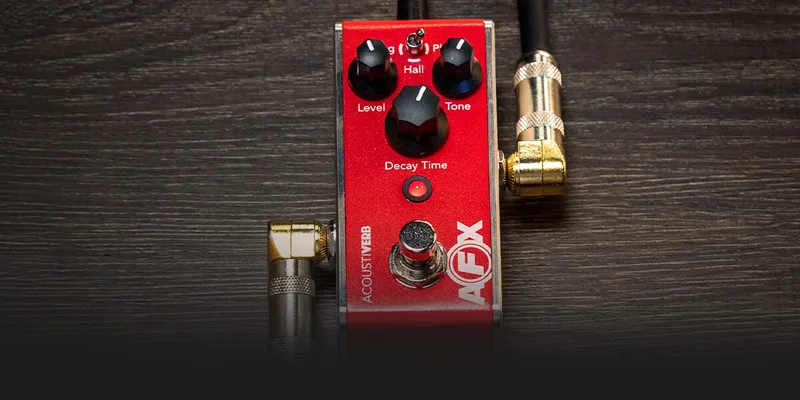
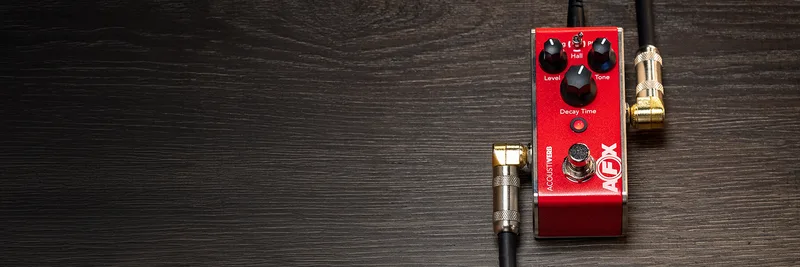
The AcoustiVerb uses a three-knob design, which RockBoard's PedalPedia describes as a straightforward operation that is easy to quickly tweak onstage3. GuitarPlayer's reviewer Jimmy Leslie noted the layout: a mini-switch to toggle between the reverb types, level and tone knobs positioned left and right, and a larger knob for decay time5.
| Control | What it does |
|---|---|
| Reverb Select switch | Quick access to the three reverb effects: Spring, Hall and Plate4 |
| Level | Adjusts the effect level, letting you balance it with your bypass volume4 |
| Tone | Adds brightness or warmth to the sound of the effect without altering your direct sound4 |
| Reverb Time / Decay Time | Controls how long you hear the effect, ranging from short to very large spaces; determines how quickly the reverb tail decays into silence4 |
| Audio Path switch | Lets you choose the audio path on which the effect is processed4 |
A key point for acoustic players: the controls only manipulate the effected sound, not the direct audio. As GuitarPlayer's review put it, the three reverbs are blended in parallel with your direct sound while preserving your acoustic tone45.
Bypass and the reverb tail
The AcoustiVerb ships with true bypass, meaning the pedal's electronics are literally removed from the signal chain when it is off4. For players who prefer a buffer, the pedal can be switched to buffered bypass instead4.
In buffered mode, the pedal lets the reverb spill over even after you hit the bypass button, so the tail decays naturally instead of cutting off abruptly5.
Power
The pedal runs on 9V DC with a center-negative connection, drawing about 53mA3. Fishman lists the 910-R AC adapter as sold separately, and says any suitable filtered and regulated 5.5mm OD, 2.1mm ID barrel connector with center negative will work4.
What reviewers said
Published reviews were positive about the pedal's sound and usability.
GuitarPlayer's review summed up its reasons to buy the AcoustiVerb as an "Intuitive layout, simple yet flexible. Luscious reverbs"5.
"how readily you can move between nearly subliminal ambience, tasty but restrained coloration, and wide-open spaces"
Premier Guitar also found sweet spots easy to find thanks to the economical control set, calling the AcoustiVerb an adaptable tool for quiet stage support or unorthodox acoustic ambience, and noting its small size and accessible $119 price1.
The AFX Mini series
Fishman lists the AFX AcoustiVerb at $119 USD, powered by a 9V DC center-negative supply with a 53mA current draw4.
Videos
Fishman Music
Fishman Music
Fabian Holland
Questions
Is the Fishman AFX AcoustiVerb analog or digital?
It is a digital pedal with an analog signal path. The reverb processing uses 32-bit DSP, and the conversion between analog and digital runs at 24-bit. Fishman describes the audio path as analog, with the effect blended in parallel with your direct sound.
How many reverb types does the AcoustiVerb have?
Three: Spring, Hall and Plate. A selection switch on the pedal gives quick access to all three. Spring recreates the classic amp-spring sound, Hall covers natural rooms from small to large, and Plate emulates the mechanical plate reverbs of the 50s, 60s and 70s.
What power does the AcoustiVerb need?
It runs on 9V DC with a center-negative barrel connector, drawing about 53mA. Fishman sells its 910-R AC adapter separately, and any suitable filtered and regulated 5.5mm OD, 2.1mm ID barrel supply with center negative will work.
Does the AcoustiVerb affect my direct signal?
No. The three reverbs are blended in parallel with your direct sound, and the Level, Tone and Decay Time controls only manipulate the effected sound, not the direct audio. Your acoustic's core tone passes through unchanged.
Can the reverb tail continue after I bypass the pedal?
Yes, in buffered mode. The pedal ships with true bypass, but you can switch it to buffered bypass, and in that mode the reverb spills over naturally after you hit the bypass button instead of cutting off abruptly.
Which other pedals are in the Fishman AFX Mini series?
The AFX Mini series launched in October 2023 with four pedals aimed at acoustic guitarists: the AcoustiVerb reverb, the Pro EQ Mini preamp and EQ, the Broken Record looper, and the Pocket Blender. Fishman also makes AFX Mini delay, chorus and compressor pedals.
Sources (5)
- Fishman AFX AcoustiVerb Review, Premier Guitar, 2023-10-16
- Expand Your Creativity with Acoustic Effects Pedals, Fishman
- AFX AcoustiVerb by Fishman, RockBoard PedalPedia, 2026
- AFX AcoustiVerb Mini Acoustic Guitar Reverb Pedal, Fishman
- Fishman AFX Mini Acoustic Pro EQ Mini, Broken Record, AcoustiVerb and Pocket Blender Effects Pedal Reviews, GuitarPlayer, 2023-08-18