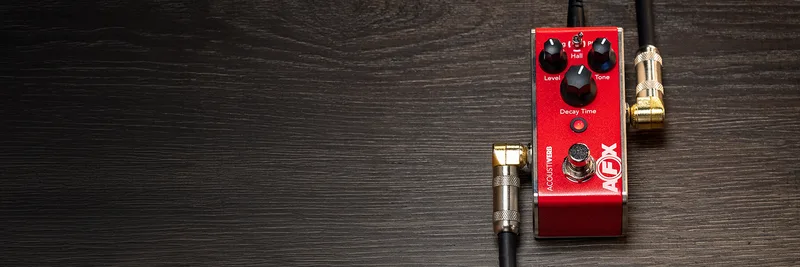

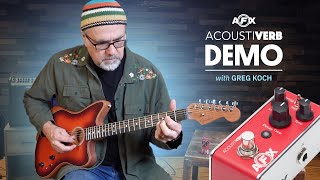

Spring, Hall and Plate reverb in a mini pedal
A single Reverb Select switch on the pedal gives quick access to the three reverb types1:
| Mode | What Fishman says it does |
|---|---|
| Spring | Recreates the classic sound of a spring type reverb found in many electric guitar amplifiers1 |
| Hall | An all-around reverb with natural, resonant spaces capable of replicating rooms both small and large, with long reverb decay times1 |
| Plate | Recreates the dense reflections and metallic characteristics of mechanical plate reverbs used throughout the 50's, 60's, and 70's1 |
In Guitar Player's review, Jimmy Leslie noted that "the spring setting offers the familiar sound of a classic tube amp"4. The reverbs are blended in parallel with the direct sound while the pedal preserves the acoustic character of the instrument, which Fishman attributes to its 32-bit processing and analog signal path1. Acoustic Guitar's reviewer, Emile Menasché, found that "the 32-bit AcoustiVerb has a big, lush sound and plenty of headroom"5.
The controls
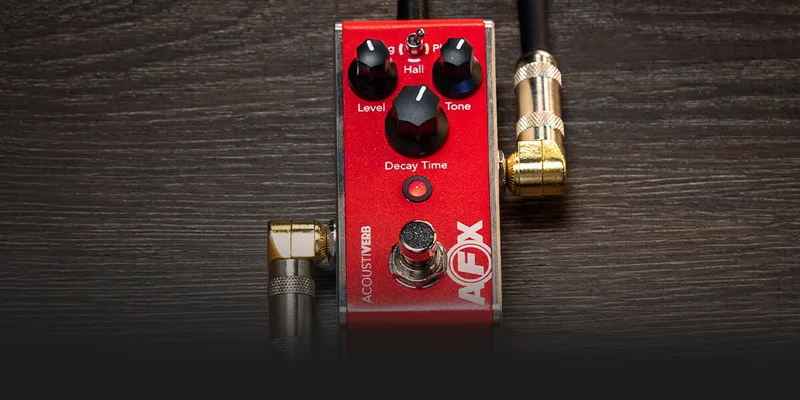
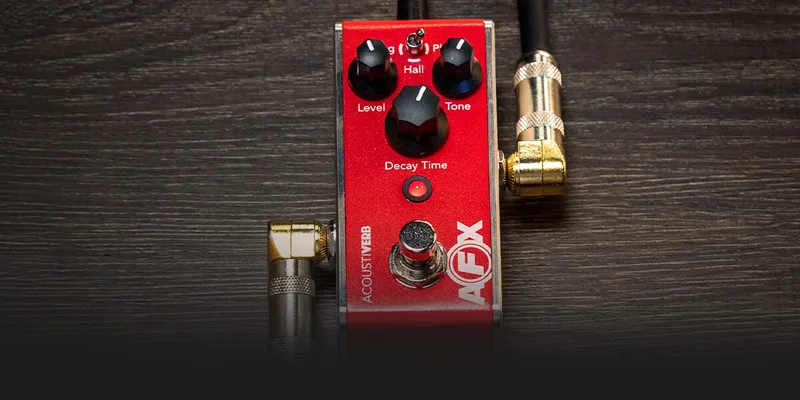
The pedal uses a three-knob design that RockBoard's PedalPedia describes as "a straightforward operation that's easy to quickly tweak" onstage2. Guitar Player describes the layout as level and tone knobs positioned left and right, with a larger knob for decay time4.
| Control | What it does |
|---|---|
| Level | Adjusts the effect level, letting you balance it with your bypass volume1 |
| Tone | Adds brightness or warmth to the sound of the effect without altering the direct sound1 |
| Decay Time | Determines how quickly the reverb tail decays into silence, ranging from short to very large spaces1 |
A point that matters for acoustic players: the controls only shape the affected sound, not the direct audio. As Leslie put it in Guitar Player, "the controls only manipulate the affected sound, not the direct audio"4. Emile Menasché describes the level control as a mix control, alongside decay time and tone5.
Bypass and the Audio Path switch
The AcoustiVerb ships with true bypass, which Fishman describes plainly: "With true bypass, the pedal's electronics are literally removed from the signal chain"1. Players who prefer a buffered signal can switch it, and the choice has an audible consequence. In buffered mode, when you press the footswitch to bypass the effect, the reverb continues to decay naturally instead of cutting off dead1. Guitar Player highlighted this, noting the pedal "lets the reverb spill over even after you hit the bypass button when it's in buffered mode"4. Holding the footswitch while applying power changes the pedal to a full mute instead1.
The Audio Path switch lets you choose the audio path on which the effect is processed, deciding whether the reverb applies to the ring or the tip of the input and output15. This is the feature that ties the AFX Mini pedals together as a system for acoustic players running more than one effect.
What reviewers said
Acoustic Guitar reviewed the AcoustiVerb at the series launch and summed it up favorably5:
"Overall, the AcoustiVerb boasts an impressive sound, easy operation, and surprising versatility"
Premier Guitar covered the pedal as part of its demos of the AFX Mini Series, alongside the Pro EQ and Broken Record3.
Videos
Fishman Music
Fishman Music
Fabian Holland
Questions
Does the Fishman AcoustiVerb have true bypass?
Yes, and it also offers buffered bypass. The pedal ships with true bypass, which removes its electronics from the signal chain, but you can switch to buffered operation. In buffered mode, the reverb tail spills over and decays naturally after you hit the bypass switch, instead of cutting off abruptly.
What does the Audio Path switch do?
The Audio Path switch lets you choose which audio path the effect is processed on, deciding whether the reverb applies to the ring or the tip of the input and output connection. This is useful when running Fishman AFX Mini pedals together in a stereo or dual-cable setup.
Is the Fishman AcoustiVerb analog or digital?
It is a digital pedal with an analog signal path. Fishman specifies 32-bit signal processing with 24-bit A/D and D/A conversion, which the company says preserves the extended dynamic range of an acoustic pickup while the effect is blended in parallel with the direct sound.
What reverb types does the AcoustiVerb offer?
Three: Spring, Hall and Plate. Spring recreates the classic spring reverb of many electric guitar amplifiers, Hall covers natural rooms from small to large with long decay times, and Plate recreates the dense, metallic reflections of mechanical plate reverbs from the 1950s, 60s and 70s.
Is the AcoustiVerb part of the AFX Mini Acoustic series?
Yes. Fishman launched the AFX Mini Acoustic series on October 13, 2023, releasing four pedals for acoustic guitarists: the Pocket Blender, AcoustiVerb, Broken Record and Pro EQ Mini. The AcoustiVerb carries the model number PRO-AFX-RV2.
Sources (5)
- AFX AcoustiVerb Mini Acoustic Guitar Reverb Pedal, Fishman
- AFX AcoustiVerb by Fishman, RockBoard PedalPedia, 2026
- Fishman AFX AcoustiVerb Review, Premier Guitar, 2023-10-16
- Fishman AFX Mini Acoustic Pro EQ Mini, Broken Record, AcoustiVerb and Pocket Blender Effects Pedal Reviews, GuitarPlayer, 2023-08-18
- Fishman’s New AFX Mini Acoustic Pedals Are Tailored for Acoustic Guitarists, Acoustic Guitar (acousticguitar.com), 2023-10-13