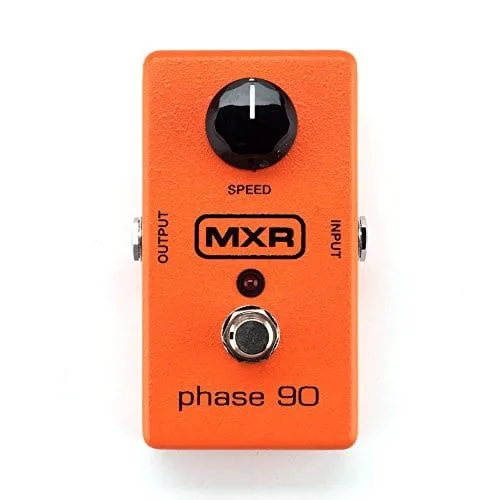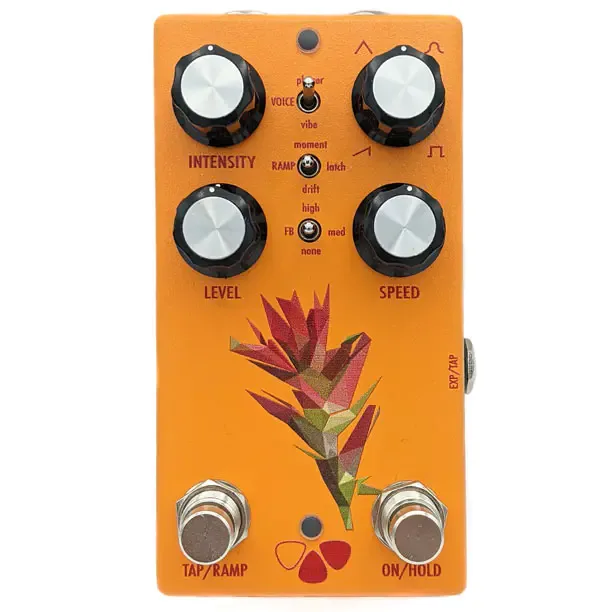


The Flower Pedals Castilleja is a four-stage analog optical phaser pedal with digital controls, and it stands apart from most phasers by offering two voicings in one box: a standard four-stage phaser in the vein of classics such as the MXR Phase 90, and a voicing modeled on the classic Univibe, selected with a toggle on top of the pedal1. Delicious Audio describes it as a boutique multi-modulation pedal with plenty of flexibility, noting that beyond phaser and Univibe sounds it can also cover vibrato and chorus duties2.
The analog side is the audio path itself: four optical phase stages, the same general approach as the vintage units its voicings reference. The digital side is the control layer, which is what makes tap tempo, selectable waveforms and the ramping modes possible1.
The controls
The front panel keeps the core modulation controls simple. The Speed and Intensity knobs set the frequency and depth of the LFO, and the Level knob controls overall output volume, with what Delicious Audio calls plenty of boost on tap2.
The waveform side is where the digital control layer shows itself. The top left knob offers four LFO waves: sine, square, sawtooth and triangle2. Premier Guitar describes these as four continuously variable waveforms selected via the Shape knob, so you can blend between them rather than jumping between fixed settings1.
| Control | What it does |
|---|---|
| Speed | Sets the LFO frequency (main speed) |
| Intensity | Sets the LFO depth |
| Shape (top left) | Selects among four continuously variable LFO waves: sine, square, sawtooth, triangle |
| Level | Overall output volume, with boost available |
| Top toggle | Selects the phaser or Univibe voicing |
| Third toggle | Configures the Tap/Ramp footswitch mode |
The pedal also carries three levels of feedback: none, low and high1. Feedback controls how much of the phased signal is recirculated through the stages, which shapes how pronounced and resonant the sweep sounds.
Ramping, latch and drift modes
A third toggle switch configures the Tap/Ramp footswitch in one of three modes2:
- Momentary ramping: ramps the LFO's speed to a secondary speed for as long as you press the footswitch2.
- Latch ramping: ramps to the secondary LFO speed and stays there until you press the footswitch again2.
- Drift mode: takes your base speed and modulates that speed up and down to a different LFO, while still letting you use tap tempo to set your main speed2.
The speed and depth of these ramping modes are set by holding the On/Hold footswitch and adjusting the Speed and Shape knobs2. In practice this gives you two speeds per patch: your main speed, and a secondary speed you can ramp to for a swell or a shift in intensity, either momentarily or latched.
Tap tempo and expression
The Castilleja offers tap tempo with four different subdivisions2. The Exp/Tap jack on the pedal accepts either an external tap connection to control tap and ramp, or an expression pedal (signal tip) to control the speed2.
When an expression pedal is plugged in, you can set the heel and toe speeds using the Speed knob and the secondary function of the Speed knob2. That means the sweep of the expression pedal can be limited to a useful range rather than spanning the pedal's entire speed range.
What reviewers said
Premier Guitar reviewed the Castilleja in June 2023 and positioned it as a bridge between two camps of phaser design3:
"If you're looking for a middle ground between straightforward, vintage phase sounds and the parameter depth of a programmable device, Flower Pedals' Castilleja could be a godsend."
The reviewer also noted that its orange exterior hints at the classic four-stage phase sounds of yore3, a nod to the Phase 90 lineage its standard voicing draws on.
Availability and price
At its launch, the Castilleja was available for purchase on the Flower Pedals website and Reverb.com for $249 plus free shipping in the U.S.1. That price dates from Premier Guitar's May 2021 coverage.
Videos
Flower Pedals
AndyDemos
collector//emitter
Questions
Can the Flower Pedals Castilleja do chorus and vibrato?
Yes. Its Univibe voicing is the classic route to those sounds: Delicious Audio notes that alongside the phaser and Univibe voicings it can also cover vibrato and chorus duties. Switch to the Univibe side of the top toggle and dial the intensity back for chorus-style movement, or up for vibrato.
What power supply does the Castilleja need?
It runs on 9V DC with a center negative plug, drawing less than 100 mA. That suits a standard pedalboard power supply, and the sub-100 mA draw leaves room on most isolated outputs shared with other small pedals.
Is the Castilleja analog or digital?
Both, in a hybrid design. The audio path is a four-stage analog optical phaser, while the controls are digital. That is what allows features like tap tempo with four subdivisions, selectable LFO waveforms and the ramping and drift modes.
How much does the Flower Pedals Castilleja cost?
Premier Guitar reported a price of $249 plus free shipping in the U.S., available on the Flower Pedals website and Reverb.com. That was the price at launch coverage in May 2021; current pricing may differ.
Sources (3)
- Flower Pedals Releases the Castilleja Phaser, Premier Guitar, 2021-05-10
- Flower Pedals Castilleja Phaser/Uni-Vibe, Delicious Audio, 2021-05-31
- Flower Pedals Castilleja Phaser Review, Premier Guitar, 2021-11-14