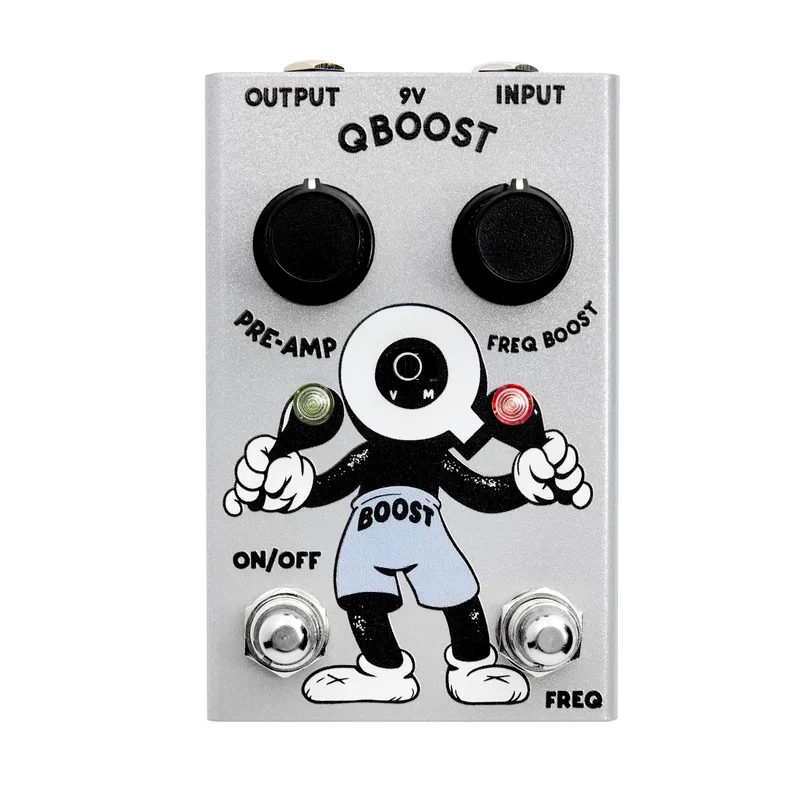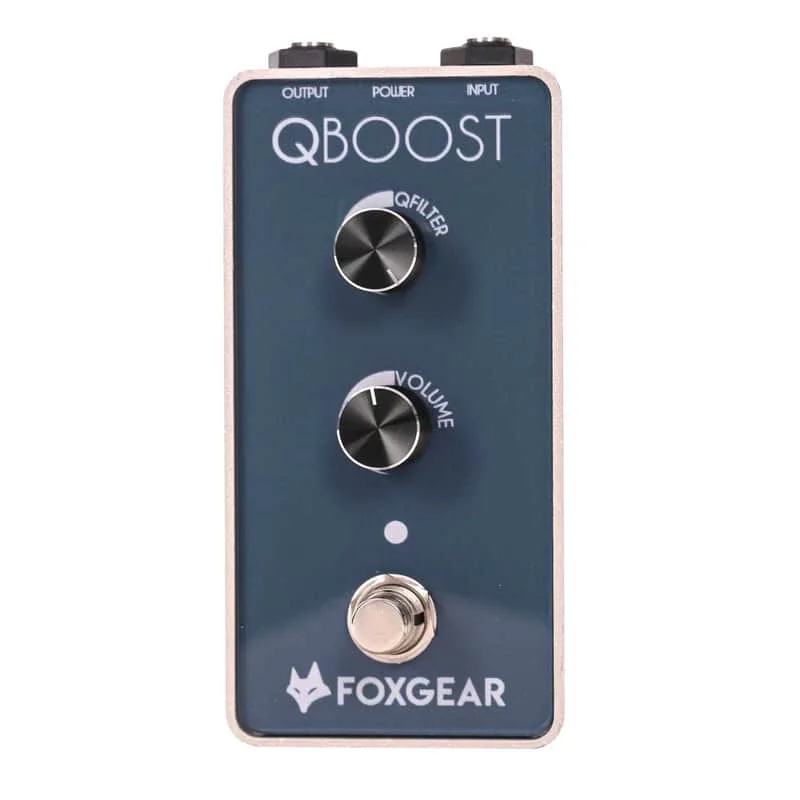

The Foxgear QBoost is an analog booster pedal built around a semi-parametric tone filter. Instead of a single fixed boost, it lets the player choose the precise frequency to boost, which RockBoard's PedalPedia says can be used to lift middle frequencies for a cutting tone, push an amp's preamp with selected frequencies, or run always-on as a personalized tone shaper1. It sits in the wider family of boost pedals, but the tunable filter sets it apart from a simple clean volume push.
What the QBoost does
The heart of the pedal is its tone filter. RockBoard's PedalPedia describes the range of the QBoost's filter as much akin to that of a wah-wah pedal, meaning it sweeps across a wide band of the guitar's frequency range rather than acting on one narrow slice1. Because the boost is semi-parametric, the player selects both that a frequency is boosted and which one, from lows to highs, with what the maker calls a natural Q factor2.
In practice, that gives a player three broad uses:
- As a mid boost, it can push a solo forward in a mix.
- As a preamp push, feeding selected frequencies into the front of an amp, it can drive the amp into break-up in a more targeted way than a flat boost.
- Left on all the time, it can act as a fixed tone shaping stage.1
The Stone Deaf QBoost connection
The QBoost has also been covered in the press under the Stone Deaf FX name. Guitar.com described the launch of the QBoost as "a pedal that combines a preamp and a parametric frequency booster"3, and MusicRadar noted an onboard frequency booster covering 35Hz to 6kHz4. Guitar World put the range of sounds this way:
"the QBoost aims to give you everything from a transparent boost to a saturated, dying amp fuzz"
Guitar.com's review described the pedal as "a full-range booster/preamp with switchable vintage saturation and a separate frequency-tunable boost circuit". The same publication suggested uses including pushing an amp into break-up with the preamp side and cutting through the mix for a solo with the frequency side, or pairing it with other drive or fuzz pedals to bring out more focused, filtered sounds from them3. The Stone Deaf version of the pedal is covered separately on the Stone Deaf QBoost page.
The QBoost draws 100mA at 9V DC, center negative1. That is more than some low-draw boost pedals need, so it is worth checking what a pedalboard power supply can deliver on the outlet used.
How it compares
A conventional boost pedal usually raises the whole signal evenly, or tilts it with one fixed tone control. The QBoost's semi-parametric approach means the boost can be aimed: the player dials in the frequency, and the filter's wah-like range covers everything from low-end body to upper presence1. Where a player wants the preamp-pushing and saturation behavior the press described, the QBoost overlaps with preamp pedals as well as boosters673.
| Approach | What it does to the signal |
|---|---|
| Conventional boost | Raises the whole signal evenly, or tilts it with one fixed tone control |
| QBoost semi-parametric | Player dials in the frequency to boost, with a wah-like filter range from low-end body to upper presence1 |
Videos
Robert Jackson
Sources (7)
- QBoost by Foxgear, RockBoard PedalPedia, 2026
- Qboost by Stone Deaf Effects, RockBoard PedalPedia, 2026
- Stone Deaf FX launches the QBoost, Guitar.com, 2020-12-16
- Stone Deaf launches the limited edition QBoost analogue preamp and tone-shaper, MusicRadar, 2020-12-16
- Stone Deaf seeks to "make good tones great" with the QBoost preamp/tone shaper, Guitar World, 2020-12-16
- Gear Of The Year: Best Affordable Effects Pedal of 2021, Guitar.com, 2021-12-10
- Stone Deaf QBoost review: a versatile tone-shaping and gain-boosting pedal, guitar.com, 2021-08-23