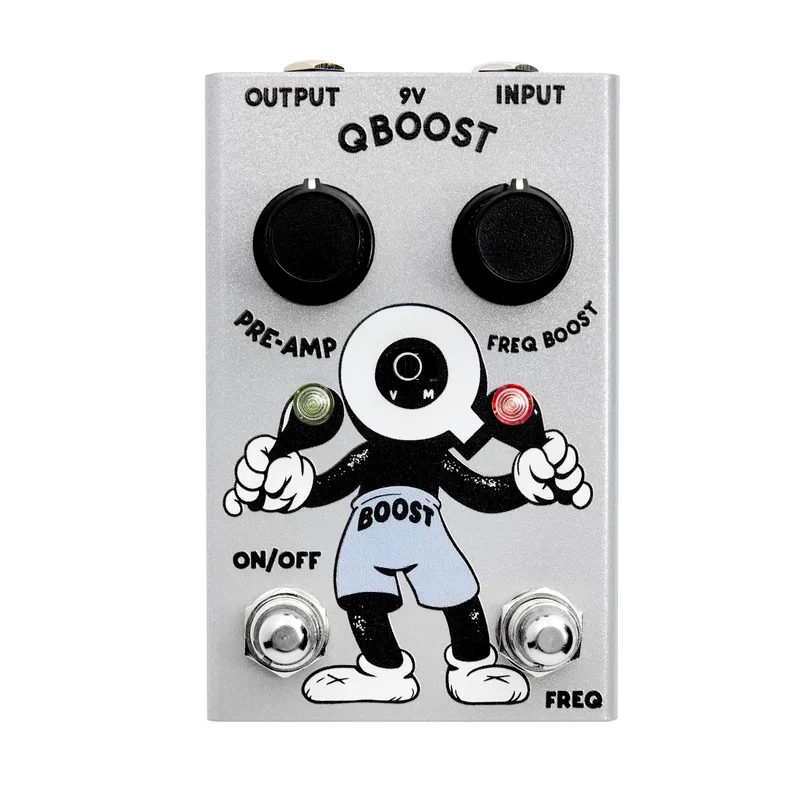


The Stone Deaf QBoost is an analog boost pedal and preamp from Stone Deaf, the British builder hand-building pedals just outside Manchester1. What sets it apart from a standard clean boost is a second, footswitchable circuit: a parametric frequency boost that pushes a specific frequency you can sweep anywhere from 35Hz to 6kHz23. Stone Deaf rates the pedal at nearly 40dB of total overall gain4.
Think of it as two pedals in one box. The preamp side is a full-range booster with switchable vintage saturation1; the frequency side adds a tunable hump on top, with its gain and bandwidth fixed and only the center frequency under your control1. Guitar.com summed it up as "a pedal that's about as versatile as a compact tone-shaping and gain-boosting pedal could possibly be"5.
What the QBoost does to your sound
The preamp side is straightforward: turn the Preamp knob clockwise and you hit your pedals and amp harder6. In Modern mode that is a clean, transparent boost that never distorts2, which Stone Deaf says works well for filling out your tone, pushing solos and breaking up your amp4. Guitar.com's reviewer found unity gain at around 10 o'clock on the preamp knob, just a touch thicker and darker than the bypass sound1.
The frequency side is where the QBoost earns its name. Stepping on the second footswitch adds a boost at whatever frequency you have dialed in, from 35Hz to 6kHz, covering the bass-to-treble spectrum of guitar-centric frequencies38. Stone Deaf describes the Q, the shape of the frequency hump, as medium, meaning no awkward resonant harshness should come from extreme settings3. In Vintage mode the Freq Boost knob sweeps the frequencies with that fixed gain and natural EQ curve, adding bite, air, warmth or fatness as needed2.
Delicious Audio's write-up captured the range: "The QBoost does it all, from transparently frequency boost to saturated overdrive and 'dying amp' fuzz."2
The controls
| Control | What it does |
|---|---|
| Preamp knob | Sets the output level of the main boost1 |
| Frequency knob | Adjusts the center frequency of the hump, from 35Hz to 6kHz; the hump's gain and bandwidth are fixed13 |
| Mode switch | A slider or toggle in the center of the pedal selecting Vintage or Modern preamp modes12 |
| Left footswitch | Engages the preamp3 |
| Right footswitch | Adds the frequency boost independently1 |
| Master bypass footswitch | Bottom-left; takes the whole pedal out of the chain1 |
The layout is two amp-style knobs, a single toggle switch and two footswitches, with top-mounted jacks3. The enclosure is a rugged little metal brick1; the limited edition carried Mickey Mouse-themed artwork by McBess2.
Vintage and Modern modes
A two-way switch in the center of the pedal selects between the two preamp voices2, which Stone Deaf calls a double-sided circuit6.
- Modern: A clean, transparent boost that never distorts2. Stone Deaf says it fills out bass and guitar tones and is great for solos and breaking up your amp4; Guitar World described the modern voicing as promising pristine cleans8. Depending on pickups and amplifier, it can induce a glassy overdrive tone7.
- Vintage: A more saturated, distorted boost in the vein of old-school treble boosters8, aiming at the tone of saturated drive and fuzz8. Delicious Audio found it full of saturation even at low levels, delivering distorted and even fuzzy tones at higher gain2. Guitar.com's reviewer went further: push the preamp close to maximum and "it could almost be a Big Muff"1.
Where it came from
The QBoost launched on 16 December 2020 as a limited edition of 500 units worldwide, priced at £170 and available immediately68. It was hand-made in Manchester8.
In August 2021 the pedal went into full production as an unlimited version, doing the same job with a different paint job, at £1391. A Silver Edition followed, bringing back the original McBess artwork in a different colorway with a custom toggle switch, after customers asked for it7. The original limited edition itself is now sold out and discontinued4.
If you are shopping for a QBoost today, the 2020 limited edition is discontinued4. The full-production version and the Silver Edition are the ones to look for, and their power specs differ slightly from the review unit: the Silver Edition's maker listing specifies 9V DC center negative at 55mA7, while Guitar.com's 2021 review unit ran on a 9-volt mains supply at 65mA1.
What reviewers said
Guitar.com's Richard Purvis reviewed the full-production version in August 2021 and found it "deceptively flexible"1. On the frequency boost, he reported that "with the frequency dial set anywhere around halfway, we're greeted by a rich and spicy honk", a tightening of tonal focus, maybe not quite a stuck wah effect1. MusicRadar's Jonathan Horsley had earlier reported that depending on where you place the Freq Boost, "you can get some very gnarly Schenker-esque cocked wah tones"6.
Delicious Audio called it "an incredibly flexible pedal that does a lot by itself but that can do a heck of a lot more when used in conjunction with an amp"2. Guitar.com's 2021 affordable-pedals awards feature echoed the versatility verdict, describing the result as about as versatile as a compact tone-shaping and gain-boosting pedal could possibly be5.
Using it with other gear
The QBoost works for guitar or bass rigs2, and Stone Deaf positions it as an essential piece of kit for any bass or guitar player4. The 35Hz bottom of the frequency sweep reaches low enough to push bass fundamentals rather than just guitar mids3.
Guitar.com suggested typical pairings: pushing an amp into break-up with the preamp side and cutting through the mix for a solo with the frequency side, or pairing it with other drive or fuzz pedals to bring out more focused, filtered sounds from them3.
Videos
Pete Thorn
Stone Deaf FX
Eirik Stordrange
Questions
Does the Stone Deaf QBoost take a battery?
No. The QBoost runs on a 9-volt power supply only, with no battery option. The review unit measured by Guitar.com drew 65mA, while the Silver Edition's maker listing specifies 9V DC center negative at 55mA, so plan a spot on a power supply rather than a daisy chain with tight headroom.
Is the Stone Deaf QBoost true bypass?
Yes. Both Guitar.com's news coverage and its full review list true-bypass switching, so the pedal is out of the signal path completely when disengaged. It also has top-mounted jacks, which helps with tight pedalboard layouts.
Can the QBoost be used on bass?
Yes. Stone Deaf describes it as a boost and tone shaper for bass or guitar players, and the frequency boost sweeps down to 35Hz, low enough to push bass fundamentals. Delicious Audio also pitched it at guitar or bass rigs.
Can the QBoost sound like a cocked wah?
It can get close. MusicRadar reported that depending on where you set the Freq Boost control you can get gnarly, Michael Schenker-style cocked wah tones. Guitar.com's reviewer described the halfway setting as a rich honk and tightening of focus, maybe not quite a stuck wah.
How many limited edition QBoost pedals were made?
The original QBoost launched in December 2020 as a limited edition of 500 units worldwide, priced at £170. It went into full production in 2021 as an unlimited version with a different finish, and a Silver Edition with the original McBess artwork in a new colorway followed.
Sources (8)
- Stone Deaf QBoost review: a versatile tone-shaping and gain-boosting pedal, guitar.com, 2021-08-23
- Stone Deaf FX Q Boost/Distortion, Delicious Audio, 2021-10-01
- Stone Deaf FX launches the QBoost, Guitar.com, 2020-12-16
- Q Boost Ltd, Stone Deaf
- Gear Of The Year: Best Affordable Effects Pedal of 2021, Guitar.com, 2021-12-10
- Stone Deaf launches the limited edition QBoost analogue preamp and tone-shaper, MusicRadar, 2020-12-16
- Q Boost Ltd Silver Edition by Stone Deaf Effects, RockBoard PedalPedia, 2026
- Stone Deaf seeks to "make good tones great" with the QBoost preamp/tone shaper, Guitar World, 2020-12-16