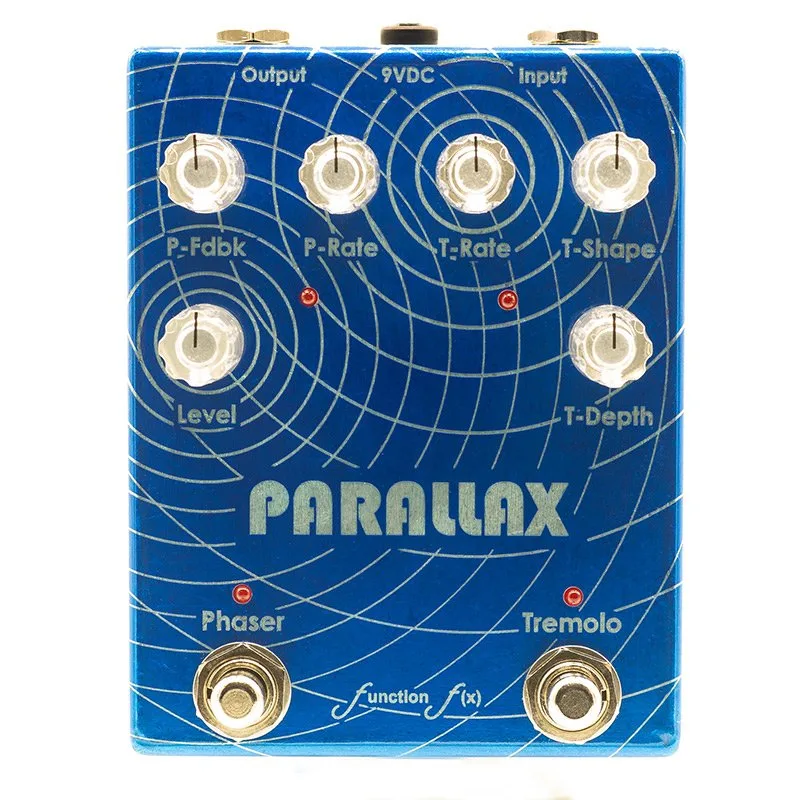

The Function f(x) Parallax is a modulation pedal that combines an optical, op-amp-based tremolo with an OTA-based 5-stage phaser in one box1. Function f(x) describes it as a mashup, and the manual sums up the design in one line:
"Think of the Parallax as a flexible tremolo with a phaser riding shotgun."
The signal hits the tremolo first, then the phaser. The tremolo can be transparently subtle or very deep, with triangle and square waveshapes that can be blended, while the phaser is capable of very slow and subtle filter effects up through what the maker calls "watery phase-shifting madness"3. Both effects have independent low-frequency oscillators with dedicated controls, so the two sides can sweep at entirely different speeds1.
What it does: optical tremolo into a phaser
The tremolo section is optical, using a sealed vactrol as the optical element, which Function f(x) says maximizes consistency in sound from unit to unit3. The circuit is what the maker calls "a very clean and straightforward implementation drawing from a variety of historical optical tremolo circuits," adapted to play well with a phaser3.
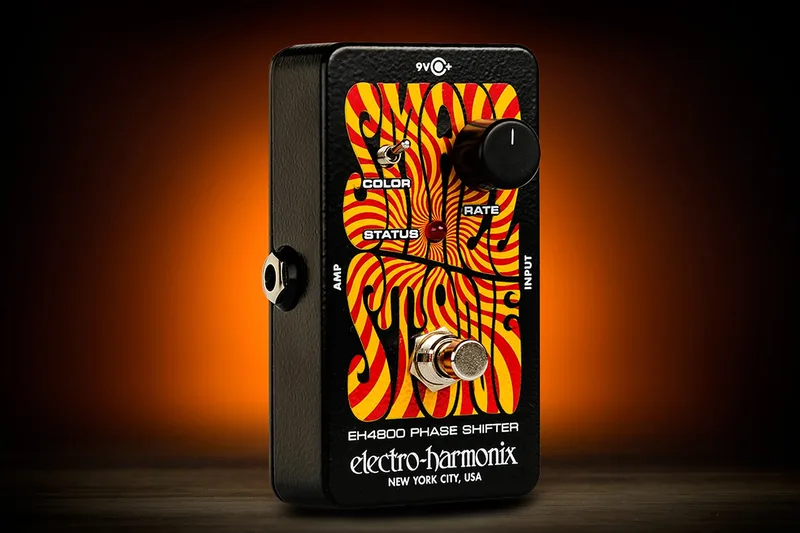
The phaser section has 5 phase stages: 4 are "swept" OTA (operational transconductance amplifier) stages, with an additional "fixed" op-amp-based phase stage3. In Function f(x)'s own technical writing on phaser pedals, the Parallax sits alongside the Electro-Harmonix Small Stone and Subdecay Quasar Deluxe as a commercial example of OTA-based phase shifting5.
Because the tremolo feeds the phaser, the amplitude wobble of the tremolo is shaped further by the phase sweep, which is what gives the pedal its layered, moving character compared with running either effect alone. Players looking for either effect on its own can read more at tremolo pedals and phaser pedals.
The controls
The manual names the controls and what each does2:
| Control | What it does |
|---|---|
| P.Rate | Controls the rate (or speed) of the phaser's LFO |
| T.Shape | Controls the waveshape of the tremolo's LFO; fully counterclockwise is a triangle wave, fully clockwise is a (pseudo) square wave, in between is a mix of the two |
| T.Depth | Controls the tremolo's LFO depth |
| Level | Overall output level, to match bypass volume |
The phaser front-end can be toggled on and off via a dedicated footswitch, so the phaser can be pulled out of the chain while the tremolo keeps running3. The pedal's main footswitch handles the true bypass switching for the whole unit3.
A phaser from the Maestro Phase Shifter, a tremolo from optical circuits
Function f(x) is direct about where the circuits came from. On the phaser side321:
"credit is due to the old Maestro Phase Shifter, which we updated with modern components and modified for inclusion in this pedal."
The tremolo side draws from a variety of historical optical tremolo circuits rather than one specific ancestor, adapted so the two sections work together3. The enclosure carries laser-etched artwork1.
Power, bypass and warranty
The Parallax runs on 9V DC, the industry-standard pedal supply voltage, and draws about 35mA3. Switching is soft-touch and relay-based true bypass, the same system Function f(x) uses across its pedal line3.
Function f(x) warrants its pedals against defective parts and workmanship for 1 year from the date of purchase, excluding damage caused by user error2. After that first year, repairs may incur a fee to cover parts or labor, and a full PCB replacement can take as long as 4 to 6 weeks if critical parts are out of stock; the maker asks for no costs upfront2. Support contact is support@function-fx.com, with replies usually within 24 hours2.
The Parallax is listed as out of stock on the maker's site, with a waitlist available for notification when it returns3. The list price of $229.00 appears on the maker's site as of September 20264.
Videos
Mike Hermans
Ed Pettersen
Questions
Is the Function f(x) Parallax true bypass?
Yes. The Parallax uses a soft-touch, relay-based true bypass switching system, which Function f(x) fits across its pedal line. When the pedal is off, the signal passes through without active buffering.
Can the phaser and tremolo on the Parallax be used separately?
Partly. The phaser front-end has its own footswitch, so you can toggle the phaser on and off independently and run the tremolo on its own. The tremolo and phaser also have independent low-frequency oscillators with dedicated controls, so each side can be set to its own speed and depth.
How much current does the Parallax draw?
The maker lists a current draw of about 35mA at 9V DC, which is modest by modern pedal standards and well within what a typical isolated power supply brick supplies per output.
What tremolo waveshapes does the Parallax have?
The tremolo offers triangle and square waveshapes that can be blended. The T.Shape knob moves from a triangle wave fully counterclockwise to a pseudo square wave fully clockwise, with a mix of the two in between.
What warranty does Function f(x) give on the Parallax?
Function f(x) warrants its pedals against defective parts and workmanship for 1 year from the date of purchase, not covering damage from user error. After that period, repairs may incur a fee for parts or labor, and a full PCB replacement can take as long as 4 to 6 weeks if critical parts are out of stock.
Sources (5)
- Parallax Tremolo + Phaser, function-fx.com, 2018-09-13
- Parallax Tremolo + Phaser, Function f(x), 2019
- Parallax, Function f(x), 2025-10-11
- Accufunkture Envelope Filter, Function f(x), 2026-09-02
- Guitar Phaser Pedal Types: JFET, Optical, OTA, and Others, Function f(x), 2022-03-18