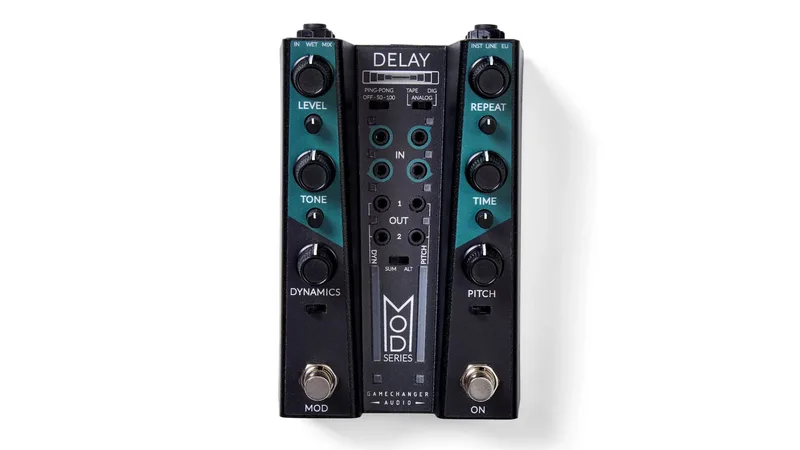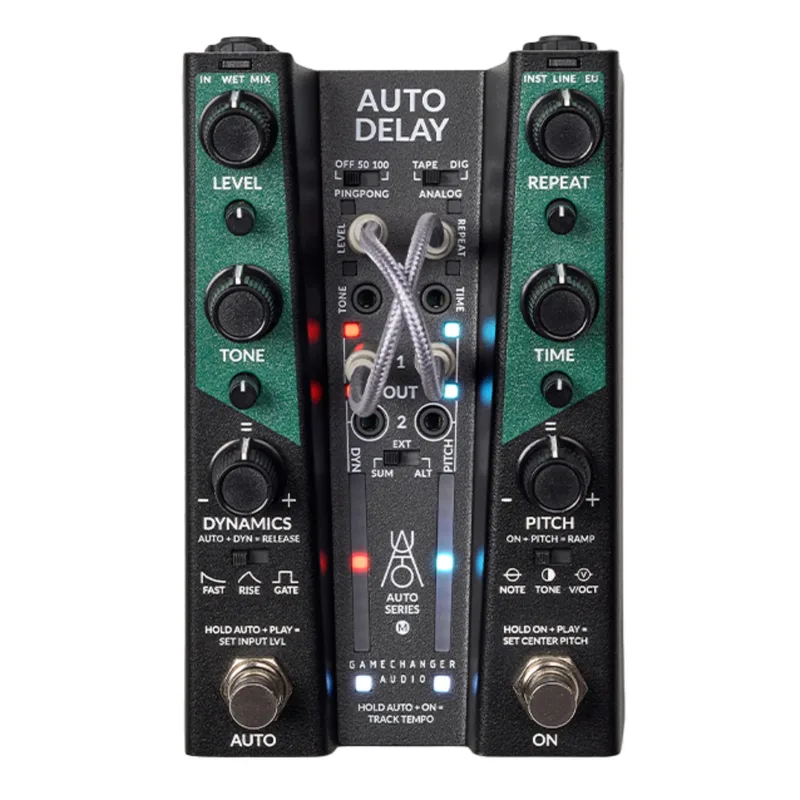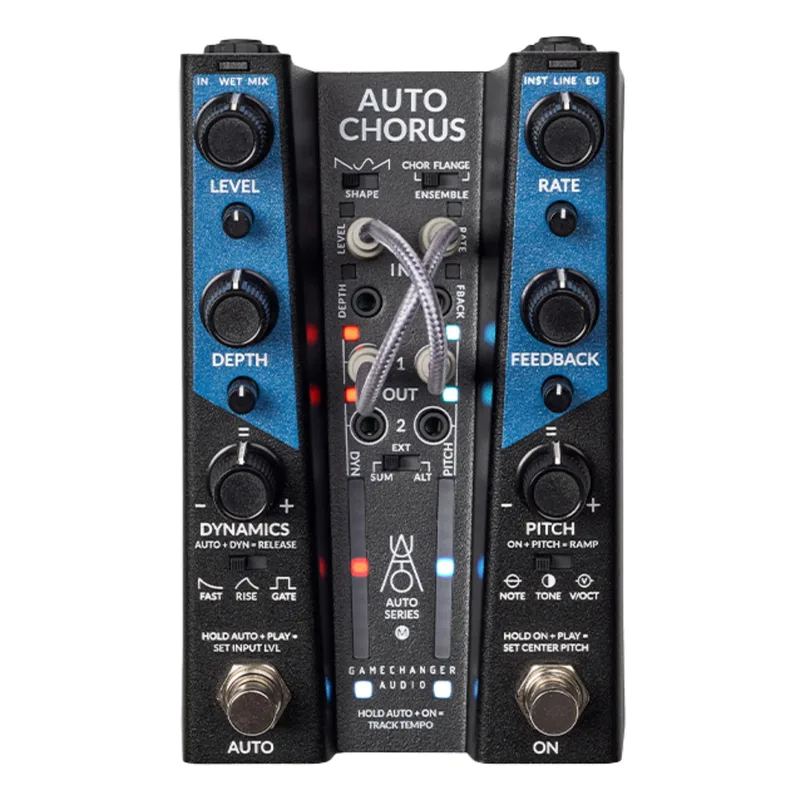
The Gamechanger Audio MOD Chorus is one of three pedals in the MOD Series announced on 24 January 2024, alongside the MOD Delay and MOD Reverb. It is a stereo chorus pedal with three modes, Chorus, Ensemble and Flange, and it belongs to a series built around the idea of bringing modular synth style patching and dynamics control to stompboxes1.
What sets it apart from a conventional chorus is how the modulation can be driven. Each MOD Series pedal has a Mod switch alongside the bypass switch, and when activated it allows a parameter to respond to your playing, for example a decay time increasing on higher notes2. The pedal also exposes its internal control voltages, so it can interact with other gear rather than simply processing a signal.
Chorus, Ensemble and Flange modes
The Mode control selects between Chorus, Ensemble and Flange1. MusicRadar described the three options as Deep Flange, Lush Chorus & Vibrato and Grand Ensemble3. In practice this gives one pedal access to three related modulation effects: the wavering doubling of a chorus, the thicker multi-voice spread of an ensemble, and the swept resonant whoosh of a flanger.
The modulation engine offers three LFO shapes, selected by the Shape control: Ramp Down, Sine and Ramp Up1. Guitar World called these "three shapes waiting to be unleashed: sawtooth, sine and ramp"4. The shape choice changes how the pitch wobble moves: a sine gives a smooth, even sweep, while the ramp shapes produce a more directional, asymmetric motion.
The series also has a dynamics angle. Guitar World noted that for the chorus, only louder strums will feature the wavering sonics of the effect4, which is the practical result of tying modulation depth to your picking dynamics rather than leaving it static.
Gamechanger Audio positioned the whole series squarely at experimental players. In the maker's own words4:
"Targeted at sound explorers, the MOD Series offers a combination of easy-to-use interfaces and profound sound manipulation possibilities"4
Controls
The control set mixes familiar chorus knobs with modular style utilities. Guitar World summarized the player facing controls as four knobs for level, depth, rate and feedback4, while the full control list from Guitar Pedal X adds the mode, shape and dynamics functions1.
| Control | What it does |
|---|---|
| Level | Sets the effect level; the knob can be assigned to Mix, Wet only or In1 |
| Level Attenuverter | Scales the level control's response1 |
| Depth | Modulation depth14 |
| Depth Attenuverter | Scales the depth control's response1 |
| Rate | Modulation speed14 |
| Rate Attenuverter | Scales the rate control's response1 |
| Feedback | Regeneration, most audible in Flange mode14 |
| Dynamics | On/Off, enables playing responsive modulation1 |
| Pitch | Pitch related modulation control1 |
| Shape | Ramp Down / Sine / Ramp Up LFO shape1 |
| Mode | Chorus / Ensemble / Flange1 |
| Sum / Alt switch | Selects how modulation is summed or alternated1 |
| Modulation footswitch | Engages the modulation1 |
| On footswitch | Bypass switch1 |
The attenuverter controls are a modular synth convention: they determine how strongly an incoming control voltage, or the paired knob, affects the parameter, so the same CV source can produce subtle or extreme results depending on how it is scaled.
Inputs, outputs and power
The MOD Series pedals handle both stereo and mono signal processing, and stereo routing works with regular TS mono and TRS stereo cables4. On the input side, the pedal's input tower carries jacks for stereo and mono in plus auxiliary inputs for track and MIDI/clock4, and four CV inputs accept control voltages1. The output side mirrors this with a mono plus stereo output that can use separate cables or TRS for stereo, a track out, two dynamics outputs and two pitch outputs1.
The input level is switchable between EU, Line and Inst, so the pedal can sit happily with instrument level guitars or line level sources1. There is also a USB-C port1.
Power comes from a 9V DC center negative supply drawing 250mA1.
At 250mA, the MOD Chorus draws far more current than a standard analog pedal. A dedicated isolated 9V output is the safe way to power it, and a battery is not an option.
Price and availability
The MOD Chorus was announced at $299, the same price as the MOD Delay and MOD Reverb, with a UK price of £26923. All three pedals were available to order as of the January 2024 announcement4. Guitar Pedal X's reviewer thought the pricing was justified:
"with the amount of R&D involved and custom components - enclosures etc. the $299 price point per unit is really very fair"1
Questions
How much does the Gamechanger Audio MOD Chorus cost?
The MOD Chorus was announced at a list price of $299, the same price as the MOD Delay and MOD Reverb in the series. Guitar Pedal X's reviewer called the $299 price point per unit really very fair given the research and development and custom components involved.
What power does the MOD Chorus need?
It runs on 9V DC with a center negative polarity, drawing 250mA. That current draw is well above what a typical battery or a small daisy chain can supply, so a dedicated 9V power supply output is the practical choice.
Does the MOD Chorus work in stereo?
Yes. The MOD Series launched with stereo Reverb, Delay and Chorus pedals, and all three handle stereo and mono signal processing. Stereo routing works with regular TS mono and TRS stereo cables, or you can use separate cables for the stereo output.
What waveform shapes does the MOD Chorus offer?
The modulation section offers three LFO shapes: ramp down, sine and ramp up, which Guitar World described as sawtooth, sine and ramp. The Shape control switches between them, changing the character of the pitch wobble from smooth to more angular.
Can the MOD Chorus take CV or MIDI input?
Yes. Alongside the mono and stereo audio inputs and a track input, the pedal has a MIDI/clock input and four CV inputs. It also carries two dynamics outputs and two pitch outputs, so it can be cross-patched with other MOD Series pedals or modular gear.
Sources (4)
- Guitar Pedal X, Guitar Pedal X, 2024-01-24
- NAMM 2024: "This series isn't just an evolution in audio processing, it's a complete reimagining of what a pedal can be", MusicRadar, 2024-01-24
- Bored of your 'board? Stomp this way for the must-have new guitar effects pedals of 2024, MusicRadar, 2024-03-28
- NAMM 2024: “Become the architect of tones and textures that respond to your performance in real-time”: Gamechanger Audio's new player-responsive MOD Series pedals can literally be wired like a modular synth, Guitar World, 2024-01-25