

The Gamechanger Audio Motor Pedal is a fully playable electro-mechanical synth voice that tracks the pitch of your playing in real time. Its sound engine is not a DSP model: it is a specially designed brushed DC electro-motor block, spinning at 3 Hz per rotation, whose rotation speed is matched to the fundamental frequency of your input signal. To hit an A440 note, the motor spins at 146 revolutions per second12. Gamechanger Audio describes the result as "the sound of a spinning brushed DC motor, pushed to the edge and tamed with precision control," and is explicit that "this isn't an emulation. This isn't analog modeling"1.
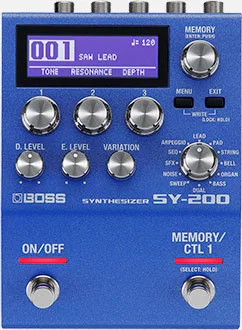
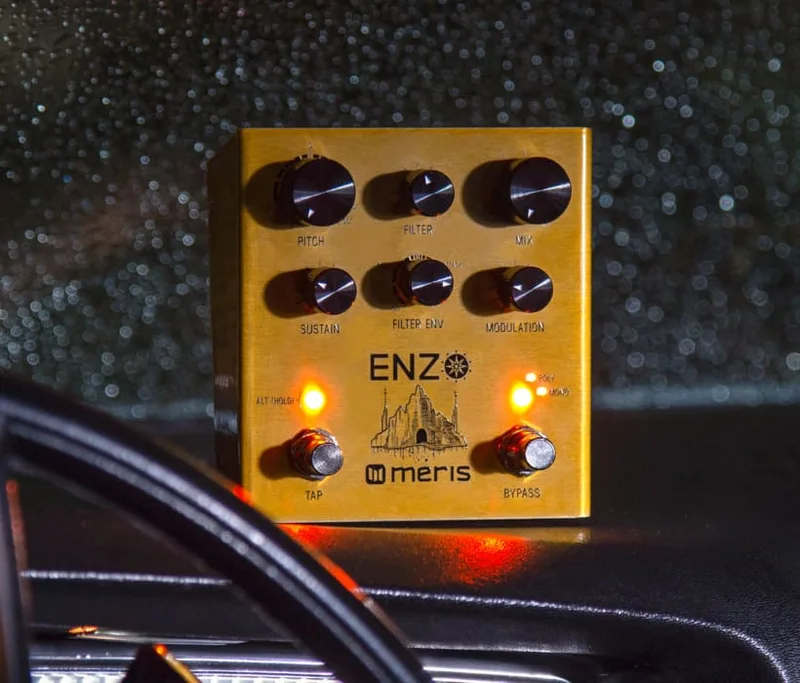
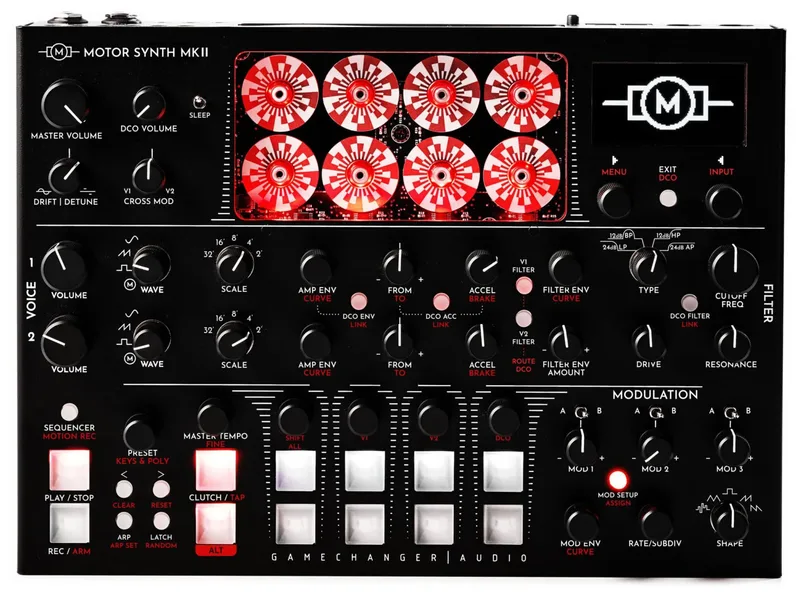
The pedal is a reduction of the company's desktop Motor Synth II, using one of that machine's oscillator motors3, and it sits in the broader family of synth pedals alongside pitch-tracking units like the Boss SY-200 and Meris Enzo. It tracks guitar, bass, synth or voice, and can serve as a drone element that doubles your lines, or as a ring-mod or x-mod engine for your signal1.
The engines and modes
The Motor Pedal's sound comes from five engine modes, selected with an Engine Mode switch45. Each takes a different approach to the spinning motor:
| Engine | What it does |
|---|---|
| MOTOR | Raw electromagnetic pickup of the spinning coils. Glitchy, growling, magnetic4 |
| MXD | Cross-modulation of the motor with a digital waveform, creating harsh, distorted and metallic textures4 |
| M-WAVE | A digital oscillator pitch-locked and hard-synced to the motor's output, a multitimbral synth with what the maker calls an imperfect mechanical soul4 |
| COIL | Alternating current injected into the motor's coils instead of spinning it with DC, creating resonant analog vibrations and metallic hums4 |
| VOCODER | A 24-band digital vocoder using the motor's output as the carrier and your instrument's signal as the modulator4 |
Guitar Pedal X's summary of the engine lineup groups them the same way: MOTOR as raw and growling, MXD as cross-modulation, M-Wave as a multitimbral synth, Coil as AC coil injection versus DC, and a 24-band Vocoder5. Beyond the engines, an X-MOD mode uses amplitude modulation to cross-mod your input signal with all of the motor engines4.
The controls and expression pedal
The pedal's most distinctive control is its spring-loaded foot controller, which Gamechanger Audio likens to a car's pedals: it can act as an accelerator, brake, clutch or volume pedal6. Each mode changes what your foot does to the sound4:
- ACCELERATOR: a wide range of controlled pitch-shift, or floor it to redline the motor
- BRAKE: downward pitch-shift, or mash the pedal to bring the motor to a stall
- DRIFT: play it like a gentle vibrato arm, or floor it for a complete wipe-out
- VOLUME: use the spring-loaded pedal to create volume swells
Guitar.com's reviewer, Richard Purvis, found the expression pedal versatile: "It can be set to go up or down an octave, engage infinite sustain, add momentary vibrato or serve as a volume pedal." He also noted that pushing down extra-hard in vibrato mode increases the speed, and that in either octave mode it soars beyond its range7.
On the panel itself, two volume knobs give independent control of the dry signal and the motor output, and an analog TONE BOOST provides a tilt EQ for shaping the motor output4. A sound shift control offers vibrato or glide with interval settings from -OCT through -5th, -4th, 0, +4th, +5th to +OCT, with a maximum vibrato depth of +/-100 cents and a maximum glide of 58.
Power and connections
The Motor Pedal runs on a standard 9V DC center-negative pedal power supply of at least 500 mA, and the supply is not included in the box14. There is no battery option8.
Gamechanger Audio warns not to use an 18-volt power source with the Motor Pedal8.
Other measured specifications from the maker include an input impedance of 0.5 MΩ, output impedance of 100 Ω, maximum input level of 9 dBu, signal level of 4Vpp max on all audio connections, frequency response of 20 Hz to 20 kHz (±1 dB), signal-to-noise ratio of 90 dB (A weighted), and an operating temperature range of 0 to 50 degrees C8. MIDI comes in over 5-pin DIN, with USB-C handling MIDI, firmware updates and diagnostics18.
History and versions
The concept predates the pedal by years: Gamechanger Audio demoed a Motor pedal in a Premier Guitar video, where Jason Shadrick highlighted "another ear-twisting filter that is incredibly deep"9. The desktop ancestor, the Motor Synth, is described by its maker as the world's first electro-mechanical desktop synthesizer, built around a system of eight electro-motors that change rotation speed to produce musical notes. The current Motor Synth MKII adds a third digital voice with adjustable four-note polyphony, a virtual-analog oscillator and noise engine, a dedicated multimode digital filter, and MIDI and CV control1011.
What reviewers said
Videos
Gamechanger Audio
Gamechanger Audio
Gamechanger Audio
Questions
How long does the Motor Pedal's motor last?
Gamechanger Audio estimates the motor block's lifespan at around 3000 to 5000 hours of intensive playing. The figure depends on how hard the motor is driven: the maker rates it at 1500 to 3000 hours running continuously at D6 pitch (1125 Hz, or 22500 rpm) and 3800 to 8000 hours at A4 (440 Hz, or 8800 rpm).
Can the motor in the Motor Pedal be replaced?
Yes. The Motor Pedal contains a DC motor that is replaceable, and Gamechanger Audio sells a replacement motor block for under $30. The pedal carries a Limited Lifetime Warranty covering manufacturing and material defects, though not wear and tear or user damage.
Is the Gamechanger Motor Pedal stereo?
No. The Motor Pedal is mono in and mono out. Its connections are IN, TRACK IN, MIDI IN and USB-C on the input side, and OUT and TRACK OUT on the output side.
Does the Motor Pedal work with bass or vocals?
Yes. It tracks the pitch of any input signal in real time, including guitar, bass, synth or voice, matching the motor's rotational speed to the fundamental frequency you are playing. Delicious Audio describes it as aimed at guitarists, bassists and vocalists seeking a new sonic frontier.
Does the Motor Pedal have MIDI?
Yes. It includes a 5-pin MIDI DIN input, plus USB-C for MIDI and firmware updates. The USB-C connection also handles diagnostics and MIDI over USB.
Sources (11)
- MOTOR PEDAL, Gamechanger Audio, 2026-09-23
- Gamechanger Audio Motor Pedal, Delicious Audio, 2026-01-07
- Guitar Pedal X, Guitar Pedal X, 2025-09-17
- MOTOR Pedal, Gamechanger Audio, 2026-07-14
- Guitar Pedal X, Guitar Pedal X, 2025-12-09
- Motor Pedal by Gamechanger Audio, RockBoard PedalPedia, 2026
- Gamechanger Audio Motor Pedal review, Guitar.com, 2025-12-12
- Motor pedal support, Gamechanger Audio, 2026-07-05
- NAMM '19, Premier Guitar, 2019-01-29
- MOTOR SYNTH MKII, Gamechanger Audio, 2025-11-07
- MOTOR SYNTH MKII, Gamechanger Audio, 2026-09-23