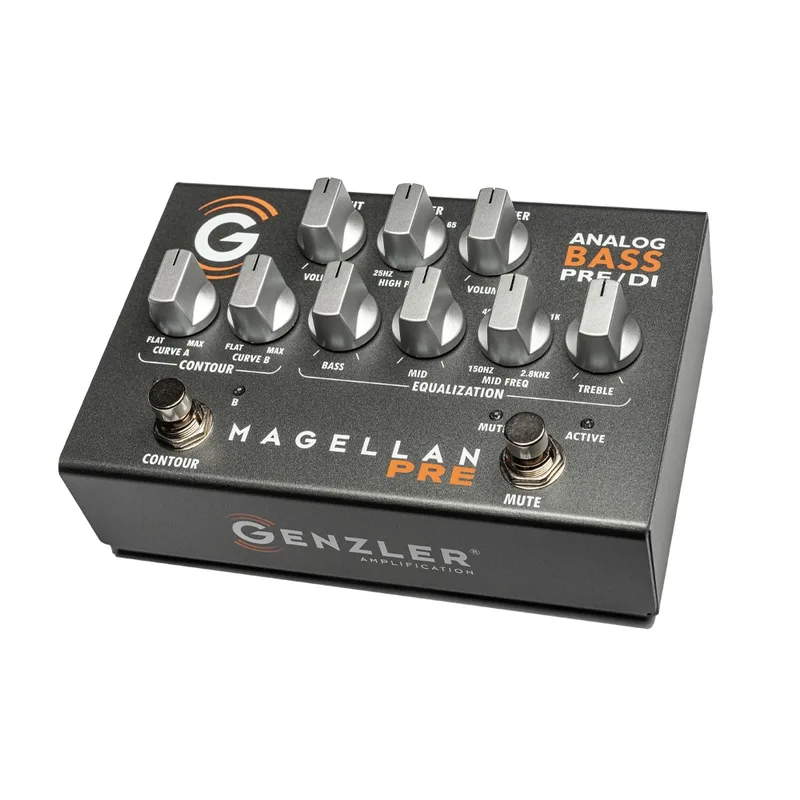


The Genzler Amplification Magellan Preamp DI is an all-analog bass preamp and DI pedal that puts the preamp of Genzler's Magellan series bass amplifiers into a compact pedalboard format1. Genzler describes it as bringing "the performance and preamp feature set of our popular Magellan series bass amps" into a pedal, so a bass player can carry the amp's front-end sound to any rig, a PA, or a set of headphones without hauling an amplifier head1.
The feature set covers what a player would expect from an amp's preamp section: a wide-range input gain control, a 3-band EQ with sweepable mids, foot switchable dual curve adjustable contour circuits, a foot switchable mute circuit, an aux input, a headphone output, a balanced/unbalanced main output and a balanced XLR direct output1. Genzler says the pedal covers everything "from natural, pristine, transparent reproduction of the bass instrument to classic, vintage harmonic textures with a 'weighted feel to the notes'"1.
What it does and how it is controlled
The signal path follows the shape of an amplifier preamp. An input gain control sets how hard the preamp is driven, and a master volume control sets the overall output level1. From there the tone shaping is a 3-band EQ with sweepable mids, plus two foot switchable contour circuits that Genzler calls its "dual curve adjustable contour" design, letting a player kick in a second voicing with a footswitch rather than bending down mid-song1. A foot switchable mute circuit silences the outputs, which is the usual way to swap basses or tune between songs without killing the whole rig1.
The EQ bands and their ranges as Genzler specifies them:
| Control | Type | Range |
|---|---|---|
| LOW | Shelving | +/-15dB below 75 Hz |
| MID | Peak/dip, sweepable | +/-15dB between 150Hz and 2.8kHz |
| HIGH | Shelving | +/-15dB above 6kHz |
The enclosure is a lightweight aluminum chassis, 6" (152mm) wide and 1.1 lb (0.5kg), so it sits on a pedalboard like any other compact pedal rather than a rack unit1.
Outputs: power amp, PA and headphones
The pedal carries three kinds of output, which is what separates a full preamp/DI from a simple DI box1.
- Preamp Output: capable of driving a separate power amp, so the pedal can serve as the front end of a full rig1. Its balanced maximum output level is +14dBu on a 9V supply, +18dBu on 12V, and +22dBu on 18V1.
- Balanced XLR direct output: mic level, nominal -30dBu, selectable pre or post, with a ground lift switch1.
- Headphone output: drives headphones and IEM buds from 8 to 200 ohms, a stereo output fed from the mono signal path1.
Genzler notes that higher impedance headphones, such as 600 ohm models, result in less output and headroom from the headphone jack1.
There is also an aux input, 10 kilohm impedance with a nominal level of -10dBu and a maximum of +10dBu, stereo and summed to mono, for playing along with a backing track or phone while practicing through headphones1.
Power
The Magellan PRE runs on any supply voltage from 9 to 18V DC, and it accepts either polarity, so center-positive and center-negative supplies both work1. Current draw is 80mA1. The jack is a 2.1mm center pin with a 5.5mm barrel, the standard Boss pedal dimensions, and the power supply is not included1. RockBoard's PedalPedia listing gives the same 80mA current draw2.
Because the pedal accepts either polarity, it works with supplies that would damage pedals wired for center negative only. The higher preamp output levels (+18dBu on 12V, +22dBu on 18V) are only available at the higher supply voltages1.
Where it came from
Genzler Amplification says the Magellan PRE continues the collaboration between its design team and Andy Field, a former Genz Benz engineer1. RockBoard's PedalPedia listing carries the same statement2. The pedal's circuit lineage is the Magellan series of bass amplifiers, whose preamp feature set it reproduces in pedal form1.
Genzler describes the Magellan's tonal range as running "from natural, pristine, transparent reproduction of the bass instrument to classic, vintage harmonic textures with a 'weighted feel to the notes'"1.
Videos
Genzler Amplification
Genzler Amplification
Nate Navarro
Questions
Does the Genzler Magellan pedal come with a power supply?
No. Genzler lists the power supply as not included. The pedal runs on 9 to 18V DC of either polarity through a 2.1mm center pin, 5.5mm barrel jack, the same dimensions as a standard Boss-style supply, and draws 80mA.
Can the Magellan Preamp DI drive a power amp directly?
Yes. Genzler specifies a Preamp Output capable of driving a separate power amp. Its balanced maximum output level depends on the supply voltage: +14dBu on 9V, +18dBu on 12V and +22dBu on 18V.
Does the Magellan preamp pedal have a headphone output?
Yes. The headphone output drives headphones and IEM buds from 8 to 200 ohms as a stereo output fed from the mono signal path. Genzler notes that higher impedance headphones, such as 600 ohm models, result in less output and headroom.
Is the Genzler Magellan preamp pedal analog?
Yes. Genzler describes the Magellan PRE as an all-analog, full featured preamp pedal, and RockBoard's PedalPedia listing likewise lists its circuit type as analog.
Sources (2)
- MAGELLAN Preamp/DI Pedal, Genzler Amplification, 2026-07-02
- Magellan Preamp DI by Genzler Amplification, RockBoard (PedalPedia), 2026
