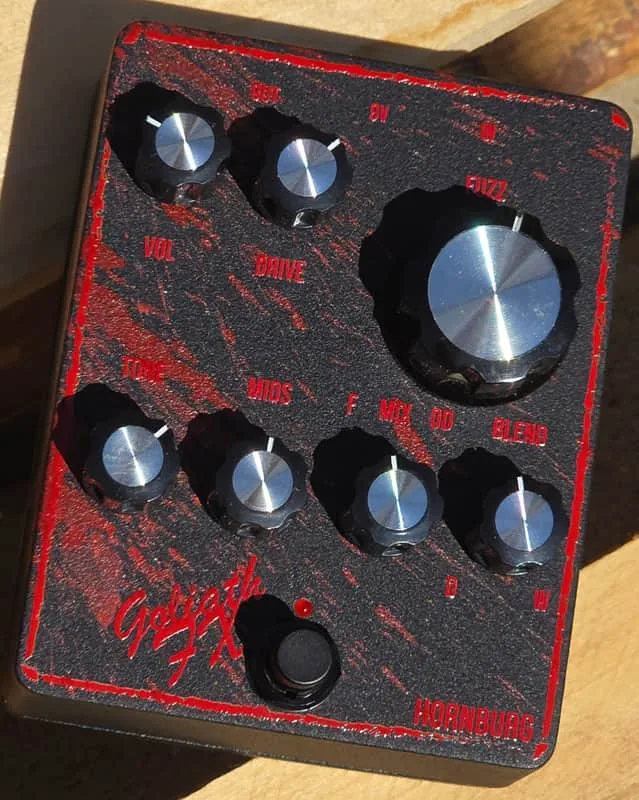


The Goliath FX Hornburg is a hand-built dual parallel drive/fuzz pedal aimed at bass players, made in England by Matt Clark, the sole force behind Goliath FX1. Instead of running one distortion circuit, it splits your signal three ways after an input buffer: one path into a modified Goliath FX Black Ice overdrive, one into a Muff-style fuzz, and one clean path that keeps your low end intact1. The current version is the V2, which was reviewed by Bass Gear Mag in January 20261.
Clark's stated aim with the pedal was, in his own words, "making the best bass big muff possible," and he describes its character as "pure rage, survival, pain and noise"1. Guitar World's reviewer Nick Wells found it "excels at the signature Big Muff snarl," and that with all controls up it produces an oppressively heavy drive sound, while careful use of the mix control gets Muse-esque sounds2.
A Muff fuzz, a bass overdrive and a clean signal in parallel
The Hornburg's whole design idea is parallel processing. After the input buffer, the signal is split three ways1:
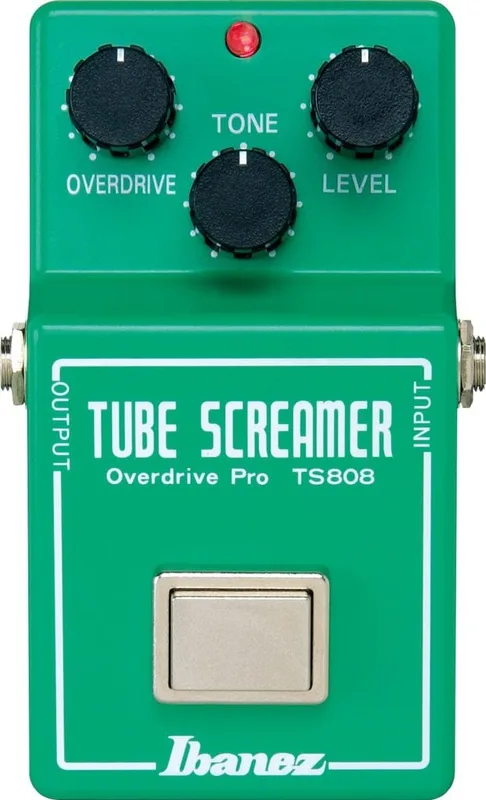
- Overdrive path: a modified Goliath FX Black Ice circuit, itself based on a TS9 Tube Screamer rebuilt for bass applications1
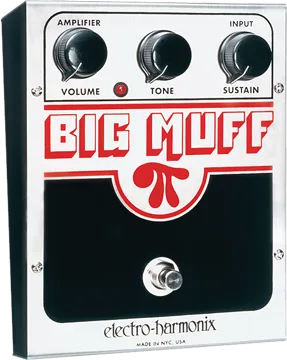
- Fuzz path: a "modded tall-fonted muff" fuzz circuit, using just the first three stages of a Civil War era Russian Big Muff design1
- Clean path: your dry signal, mixed back in with the Blend control1
The Mix control sets the balance between the two effect paths, counterclockwise for fuzz and clockwise for the Black Ice overdrive, while the Blend control mixes your clean signal against the sum of the two drives1. That clean path is what lets a bass player dial in heavy fuzz without losing the fundamental. For players comparing circuits, Guitar World's reviewer cited the Darkglass AlphaOmega as the closest comparable pedal for three-way parallel signal blending2.
The EQ is a passive tone stack with a fixed bass response, and the tone and mids controls interact in an FMV style, the interaction familiar from classic amp tone stacks1. Bass Gear Mag's Dan Veall found the EQ "offers anything from 'full phat to modern clank'"1.
The controls
The Hornburg carries six knobs2. What each one does:
| Control | What it does |
|---|---|
| Volume | Sets the overall output level2 |
| Drive | Controls saturation amount in the overdrive circuit1 |
| Fuzz | Adjusts the saturation of the fuzz circuit1 |
| Tone | Passive tone control; interacts strongly with Mids, bass filter fixed by design1 |
| Mids | Controls midrange frequencies, +/- 5dB boost or cut at around 700Hz1 |
| Mix | Blends between the fuzz circuit (counterclockwise) and the Black Ice overdrive (clockwise)1 |
| Blend | Mixes between your clean signal and the processed effect, the sum of the two drives1 |
The Mids control is the one to spend time with: because the bass filter is fixed by design, the tone and mids knobs shape the midrange against each other rather than the low end1. On the overdrive side, Veall describes the Drive control as taking the overdrive from "plectrum definition" to saturated crunch1.
There is no internal battery option, so the Hornburg needs a standard 9V DC center negative supply through its 2.1mm DC input1.
History and the V2
The Hornburg is built in a solid metal enclosure and each unit is handmade to order by Matt Clark in England, with a potential six-week lead time1. The review unit examined by Bass Gear Mag was number 22 of production1. As of March 2025, Guitar Pedal X noted the Hornburg Bass Fuzz was available on the Goliath FX webstore3.
The V2 refines the earlier iterations based on feedback from professional players: the blend control was reworked to be less "bitey," and the tone control uses a new set of component values1. If you are comparing a used earlier unit against a V2, those two controls are where the changes sit.
Goliath FX also offers the Hornburg in a V2, the current version, which reworks the blend control to be less "bitey" and uses a new set of component values for the tone control, changes made in response to feedback from professional players1.
What reviewers said
Bass Gear Mag's Dan Veall reviewed the V2 in January 2026 and called the result "a pedal with a genuinely distinctive voice," adding that "Goliath FX set out to create a monster, and I think Matt has done" it, his overall verdict being a very well-made boutique pedal1.
"The Hornburg excels at the signature Big Muff snarl."
Guitar World's review agreed on the build quality, summing it up as "Solidly built, this pedal sounds great too"2. Wells also noted the range on offer, from the oppressive heaviness of everything at full through to Muse-esque sounds with careful use of the mix control2.
Where it sits for a player
For a bass player shopping in the fuzz and overdrive lanes, the Hornburg's pitch is that you do not have to choose: the Muff-style fuzz and the Tube Screamer-derived overdrive coexist, and the clean blend keeps the low end present, the same problem parallel bass pedals of this kind set out to solve. The two published reviews disagree slightly on price, with Bass Gear Mag listing $215 (USA approx.) and £160.00 including UK VAT as of January 2026, and Guitar World listing $21012.
Videos
The Bass Channel
the wetter bass
Bass Gear Magazine
Questions
Is the Goliath FX Hornburg true bypass?
Yes. The Hornburg uses true-bypass switching, so with the pedal off your signal passes through without the circuit in the way. It also has an input buffer that conditions the signal before the three-way split when the pedal is engaged. There is no internal battery option, so it runs on a standard 9V DC center negative supply.
What fuzz circuit is in the Hornburg?
The fuzz path is a modded tall-font Muff circuit that uses just the first three stages of a Civil War era Russian Big Muff design. The overdrive path is a modified Goliath FX Black Ice circuit, itself based on a TS9 Tube Screamer rebuilt for bass. A clean path runs alongside both, and the Blend control mixes clean against the sum of the two drives.
Can the Hornburg be used on guitar as well as bass?
It is designed as a bass pedal, but it has been used in guitar contexts. Bass Gear Mag names Naomi of the Guitar Nerds podcast and Empire State Bastard as a player who used it at major festivals including Download, Hellfest and Glastonbury. The fixed bass response in the tone stack is the main thing a guitar player would notice.
Where is the Goliath FX Hornburg made?
The Hornburg is made in England and hand-built to order by Matt Clark, the sole force behind Goliath FX. Production notes mention a potential six-week lead time, and each unit carries a lifetime mechanical failure warranty for the original owner.
Sources (3)
- Goliath Effects Hornburg Dual Parallel Drive/Fuzz Pedal, Bass Gear Mag, 2026-01-13
- “Thrill-seekers wishing to add ear-melting fuzz to their bass will be in tonal nirvana”: Goliath FX Hornburg Fuzz review, Guitar World, 2024-09-28
- Guitar Pedal X, Guitar Pedal X, 2025-03-07