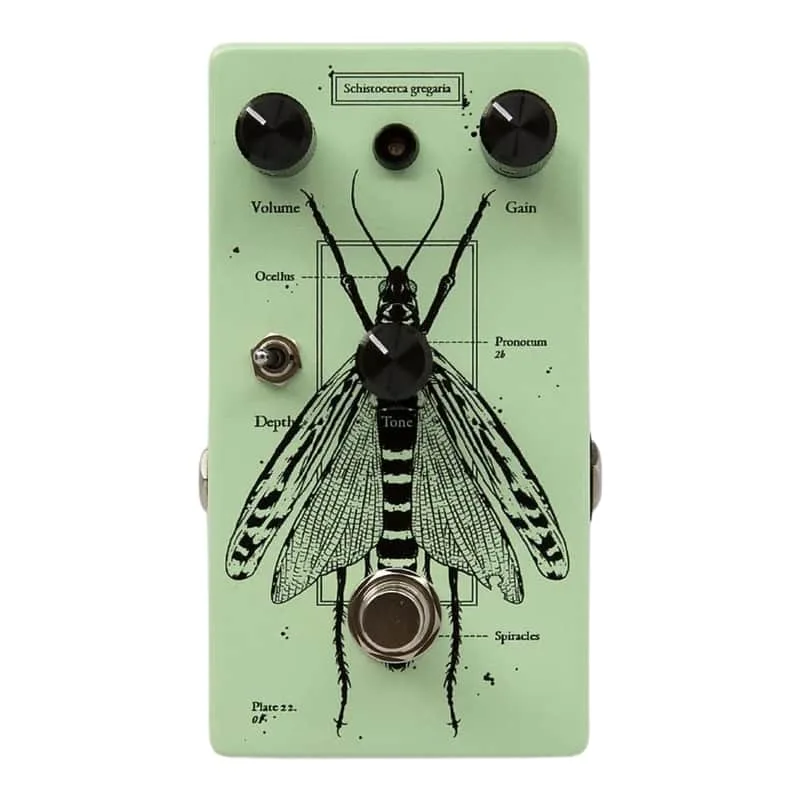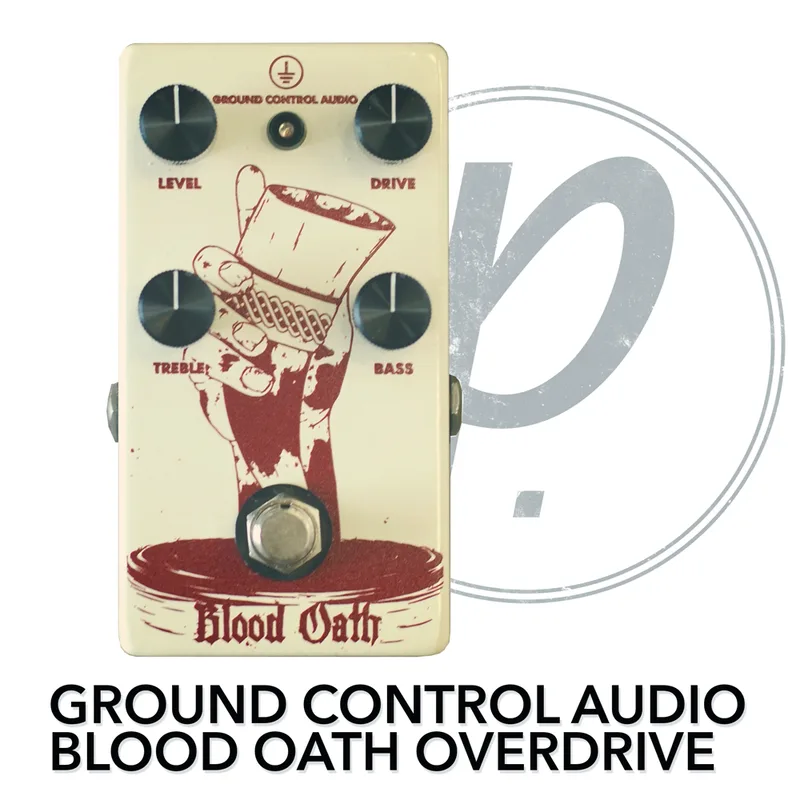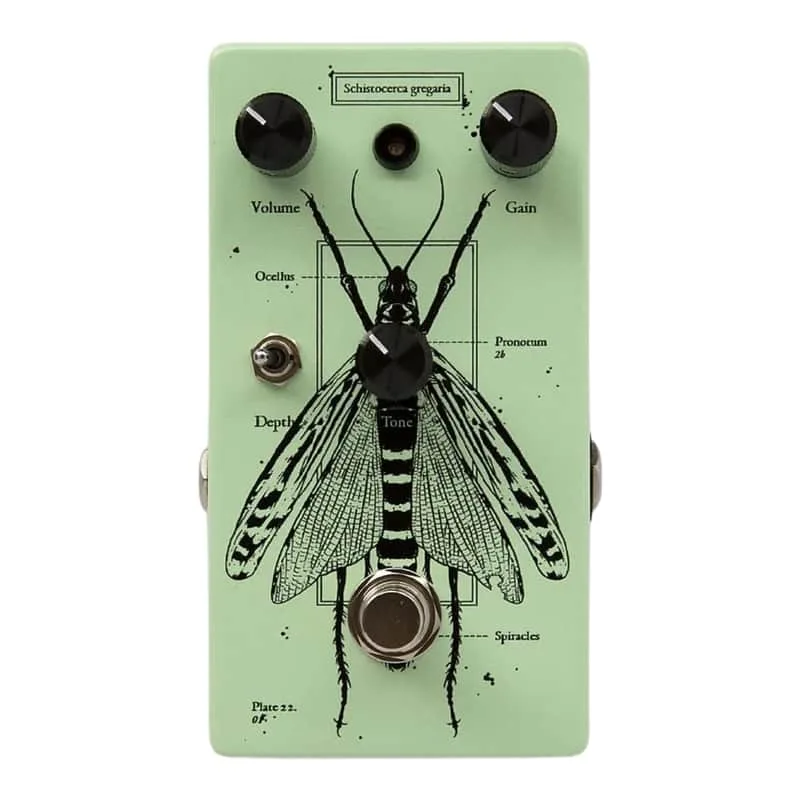


The Ground Control Audio Locust Discrete Distortion is a distortion pedal from Canadian-based Ground Control Audio, released in 2016. It uses discrete silicon amplification with a high impedance JFET frontend, a transistor-based design rather than an op-amp circuit, and it builds on the company's Blood Oath Overdrive as a step-up in gain1.
Controls
Volume, Gain and Tone make up the control section for the Locust1. Alongside them sits a toggle switch that selects from two mid-notch depth modes, which Pedal of the Day says enable both eardrum-shattering highs and a deep, dark and swarmy low-end sound1. Delicious Audio's Paolo De Gregorio writes that the two mid-notch depth modes and tone controls let you dial in ear-piercing highs for lead parts as well as darker settings2.
What it sounds like
Pedal of the Day describes the circuit as pushing silicon amplification into loud and sluggish distortion territory, scorching through a tube amp1. Though labeled as a distortion, the reviewer found the Locust extremely capable of getting warm, crunchy overdriven tones as well when the gain is backed off1. Delicious Audio agrees, noting that on low gain modes the Locust will still give you solid, warm overdriven tones2. The same review credits the high-quality parts and attention to the build as making it a solid and reliable choice for any pedalboard1.
Where the Locust sits among the "Locust" pedals
The name has been used by more than one builder, and the circuits are different134:
| Pedal | Maker | Circuit basis | Notes |
|---|---|---|---|
| Locust Discrete Distortion | Ground Control Audio | Discrete silicon, JFET frontend1 | Builds on the Blood Oath Overdrive1 |
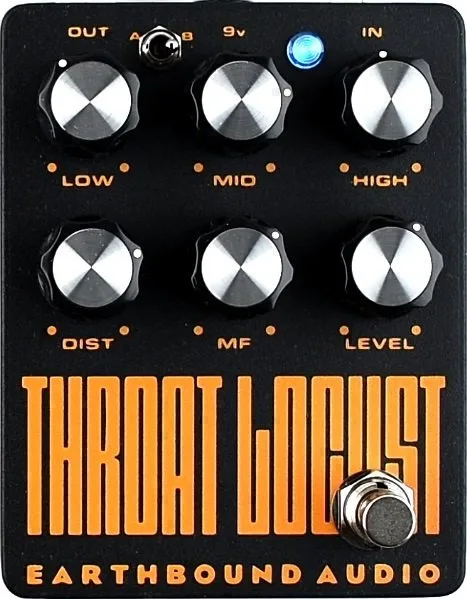
| Throat Locust | Earthbound Audio | Based on the Boss HM-2 Heavy Metal3 | Low, Mid and High controls, A/B mode toggle3 |
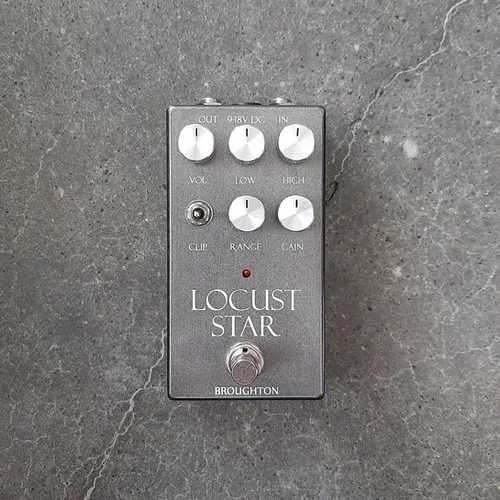
| Locust Star | Broughton Audio | Homage to the classic LM308 Rat distortion4 | Active shelving EQ with Bass and Treble4 |
The Earthbound Audio Throat Locust is aimed at heavy, doomy, stonery or just filthy and nasty tones, according to its review, and is not a clean boost or a transparent pedal3. The Broughton Audio Locust Star uses an active shelving EQ instead, with a Treble control that ranges from bright and raspy all the way to a dark and warm tone, creating far more possible tonal profiles4. If you are comparing across the distortion and overdrive categories, the Ground Control Audio original is the discrete-transistor design of the three.
Videos
Eirik Stordrange
R.J. Ronquillo
Pedal of the Day
Questions
What does the Ground Control Audio Locust sound like?
Pedal of the Day describes it as pushing silicon amplification into loud and sluggish distortion territory, scorching through a tube amp. The toggle's two mid-notch depth modes cover eardrum-shattering highs and a deep, dark and swarmy low-end sound. At lower gain settings, Delicious Audio notes the Locust still gives solid, warm overdriven tones, so it is not only a full-on distortion.
What does the toggle switch on the Locust do?
The toggle selects between two mid-notch depth modes. Pedal of the Day says these enable both eardrum-shattering highs and a deep, dark and swarmy low-end sound, letting you shape where the midrange scoop sits for leads or heavier rhythm work.
How is the Locust related to the Blood Oath Overdrive?
Pedal of the Day reports that the Locust builds on Ground Control Audio's Blood Oath Overdrive and is a step-up in gain. The Locust is the company's discrete distortion, released in 2016, while the Blood Oath is the overdrive it grew out of.
Can the Locust do overdrive as well as distortion?
Yes. Though labeled as a distortion, Pedal of the Day found the Locust extremely capable of getting warm, crunchy overdriven tones when the gain is backed off. Delicious Audio likewise notes that on low gain modes the Locust will still give you solid, warm overdriven tones.
Is the Locust a transistor or an op-amp circuit?
The Locust uses discrete silicon amplification with a high impedance JFET frontend, according to Pedal of the Day. That is a transistor-based design rather than an op-amp circuit, and the JFET input stage is said to help preserve the tone of whatever comes before it in the signal chain.
Sources (4)
- Ground Control Audio Locust Discrete Distortion, Pedal of the Day, 2016-09-28
- Ground Control Audio Locust Fuzz, Delicious Audio, 2021-08-20
- Earthbound Audio Throat Locust Heavy Distortion, Pedal of the Day, 2019-04-12
- Locust Star, Broughton Audio