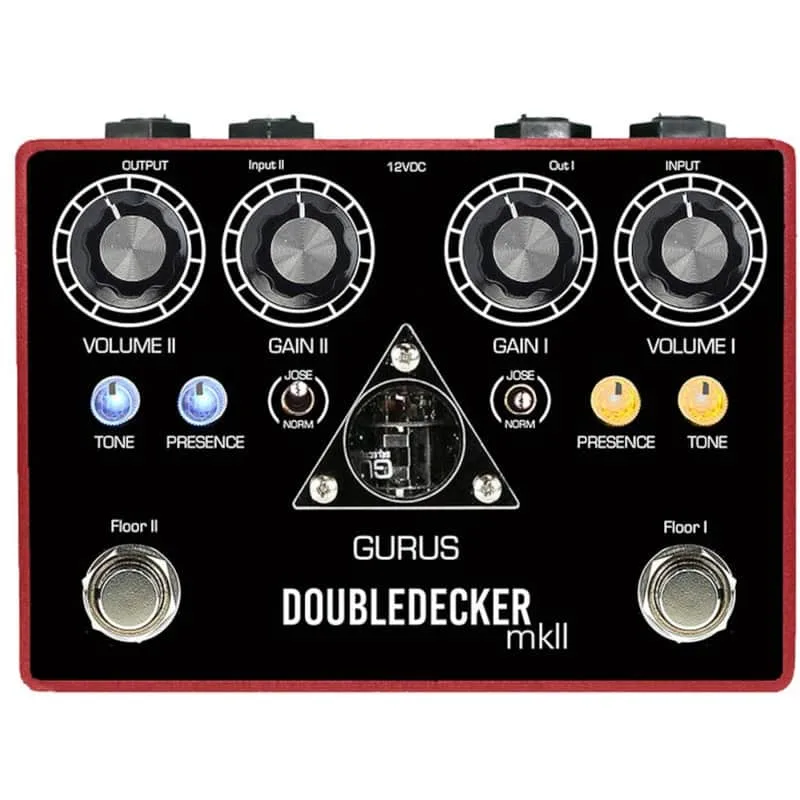


The Gurus Doubledecker MkII is a dual-channel, Marshall-in-a-box overdrive pedal with a real tube inside. Each of its two channels carries its own controls and footswitch, and the channels can be used on their own or stacked into each other for more gain. Guitar.com's reviewer put it plainly: "it's actually two Marshalls in a box"1.
Under the hood it is an analog tube preamp. Gurus started from a high-voltage tube preamp section running at 150 to 300 volts, assisted by an op-amp stage the company calls its secret weapon for tailoring the tone2. Guitar World calls the result a valve-driven overdrive pedal with two independent channels of Marshall amp flavor that can be used individually or stacked3.
What it does: two Marshall-style tube channels in one box
The MkII packs two stackable Plexi-style channels, called Floor I and Floor II, into a single enclosure that Gurus measures at 3,5" x 5"2. Each channel has its own clipping character:
- Channel 1 (Floor I): germanium NOS diodes, which Gurus says suit softer drive tones and simulate the behavior of a tube amp on the edge of breakup2
- Channel 2 (Floor II): LED diodes in a symmetrical configuration, producing what Gurus describes as smooth, complex, compressed lead tones, and slightly gainier than channel 132
With the clipping option switch and the four controls on each channel, Gurus says up to 10 different combinations are available2. The two footswitches let you bring each channel in and out independently, and stacking them lets the channels boost each other2.
Guitar.com's reviewer described the two voices in Normal mode as "delivering fresh, zingy low-gain crunch on the right and a meatier version of Plexi drive on the left", favoring an open and edgy feel over tidily compressed smoothness1.
The controls: Gain, Volume, Tone, Presence and the Jose Mod
Each channel carries the same control set31:
| Control | What it does |
|---|---|
| Gain | Sets the drive level of the channel |
| Volume | Sets the channel's output level |
| Tone | Smaller knob shaping the channel's brightness |
| Presence | Smaller knob shaping the channel's top end |
| Jose/Norm toggle | Engages the Jose Mod clipping section |
| Footswitch | Bypasses or engages the channel |
The Jose Mod is a tribute to Jose Arredondo, the tech for Van Halen and Steve Vai, who made a popular mod to Marshall amps. Gurus explains the thinking: "We wanted to pay Jose a little tribute by adding two different Clipping sections"2. The extra clipping comes from germanium diodes on channel 1 and LEDs on channel 21.
Guitar.com found the two Jose modes behave differently. On channel 1, Jose mode gives a similar tone with more gain and a touch less midrange clonk, but the output level drops dramatically, so the volume knob needs cranking to compensate1. On channel 2, Jose mode "trades in some lower-mids solidity for extra saturation", and this is where the reviewer located the really high-gain sounds1.
Routing, stacking and connections
On the surface it works like a standard pedal: one main input, one main output2. The back panel also carries separate inputs and outputs for each channel, which opens up two options32:
- Inverted routing: the signal path can be flipped so channel 2 feeds channel 1 instead of the default channel 1 into channel 22
- Split use: the two channels can be separated into two different loops of a looper or switcher, treating them as two independent pedals2
Guitar World lists the connections as a standard input, a second standard input, a standard output and a second standard output3.
The enclosure itself is distinctive: Guitar.com describes "the glassy black control panel sitting inside a sandpaper-textured red shell", with amber internal lighting behind the channel 1 knobs and blue behind channel 21. Guitar World notes the black glass surface is backlit when powered up and found the build robust3.
Power: 12V supply included
The MkII runs on a 12V DC adaptor rated at 300mA, and the adaptor is included with the pedal3. Guitar.com likewise describes it as powered by a 12-volt mains supply that comes in the box1.
The pedal runs on a supplied 12V DC adaptor rated at 300mA, so the included adaptor is the specified supply rather than something to substitute. Plan your power arrangements accordingly.
History: from the 1959 Doubledecker to the MkII
The MkII is a reduced version of the original GURUS 1959 Doubledecker, a 4-footswitch, dual-channel Marshall-in-a-box that was designed between 2012 and 2014 and released in late 20152. The original won awards from Premier Guitar, GuitarPlayer and Vintage Guitar, and has been used live on stage and in the studio by many well-known pro artists2.
The MkII trims the format down: two footswitches instead of four, in a smaller box, while keeping the two stackable channels2. Gurus introduced it as the newest version of the Doubledecker2.
What reviewers said
Guitar.com's Richard Purvis reviewed the MkII in March 2022, praising its versatility while flagging the noise when both channels run together1. His verdict on the stacked sound: "it's mighty powerful but brings with it an awful lot of background noise. A gate might be advisable here."1
Guitar World's Trevor Curwen, reviewing the pedal alongside the Gurus Sexydrive MkII, was more positive on the noise question, writing that "Both channels sound authentically Marshall-like, with great tones ranging from clean-ish to full-on"3.
"Both channels sound authentically Marshall-like, with great tones ranging from clean-ish to full-on"
Videos
Guitar Interactive Magazine
Dr.Hyenik
Musicmaker
Questions
Does the Gurus Doubledecker MkII have a real tube?
Yes. The pedal is built around a real, high-voltage tube at the core of the preamp circuit, running a tube preamp section at 150 to 300 volts, assisted by an op-amp stage that shapes the tone. Guitar World describes it as a valve-driven overdrive pedal rather than a solid-state emulation.
What is the Jose Mod on the Doubledecker?
It is a clipping option inspired by the popular mod made to Marshall amps by Jose Arredondo, the tech for Van Halen and Steve Vai. A toggle switch on each channel engages it, adding extra clipping from germanium diodes on channel 1 and LEDs on channel 2 for higher-gain, more saturated tones.
Can you reverse the channel order on the Doubledecker MkII?
Yes. The normal routing runs channel 1 into channel 2, but by using the separate inputs and outputs on the back panel the routing can be inverted so channel 2 feeds channel 1. Those separate connections also let you split the two channels into two different loops of a looper or switcher.
Is the Gurus Doubledecker MkII noisy?
It can be. Guitar.com's reviewer found it mighty powerful but said it brings an awful lot of background noise when both channels are engaged together, and suggested a noise gate might be advisable in that configuration. Used one channel at a time, no such problem was reported.
Is the Doubledecker MkII true bypass?
Yes. Both channels are true bypass, assisted by golden pin relays, which Gurus describes as the best true bypass option possible. Guitar World and Guitar.com both list true bypass among the pedal's features.
Sources (3)
- Gurus DoubleDecker MkII review: Flexible dual overdrive lets you double up on Marshall tones, Guitar.com, 2022-03-22
- Gurus Doubledecker MkII, Delicious Audio, 2022-07-15
- Gurus Double-Decker MkII and SexyDrive MkII review, Guitar World, 2022-06-09